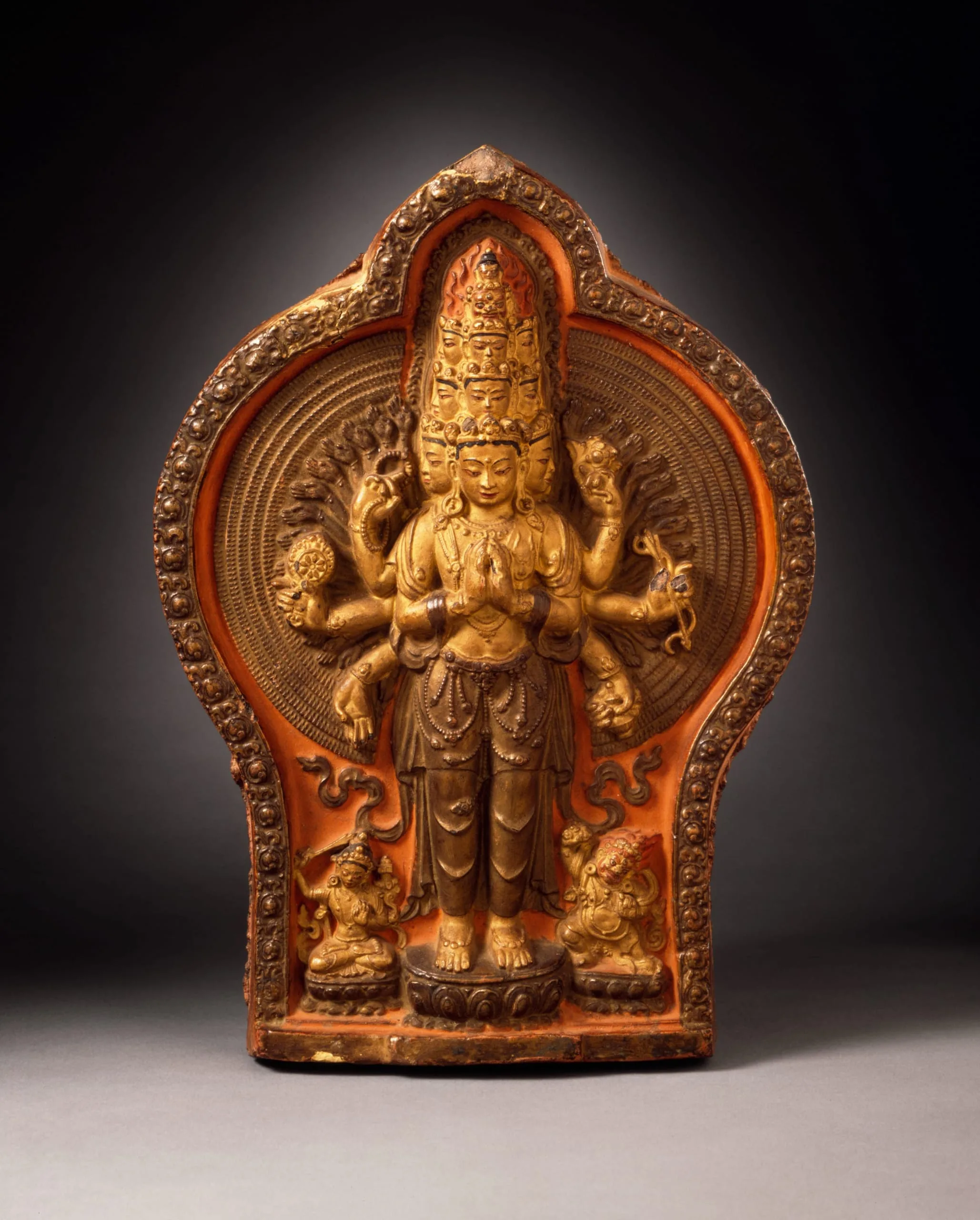
The Bodhisattva Avalokiteshvara (Tibetan: Chenrezi) is represented here in his cosmic form with eleven heads emphasizing his watchful nature and one thousand arms. Eight of the eleven heads represent the cardinal directions and their intermediate points, while the remaining three symbolize the zenith, nadir, and center. Nine of the heads have benign faces and are depicted in three rows, the tenth penultimate head is wrathful. These ten heads represent his attainment of each of the ten Bodhisattva stages and also symbolize his watching over beings throughout the ten directions of space. The eleventh head at the top represents the Buddha Amitabha, of whom Avalokiteshvara is considered to be an emanation. It symbolizes the universal compassion of all Buddhas.
Of the eight principal arms, one pair displays the gesture of greeting (anjali mudra), while the other six (beginning with the lower right and clockwise) exhibit the gesture of charity (varada mudra) and hold the flaming wheel, rosary, lotus, bow and arrow, and ascetic’s waterpot. Each hand in the secondary tier of arms forms the gesture of charity with one palm marked with an eye. Avalokiteshvara extends a thousand helping hands towards all beings, each eye searches a different world for suffering beings in need of assistance. The third tier of diminutive arms, visually reminiscent of solar rays, symbolizes the cosmic powers of the deity.
This form of Avalokiteshvara, also known as Lokeshvara, this particularly worshipped in Tibet, where the Dalai Lama is believed to be his emanation. Avalokiteshvara is flanked by the smaller seated images of Manjushri on his right and the wrathful form of Bodhisattva Vajrapani on his left.
See Pratapaditya Pal, Icons of Piety, Images of Whimsy: Asian Terra-cottas from the Walter Grounds Collection (LACMA, 1987), p. 83, no. 47.