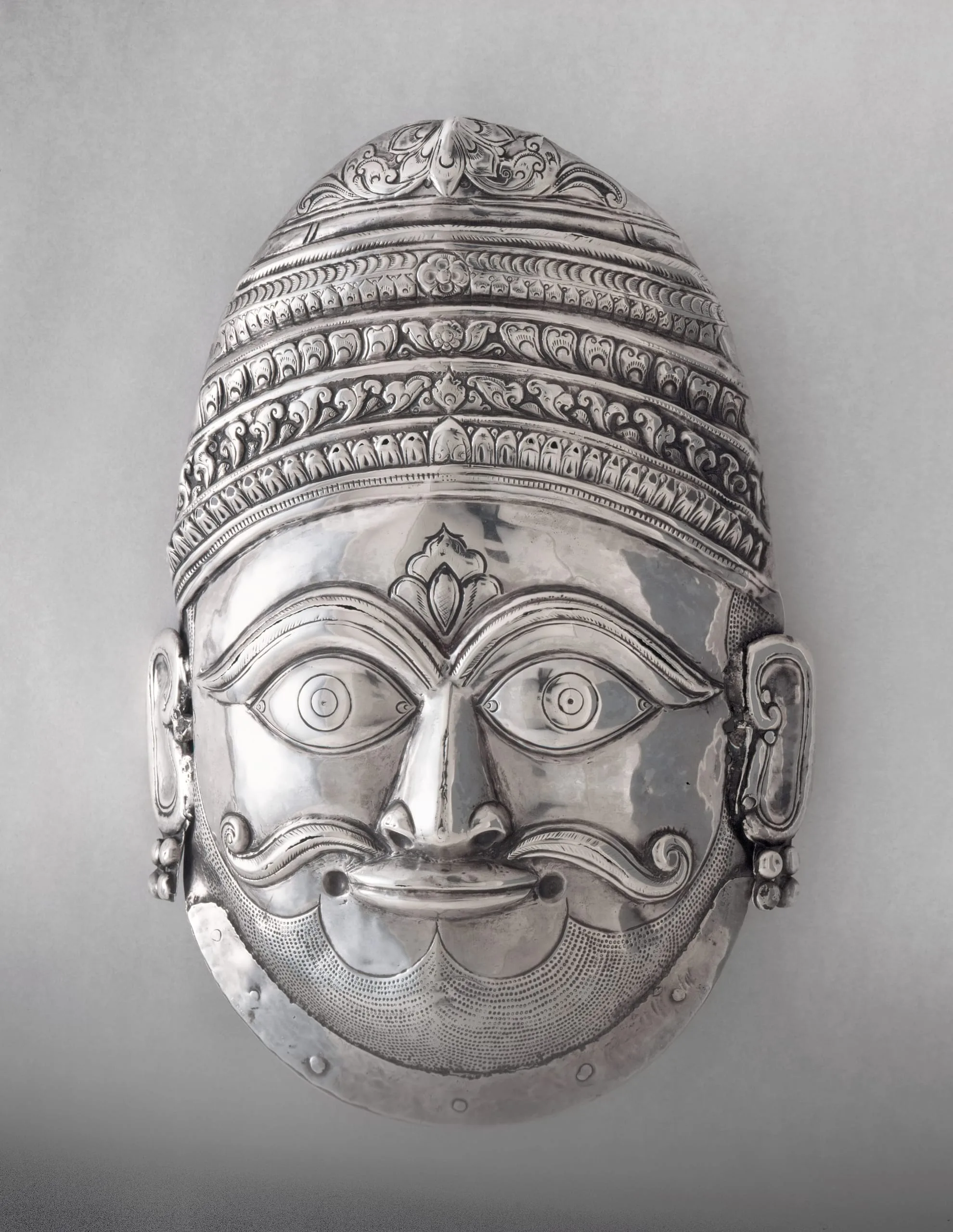
This mask of the Hindu god Shiva would have likely been used as an ornate visage for an image of the deity while in worship in a temple or domestic shrine (for comparison, see M.75.4.2), as a processional image (for comparison, see M.76.147.1), or as the divine face of Shiva gracing a Shivalinga (for comparison, see AC1995.220.1). A stylistically related silver mask of the goddess Devi is in the Sri Mangalamba Temple, Mangalore, Karnataka.
Shiva wears a tall crown with several registers of foliate or geometric motifs, which is surmounted by a lotus flower with splayed foliage. His large almond-shaped eyes are wide open in a physiognomic style favored in southern India, such as found in the narrative paintings from Paithan, Maharashtra (for example, see M.86.345.15). He has thick eyebrows, a twirled moustache, and a stubbly beard. Mustachioed Shivalingas have a long history of representation (for a late 4th-century example from Mathura, see M.2010.131; for a 17th-century Maharashtrian example, see M.84.228.4). The presence of a beard is uncommon for Shiva, but is featured on two of his iconographic forms, Bhairava (see M.82.220 and M.87.279.5) and the mountaineer hunter (kirata) in the 6th-century poem by Bharavi, the Kirata-Arjuniya, which was popularized by the paintings of Raja Ravi Varma (1848–1906). Shiva’s third eye is depicted on his forehead in its customary shape of a vertical ellipsoid or lozenge, but is here adorned with a floral motif.