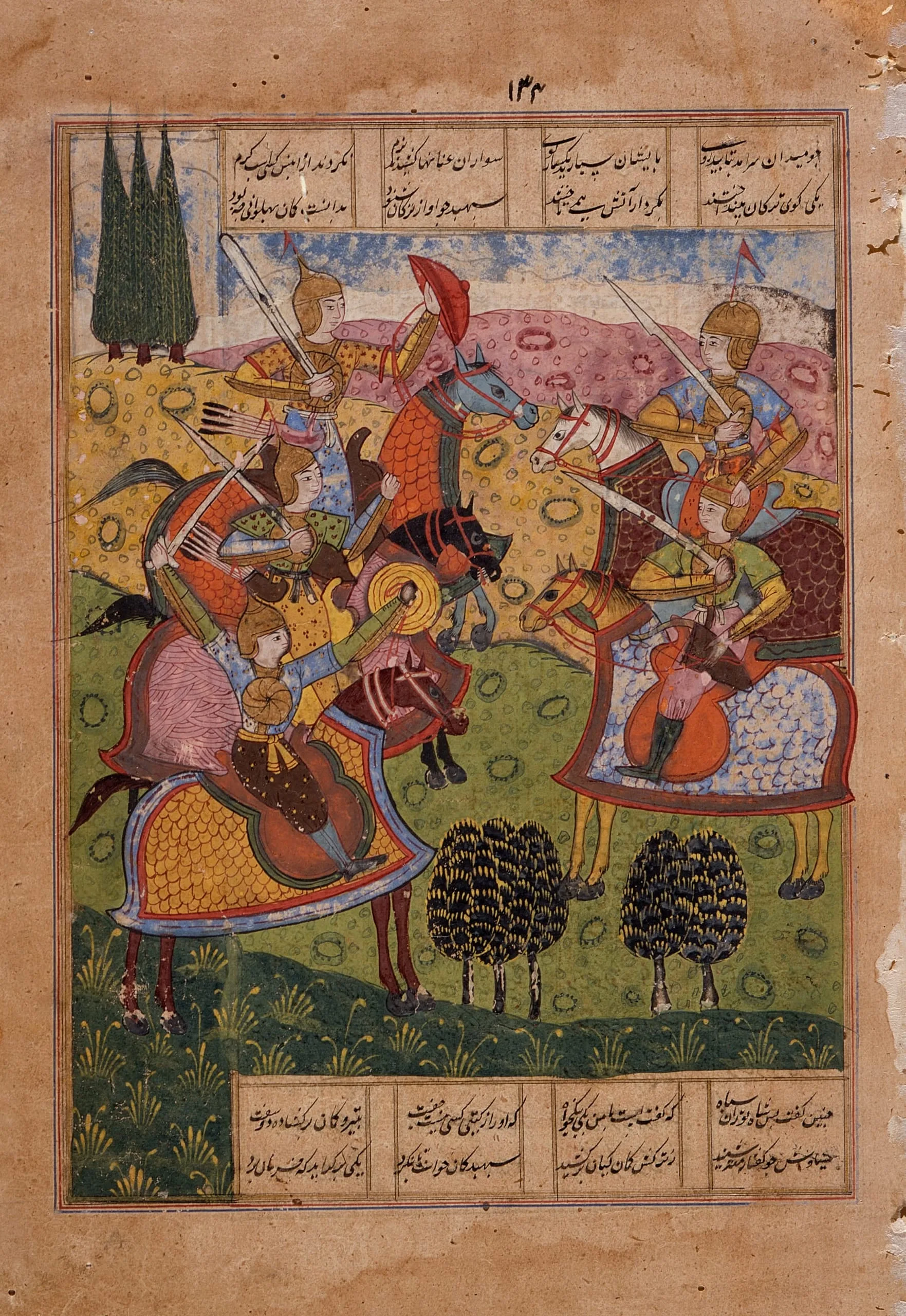
The Shahnama (Book of Kings) is an epic Persian poem composed by Firdausi (or Ferdowsi; circa 934-1020) in circa 977-1010. It narrates the legendary and historical past of the Persian Empire until the Arab Muslim conquest in the 7th century. Shahnama manuscripts were frequently produced throughout the Islamic world, including in South Asia. This folio and M.75.52 are from a dispersed manuscript that appeared on the art market in the early 1970s.
According to the chapter heading in red on the reverse, this folio is from the story of Siyavush, which is recounted in the seventh book of the Shahnama. Siyavush is a legendary early Iranian prince who was the son of the mythical King Kay Kavus (or Kai Kaus). His stepmother was Sudabeh, a Yemeni princess who married Kay Kavus to become the Queen of Iran. Sudabeh became obsessed with Siyavush and falsely accused him of rape. Siyavush goes into self-imposed exile in the legendary kingdom of Turan in Central Asia seeking the protection of the mythical King Afrasiyab (or Afrasiab). Siyavush was eventually murdered by Afrasiyab’s minions, but his wife flees to Iran and gives birth to their son who becomes the next Shah of Iran, Kay Khusraw (or Khosrow). Ultimately, Kay Khusraw’s army defeats Afrasiyab’s forces. The confrontation of the two armies may be the episode illustrated in this folio.
See also 39.12.72, 57.17.3, 57.17.4, 57.17.7, 57.17.10, M.71.49.3, M.73.5.609, M.75.52, M.78.9.5, M.81.12a-b, M.85.189, and AC1993.187.1.