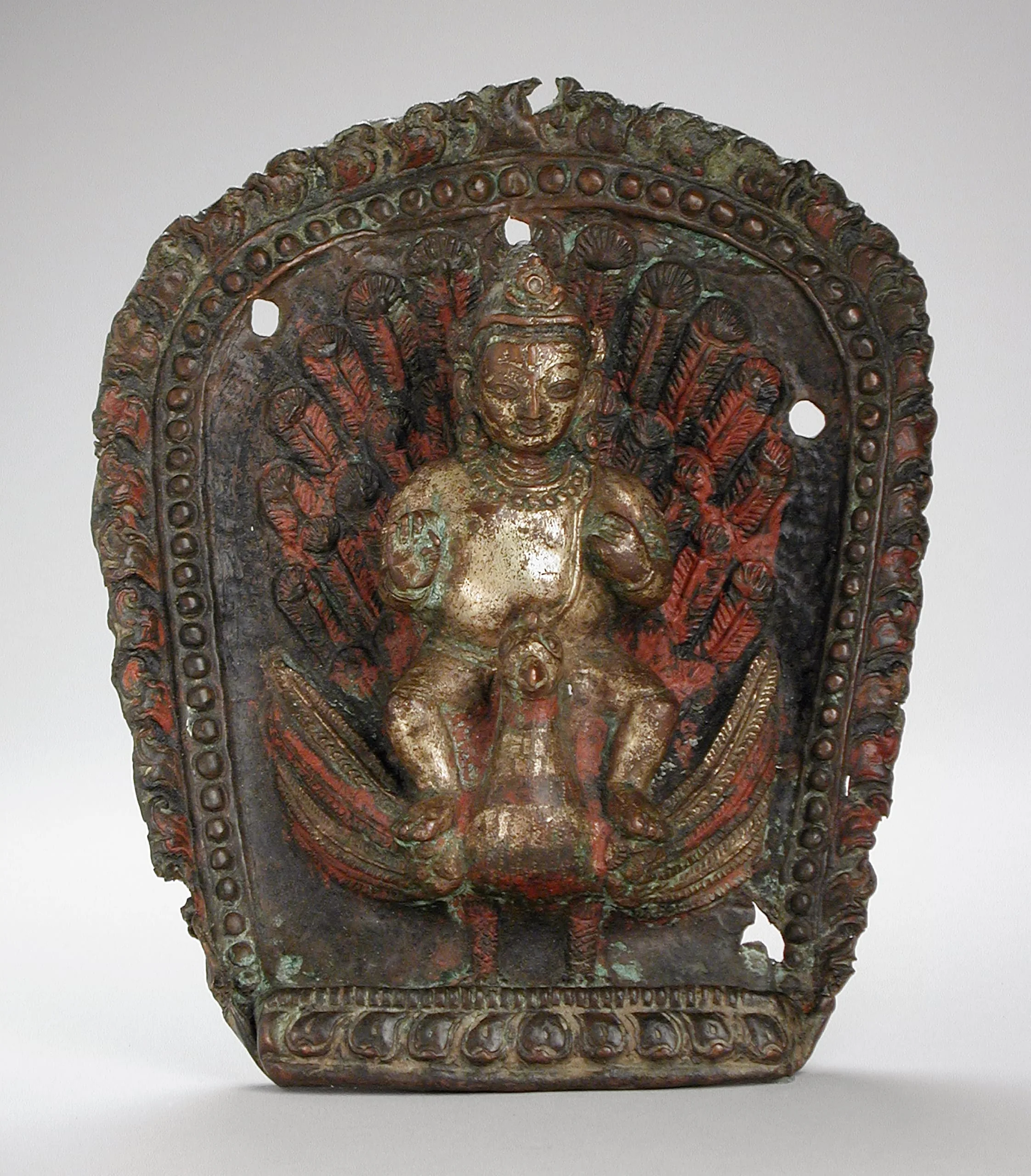
Kumara, the youthful Hindu god of war, is the son of Shiva and Parvati. He is also known as Skanda or Karttikeya in northern India and Subrahmanyam or Murugan in southern India. Although varying origin stories are presented in different textual sources, perhaps the most familiar is that Kumara was born when Shiva and Parvati were interrupted while having sex. This caused Shiva to ejaculate accidentally into a fire. As the god of fire, Agni, was unable to bear the heat of Shiva’s seed, he threw it into a thicket of reeds on the bank of the Ganges River. The embryo was found and nursed by the wives of sages known as the Krittikas (personifications of the Pleiades constellation cluster). He eventually grew into a handsome warrior boy who was destined to destroy the demon, Taraka.
Kumara rides his peacock mount (mayura) named Paravani. He has a single head (in some iconographic forms he has six heads (sanmukha). He wears a crown and jewelry, including the Brahmanical sacred thread (yajnopavita) over his left shoulder. His right hand is held in the gesture of reassurance (abhaya mudra). His left hand clenched near his chest may have once held his primary attribute, a spear made from the Sun by Vishvakarman, the architect and artificer of the gods. Kumara is enthroned on a lotus base and has a flaming aureole with a pearl border (prabhavali).
See also M.77.4, M.84.40, M.85.212.2, M.85.213.1, M.85.279.3, and AC1994.130.1.