- Title
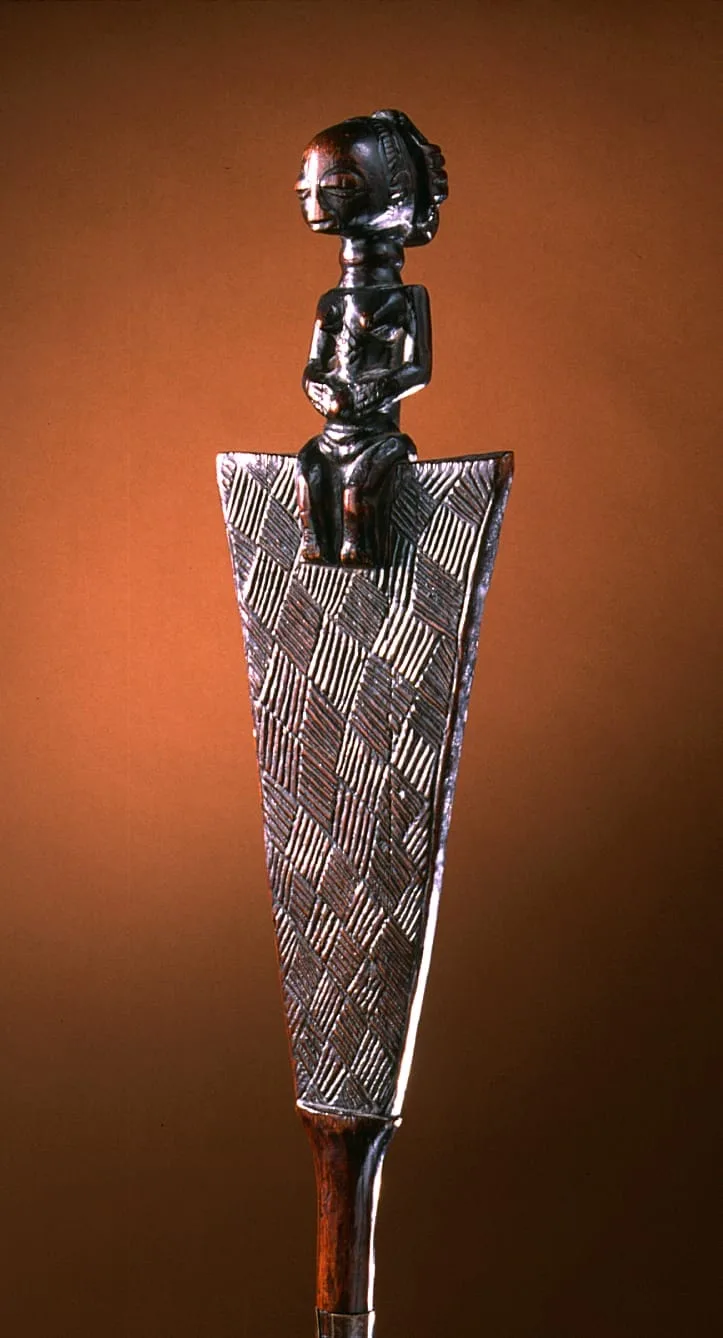
- Kibango (Chief's Staff with Female Figure)
- Date Made
- 19th-early 20th century
- Medium
- Wood and copper
- Dimensions
- Height of female figure: 7 in. (19 cm); Height of complete staff: 65 in. (165.1 cm)
- Accession Number
- AC1994.203.12
- Curatorial Notes
Within Luba culture, staffs of office sanction their owners’ authority by affirming ties to earlier Luba dynasties and serve as a crucial element of a chiefly investiture and reign. Sections of Luba staffs refer to aspects of ancestral presence. One or two figures are often depicted on the upper end of a staff. Here, a small female figure sits with arms drawn up on either side of her navel. Her torso is marked with scarifications, and she wears the cross-shaped headdress characteristic of northern Luba and Hemba peoples. She represents the female founders of specific royal lines. She perches atop a triangular form, sometimes likened to the oars of the Luba’s fishermen ancestors. The patterning may denote the landscape of the Luba royal capital, and the long shaft the uninhabited savanna. The shaft is covered with metal, reinforcing the staff as it was forcefully planted in the ground at all important public ceremonies or on the battlefield as a signifier of victory. The metal sheath may also be a reference to the ruler’s dominance over long-distance trade, and the wealth required to obtain copper, a precious metal from sources located far to the south.