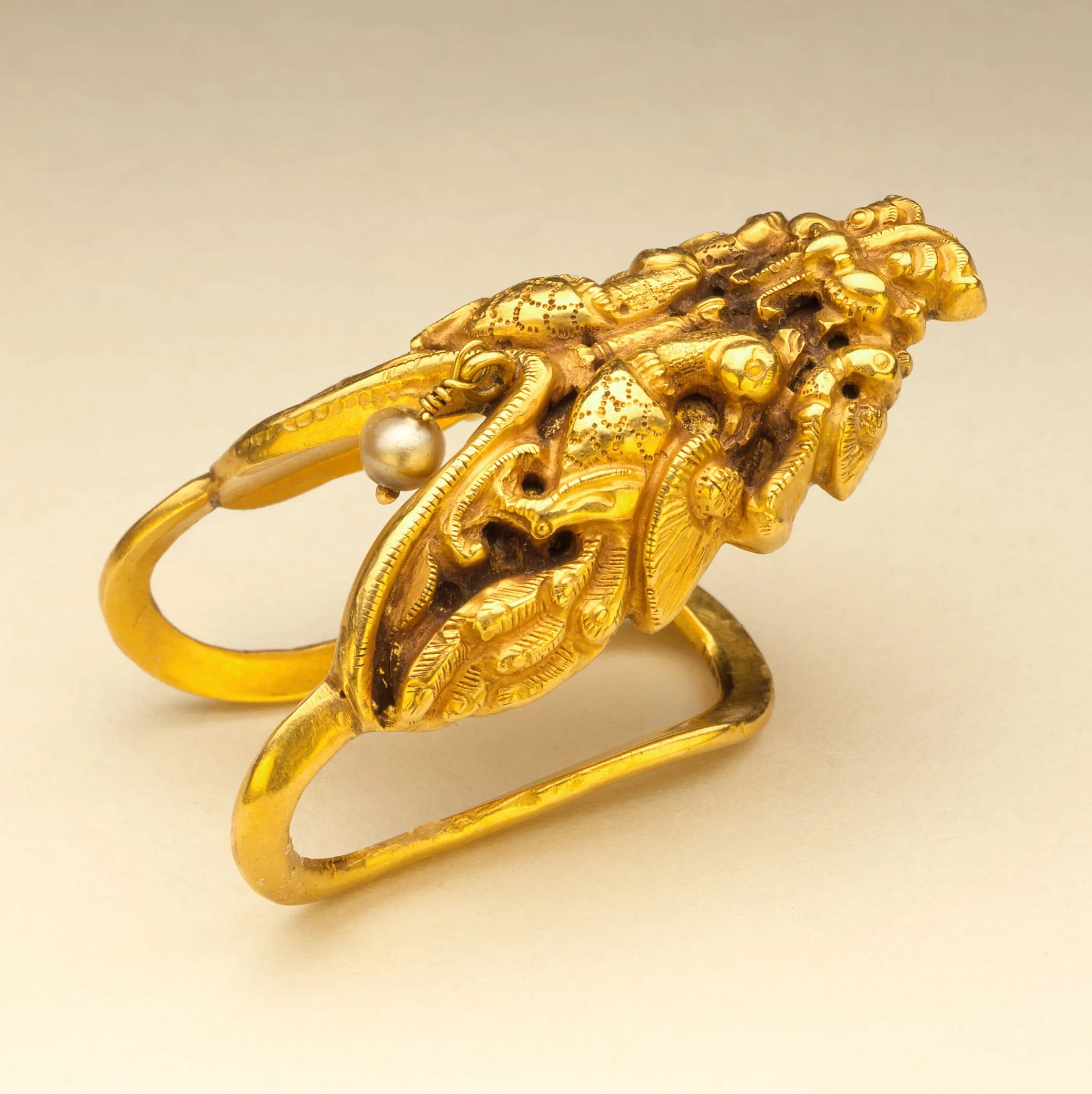
This elegant south Indian finger ring (neli) is a type of bridal ring that is bestowed by a newlywed’s relatives as a propitious gift to safeguard her in her new life. Neli rings are modeled on a distinctive style of armlet (vanki) with an inverted-V-shaped armature (see M.2002.83). The crowning motif at the top of the ring is an auspicious leonine "face of glory" (kirtimukha). Along the sides are symmetrical pairs of peacocks, the upper ones smaller in scale. A pendant pearl dangles from the apex of the arch between the lower peacocks.
Traditional south Indian gold and silver jewelry is typically cast or repoussé and finished with chisel-cut chasing. The design program consists primarily of sacred animals, especially griffins, elephants, tigers, rearing lions, and peafowl; various deities from India’s rich corpus of mythology; and lush floral and vegetal motifs. Gemstones are often utilized for their perceived astrological effects, particularly rubies, diamonds, and emeralds. Unlike northern Indian jewelry, the reverse is normally unenameled.