- Title
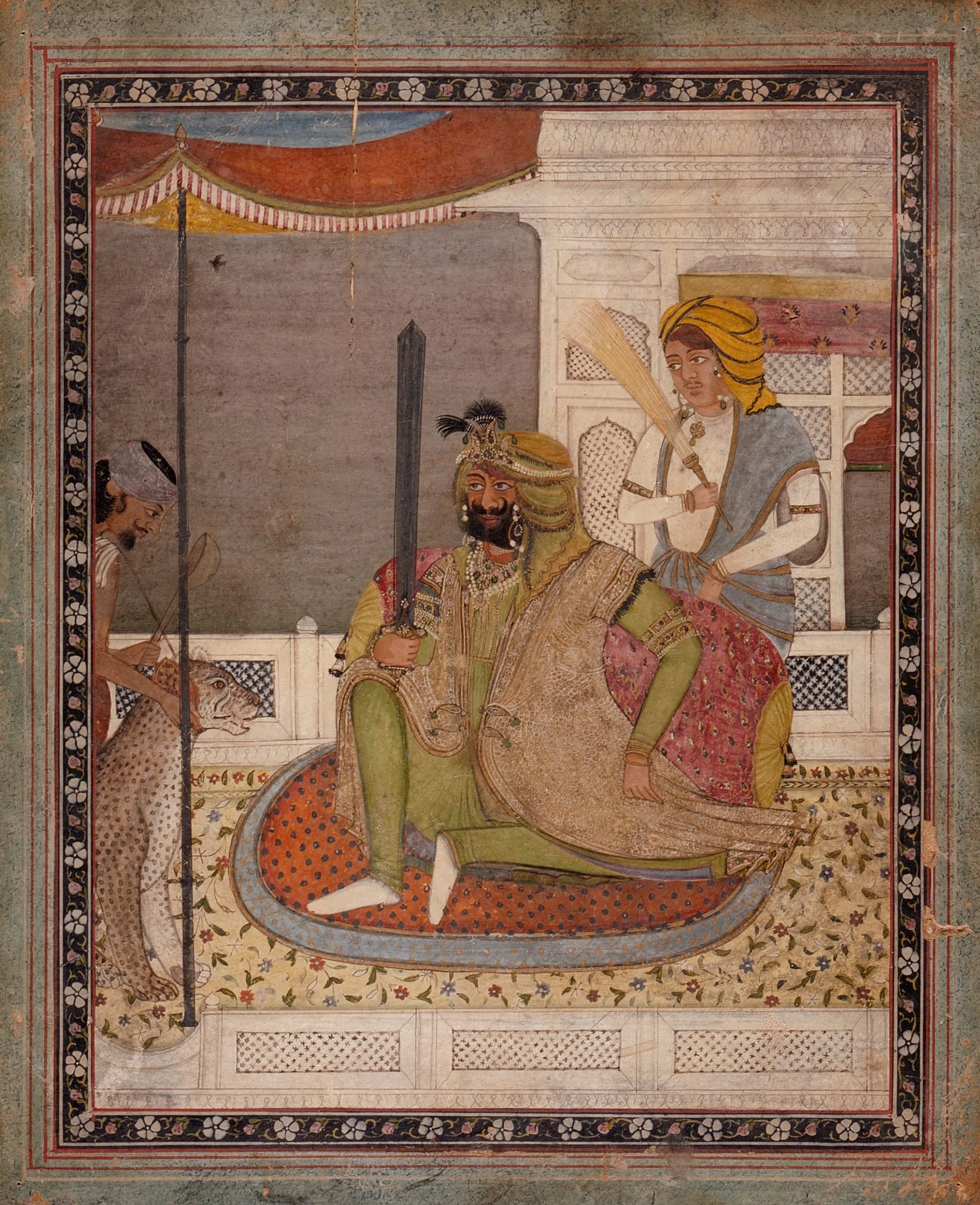
- Maharaja Sher Singh (r. 1841–1843) Being Presented with a Cheetah
- Date Made
- circa 1840-1845
- Medium
- Opaque watercolor, gold, and ink on paper
- Dimensions
- Sheet: 10 x 8 in. (25.4 x 20.32 cm); Image: 7 7/8 x 6 1/4 in. (20 x 15.88 cm)
- Accession Number
- M.90.160.3
- Curatorial Notes
Maharaja Sher Singh (r. 1841–1843) was the fourth Maharaja of the Sikh Empire (1799–1849). He was the eldest son of Maharaja Ranjit Singh (r. 1801–1839), founder of the Sikh Empire. He came to power after the sudden death of Maharaja Nau Nihal Singh (r. 1839–1840) and his subsequent bombardment and siege of the Lahore Fort in 1841. Sher Singh ruled for only two years before he was assassinated by a Sikh chieftain, Ajit Singh Sandhawalia. See also M.79.191.17. An iconographically comparable oil portrait of Sher Singh by Ágoston Schoefft (1809–1888), attributed to circa 1841–1842, is in the Princess Bamba Collection of the Lahore Fort Museum (S.M.53 (N.M.1961.333). A period copy is in the Toor Collection of Sikh Art, London.
Sher Singh is seated on a palace terrace in what is presumably the Lahore Fort. He wears a layered turban with an aigrette and the traditional turban ornaments of a feather plume turban ornament (jigha) and a horizontal tripartite ornament (sarpati). He is richly ornamented with golden jewelry inlaid with pearls, emeralds, and rubies. Over his green garments he wears a tan coat with embroidered floral decoration. Seated on floral carpets and leaning against a bolster, Sher Singh sits in the kingly posture of royal ease (maharajalila asana) with his left leg lying flat and his right knee raised. He holds a sword upright in his right hand. An attendant behind him waves an honorific fly whisk made with a white yak tail (cauri or chowri). On the painting’s left edge, a Muslim cheetah keeper (yuzdar) presents a trained Asiatic cheetah used in the royal practice of coursing (hunting) with tamed cheetahs. The cheetah wears a leather hunting hood (topah) under his chin that would be repositioned as a blindfold before a hunt to prevent distractions, like the leather hoods used in falconry. The cheetah trainer holds a hunting scoop (khurpa) used to collect animal droppings or to serve bits of meat during training rewards to keep the handler’s hands safely away from the predator's jaws. See also M.90.141.4.