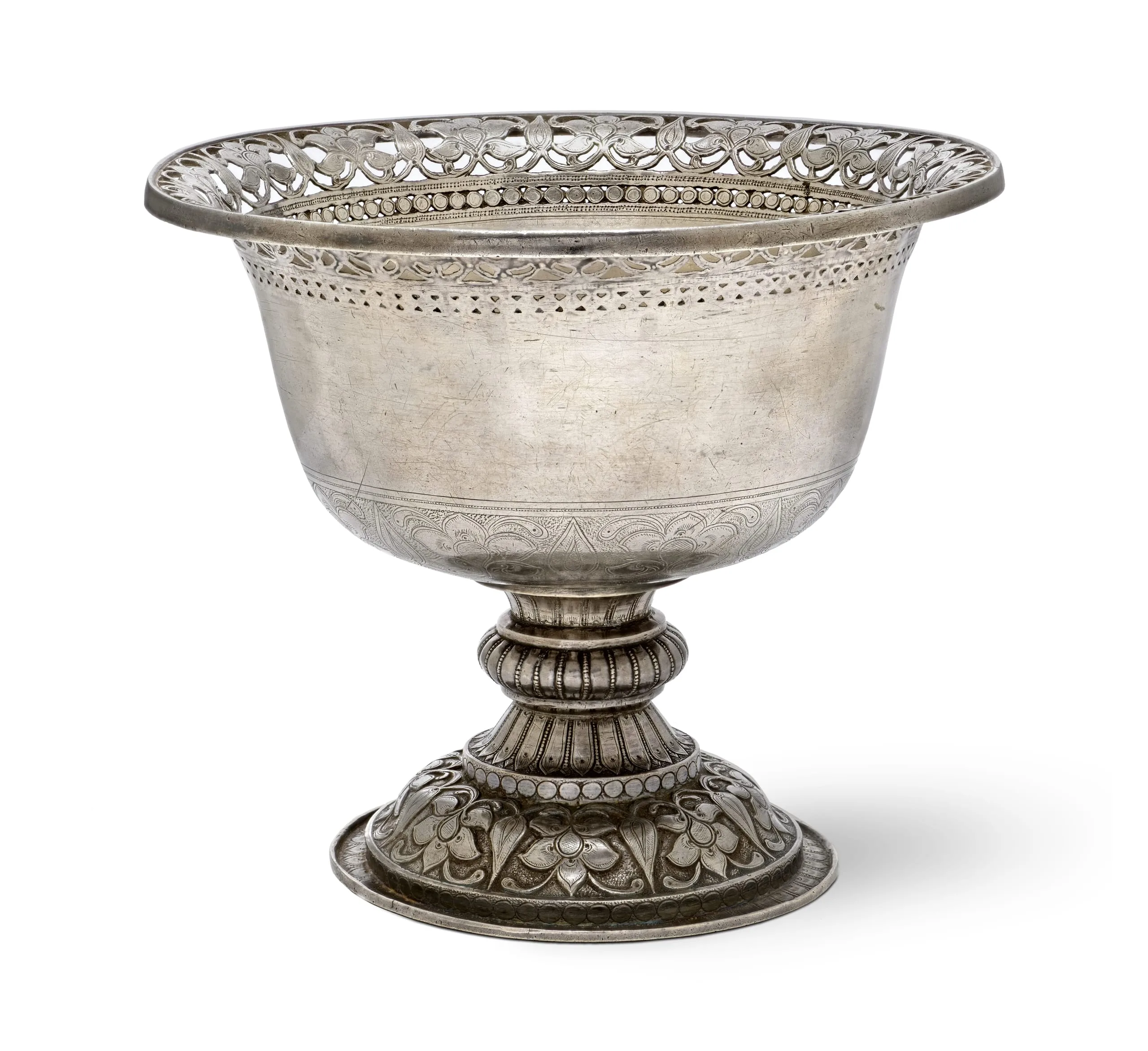
This idiosyncratically shaped bowl has a wide, deep body supported by a round pedestal foot with elongated annular ridges decorated with fluting, lappets, and bead molding. The bowl’s tiered flaring foot is soldered onto the body. The everted rim and upper bands of floriated
decoration (lilies alternating with cypress trees) and bead molding are distinctive for having a pierced background. The exterior vessel wall is predominately plain, with an incised band of the same botanical and geometric decoration forming a bottom border around the vessel body. The same decorative band set against a stippled background encircles the base of the foot, with the stylistic variance of the cypress trees being inverted.
The LACMA bowl was likely made to hold fresh flower blossoms. This interpretation is based on its partially openwork vessel rim and upper walls that would be unsuitable for holding liquids, and because of its close visual similarities with similarly shaped gold or gil ded bowls being used for holding fresh flower blossoms in contemporaneous Delhi and Lucknow paintings. For a Mughal example, see Muhammad Shah with Courtiers, attributed to Chitarman, c. 1730, now in the Bodleian Library, Oxford (MS Douce Or.a.3, fol. 14r). For Lucknow, see a painting of religious figures in a Polier album, now in the Museum für Islamische Kunst, Berlin (I. 4595, fol. 30).