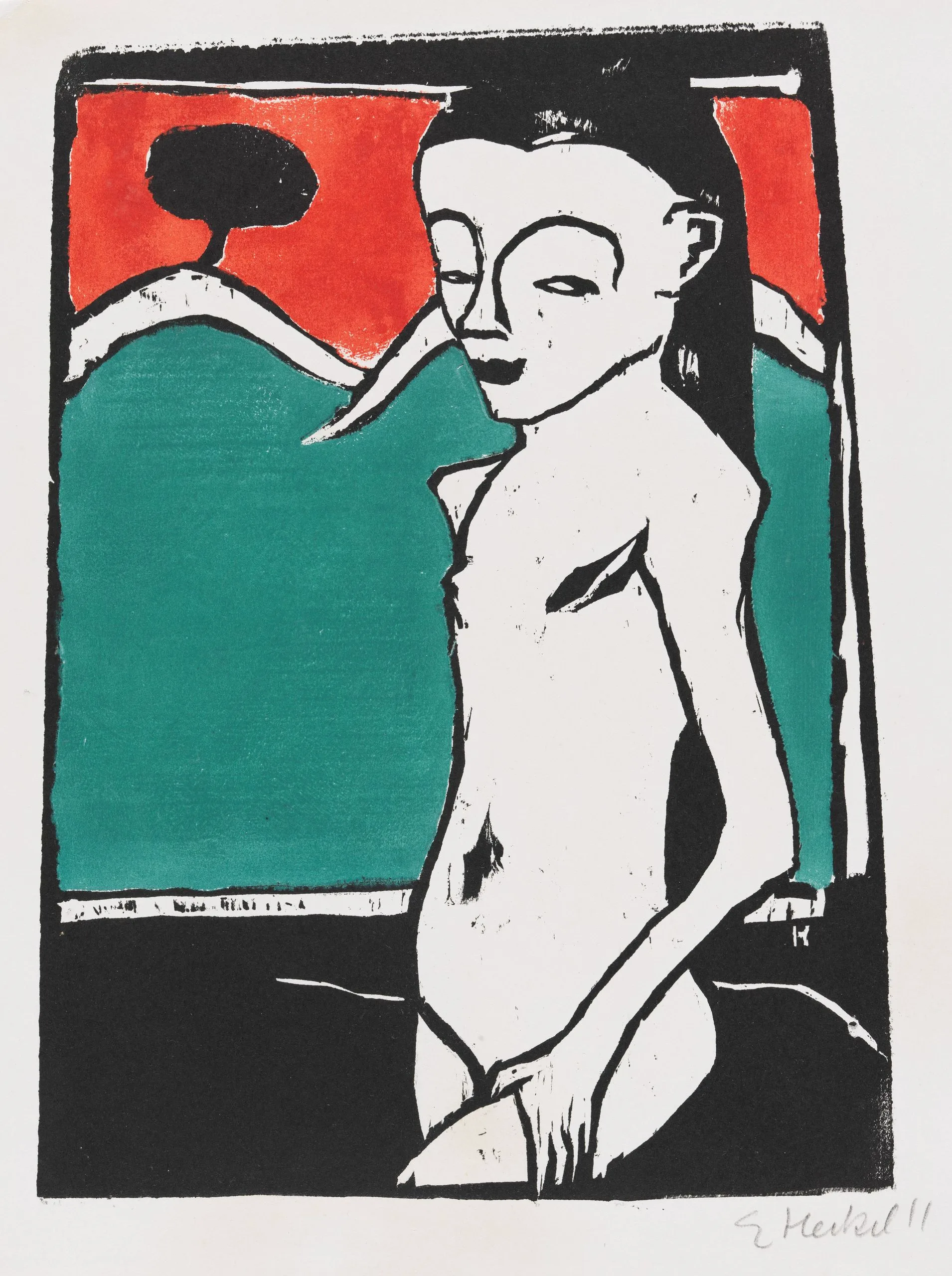
Between 1910 and 1920 the mature phase of German expressionism reflected the enormous social, cultural, and political changes of that decade. The movement's nucleus, Die Brücke (the Bridge), had four founders: Ernst Ludwig Kirchner, Karl Schmidt-Rottluff, Fritz Bleyl, and Erich Heckel. They believed that the empowering role of art could bring about a revolutionary encounter with man's materialism and spirituality in a totally new society. Architecture students and self-taught artists, they were greatly influenced by Paul Gauguin, Edvard Munch, Vincent van Gogh, and Oceanic and African tribal arts.
The German expressionists conducted prolific experiments in the graphic arts, introducing new techniques, vibrant colors, and disturbing, sometimes controversial subject matter in their prints. Woodcuts provided a way to confirm effects later appearing in their canvases: compositional structure, dramatic contrasts of light and color, and the flat picture plane.
Erich Heckel first made woodcuts in 1904. While in Dresden the four Brücke artists used an adolescent girl named Fränzi as a model. The subject of this print, she was regarded as the ideal child of the new society, at once innocent and wise. Although there are traditional elements in this composition the standing figure, the landscape beyond the window there is nothing complacent about it. In contrast to her unformed, almost sexless body, the child's strong, crudely drawn face conveys in a minimum of detail an expression implying knowledge beyond her years.