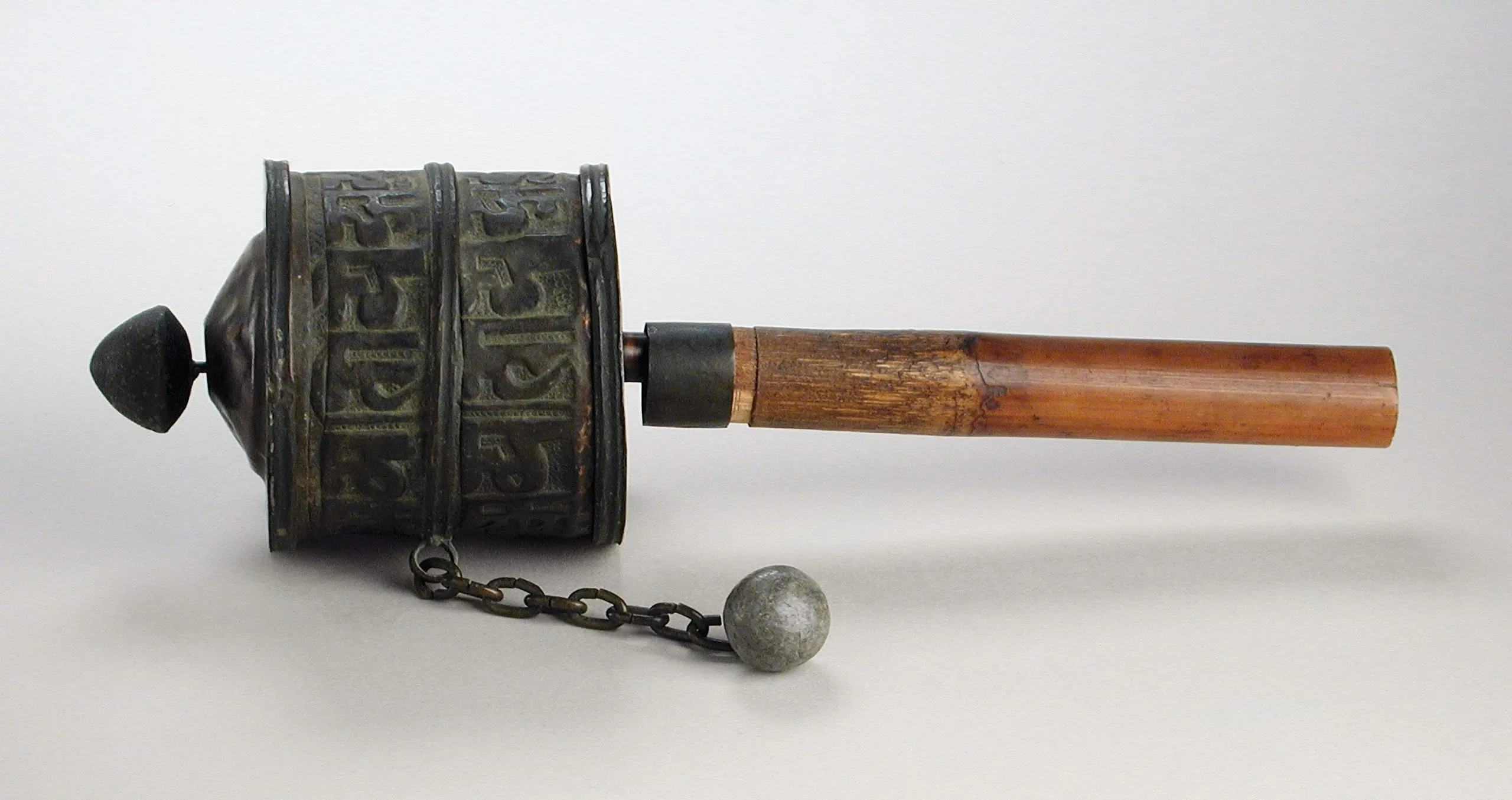
The Tibetan prayer wheel (mani khorlo) is a cylindrical wheel mounted on a spindle that is spun during the recitation of prayers by Tibetan Buddhist devotees. Their use of a prayer wheel symbolizes the Buddha’s “Turning the Wheel of the Law” (Dharmachakra). Prayer wheels typically have a carved invocation or mantra on the exterior and sometime a mantra or prayer printed on paper is contained within them. The mantra is often “Om mani padme hum” (praise to the jewel in the lotus), which is associated with Avalokiteshvara, the Bodhisattva of Compassion. Prayer wheels can be large and mounted in a framework or small and handheld. The handheld prayer wheels are specifically termed a “mani wheel” or lakkhor.
This handheld prayer wheel has a copper drum with a cast mantra, lotus bud finial, and unadorned wooden handle. It has a printed prayer inside. Attached to the drum is a short chain with a ball weight, called a “governor,” which enables the prayer wheel to be rotated with less effort.
See also AC1994.116.7. Comparable prayer wheels are in the Asian Art Museum, San Francisco (B60B158 and 1989.37), Metropolitan Museum of Art, New York (2013.430a–c), Museum of Fine Arts, Boston (47.150), Virginia Museum of Fine Arts, Richmond (2003.155), and numerous examples in the Victoria and Albert Museum, London.