LACMA

ShopMembershipMyLACMATickets
LACMA
Los Angeles County Museum of Art
5905 Wilshire Blvd.
Los Angeles, CA 90036
info@lacma.org
(323) 857-6000
Sign up to receive emails
Subscribe
© Museum Associates 2025

Museum Hours

Monday

11 am–6 pm

Tuesday

11 am–6 pm

Wednesday

Closed

Thursday

11 am–6 pm

Friday

11 am–8 pm

Saturday

10 am–7 pm

Sunday

10 am–7 pm


  • About LACMA
  • Jobs
  • Building LACMA
  • Host An Event
  • Unframed
  • Press
  • FAQs
  • Log in to MyLACMA
  • Privacy Policy
© Museum Associates 2025
Collections

Unknown
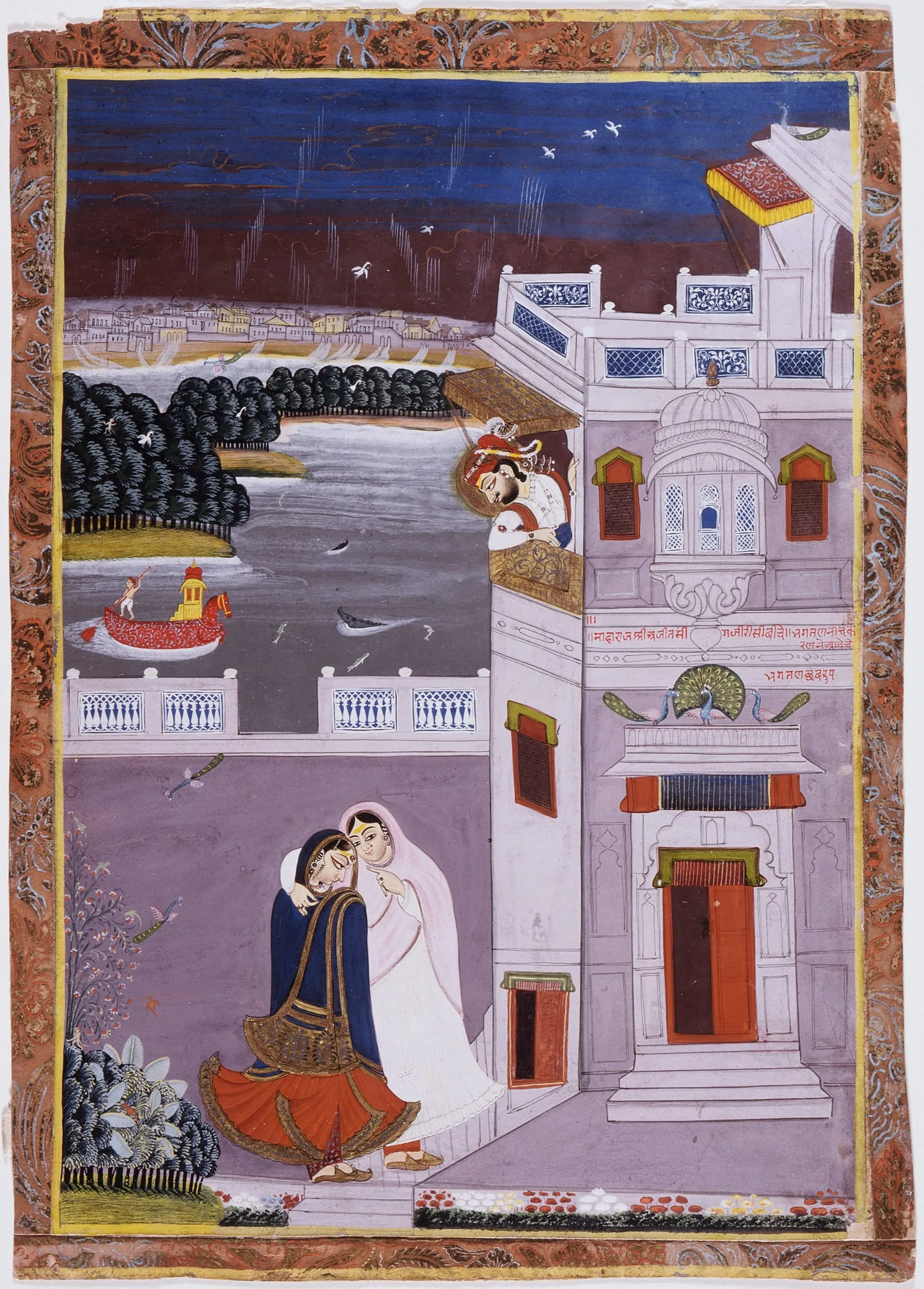
Maharaja Ajit Singh (reigned 1676-1725) and the Dancer Chhabrupdated 1814

Not on view
Indian miniature painting, two women embracing near a white palace at night, with a reclining crowned figure on a terrace above and a rain-streaked river landscape beyond
Artist or Maker
Unknown
Title
Maharaja Ajit Singh (reigned 1676-1725) and the Dancer Chhabrup
Place Made
India, Rajasthan, Jodhpur
Date Made
dated 1814
Medium
Opaque watercolor, gold, silver, and ink on paper; marbled paper border with gold
Dimensions
Sheet: 12 1/16 x 8 1/2 in. (30.64 x 21.59 cm); Image: 11 x 7 1/2 in. (27.94 x 19.05 cm)
Credit Line
Gift of Jane Greenough Green in memory of Thomas Pelton Green
Accession Number
AC1994.59.4
Classification
Drawings
Collecting Area
South and Southeast Asian Art
Curatorial Notes

The nimbate male ruler leaning out the palace window is identified by inscriptions on the front and back of the painting as Maharaja Ajit Singh of Jodhpur (reigned 1676–1725). The demure woman in the blue shawl being led by her companion is identified as the dancer Chhabrup. Ajit Singh is eagerly awaiting her arrival and performance. The composition carries a romantic overtone as it recalls images of a lover awaiting the arrival of his beloved. A poetic verse inscribed on the back reads, “while seeing her lover approach, the lady lost her luster, just as birds in trees are startled on hearing gunfire.” (Translation by Naval Krishna.) The painting is dated the thirteenth day of the fortnight, Mrigsar [January-February], [v.s.] 1872 [CE 1814].

The patronage of music and dance performances was an important part of the court life of the Rajputs, and it was not uncommon for intimacy to develop between patrons and performers. That this liaison was portrayed nearly a hundred years after the king’s death suggests that his relationship with Chhabrup had taken on a legendary quality.

Dancers such as Chhabrup, whose sole responsibility was to please the king, were often more than performers. Trained in dance and singing, many were also educated in literature and poetry, and some were poets themselves. They were instrumental to the transmission, preservation, and development of various branches of the humanities.
Selected Bibliography
  • Pal, Pratapaditya; Markel, Stephen; Leoshko, Janice. Pleasure Gardens of the Mind: Indian Paintings from the Jane Greenough Green Collection. Los Angeles County Museum of Art; Mapin Publishing Pvt. Ltd.: Los Angeles, 1993.