- Title
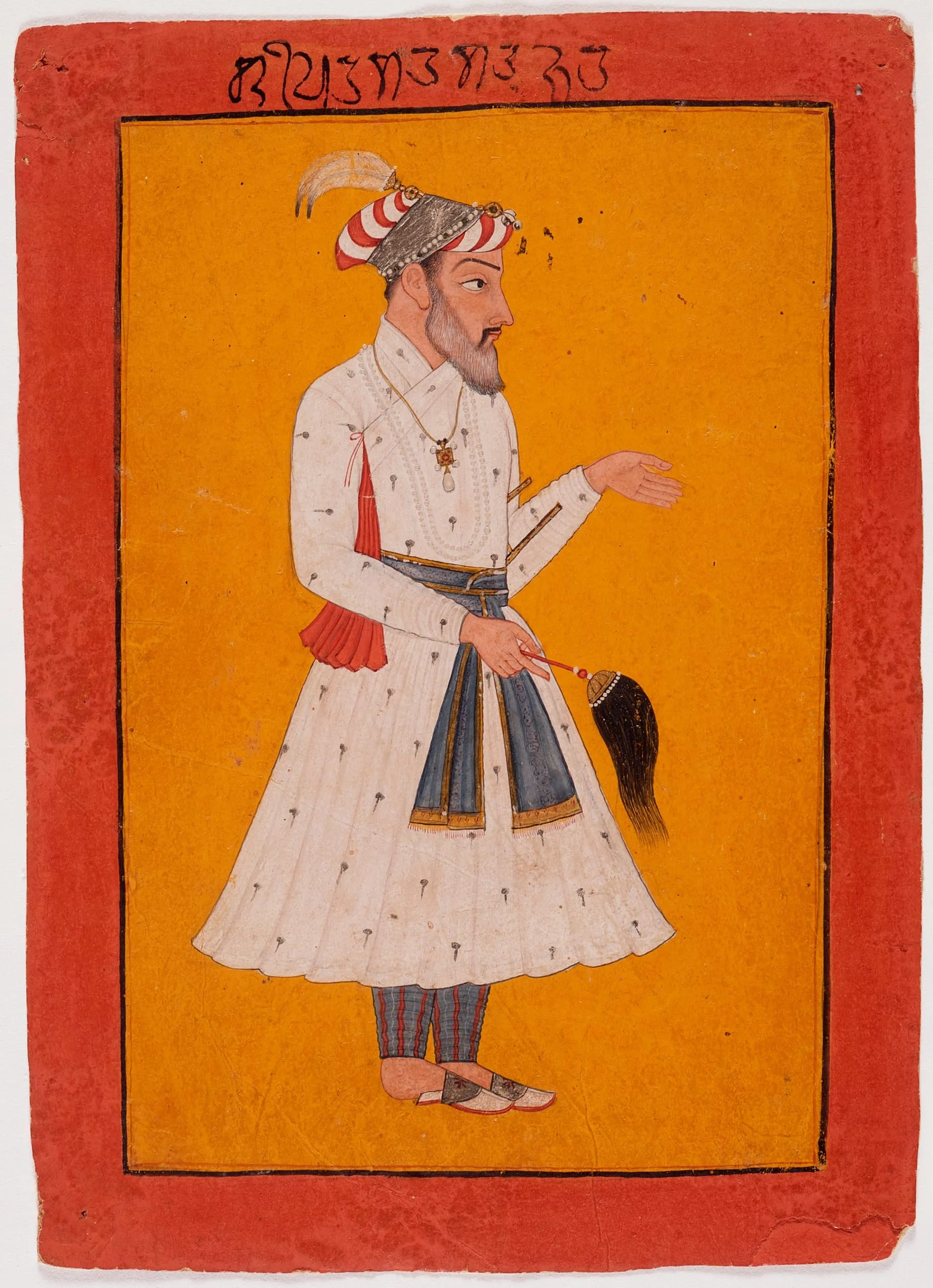
- Emperor Shah Jahan (r. 1628-1658)
- Date Made
- circa 1690
- Medium
- Opaque watercolor, gold, and ink on paper
- Dimensions
- Image: 7 x 4 3/4 in. (17.78 x 12.07 cm); Sheet: 8 1/4 x 6 in. (20.96 x 15.24 cm)
- Accession Number
- AC1994.59.2
- Curatorial Notes
A Takri inscription in the upper border of this portrait identifies the subject as the fifth Mughal emperor, Shah Jahan (1592-1666), who ruled from 1628 to 1658 and commissioned the famous Taj Mahal as a mausoleum for his beloved wife, Mumtaz Mahal. This painting was likely part of a series of posthumous royal portraits done around 1690 in either Basohli or Mankot.
Inspired by a now lost or unidentified Mughal portrait of Shah Jahan in his later years (indicated by the whiteness of his beard), the emperor stands in three-quarter view with his head facing left in full profile. On his head is a flat turban with a jigha (plume-like ornament similar to an aigrette) and a string of pearls with a pendant. Around his neck he wears two long strands of pearls and a square golden pendant inlaid with rubies, pearls at the corners, and a large pendant pearl. He wears a white coat (jama) with a discrete floral pattern and red pleats where the coat is tied under his right arm, striped pants, embroidered shoes (juttis), and a waist sash with a punch dagger (katar) tucked in on his far side. Shah Jahan carries a small flywhisk with dark tail-hairs, which symbolizes his spiritual devotion. (In contrast, flywhisks held by attendants over the heads of Mughal emperors to signify their royalty are generally made with white yak tails.) Several extant portraits show a similar small flywhisk being held by Shah Jahan and his pious successor, Emperor Aurangzeb (r. 1658-1707). See also M.78.9.15.
- Selected Bibliography
- Pal, Pratapaditya, Janice Leoshko, Joseph M. Dye, III, Stephen Markel. Romance of the Taj Mahal. Los Angeles: Los Angeles County Museum of Art, 1989.
- Pal, Pratapaditya; Markel, Stephen; Leoshko, Janice. Pleasure Gardens of the Mind: Indian Paintings from the Jane Greenough Green Collection. Los Angeles County Museum of Art; Mapin Publishing Pvt. Ltd.: Los Angeles, 1993.