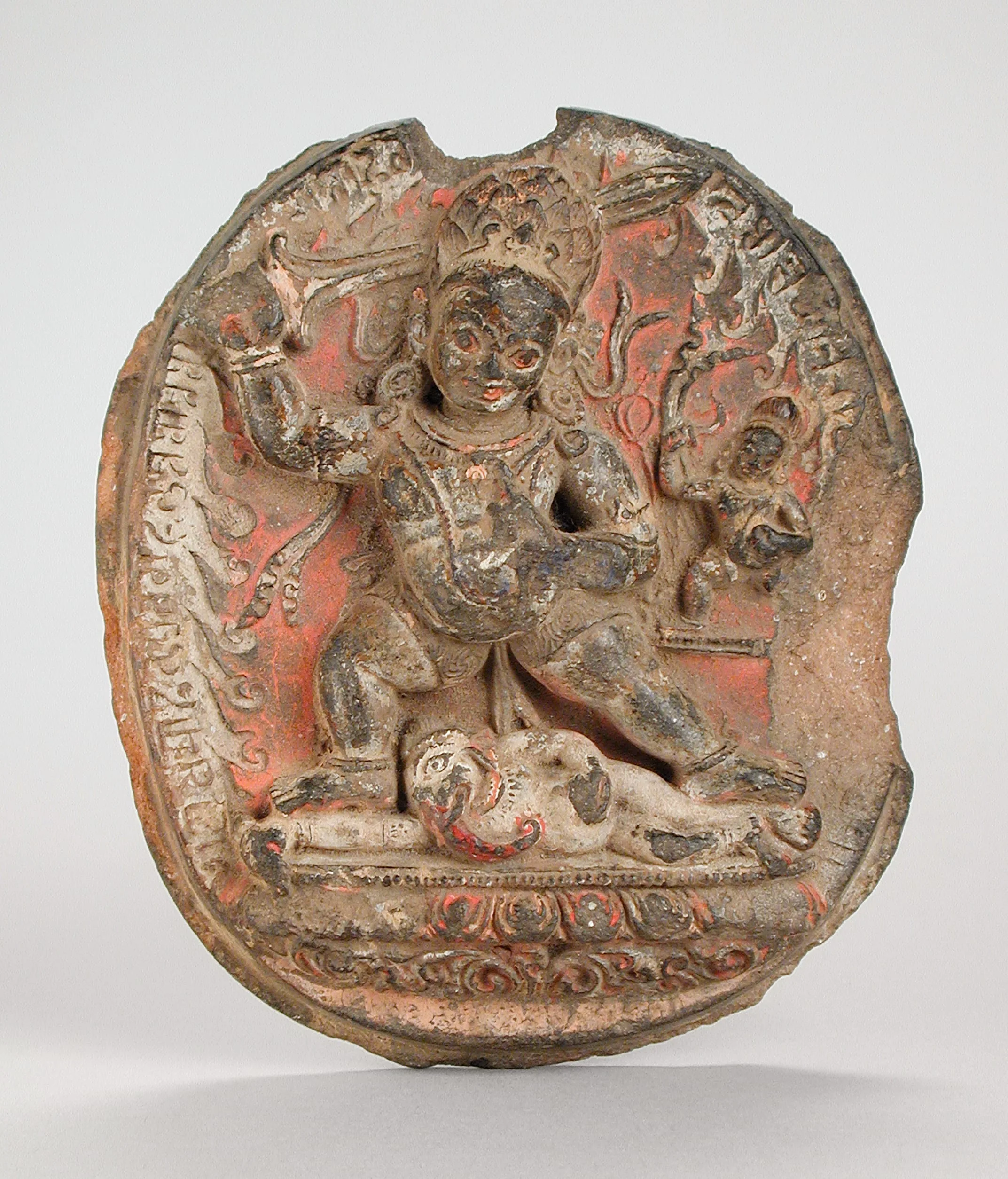
This molded earthenware votive tablet (tsatsa/tshatsha) was likely made in Bihar, India and then taken to Tibet by a Tibetan religious pilgrim where it was deposited inside a Tibetan Vajrayana Buddhist metal icon as a consecration filling to increase the image’s potency. Tsatsas are typically made of earthenware or sometimes metal. They are adorned with images of the Buddha Shakyamuni, various deities, religious teachers or shrines. The religious custom of making and depositing tsatsas originated in India and spread to Tibet in the 8th century and proliferated in the 11th century with impetus by the Indian Buddhist master and teacher Atisha (982-1054) who had traveled to Tibet in 1042. See also M.71.26.1–37, M.84.220.2, and AC1997.72.1.
Vighnantaka (Slayer of Obstacles) is a wrathful (krodha) meditational deity in Vajrayana Buddhism. He is also one of the Ten Great Wrathful Ones (Dasha Mahakrodha), which are the angry manifestations of the directional guardians (dikpala) in Vajrayana Buddhism. Vighnantaka is the Regent of the North. He has a ferocious visage and flaming hair. He wields a sword in his upraised right hand and carries a noose (pasha) in his left hand. He stands in a militant posture (alidha asana) over the recumbent figure of Ganesha, the Hindu Remover of Obstacles. To the left of Vighnantaka, a smaller version of the deity holds a saw-knife (karttrika) in his upraised right hand. See also M.84.58.3, and Himalayan Art Resources, https://www.himalayanart.org/search/set.cfm?setID=735
The Sanskrit inscription around the upper perimeter of the tablet is the Buddhist creed: The Buddha has explained the cause of all things that arise from a cause. He, the great monk, has also explained their cessation.