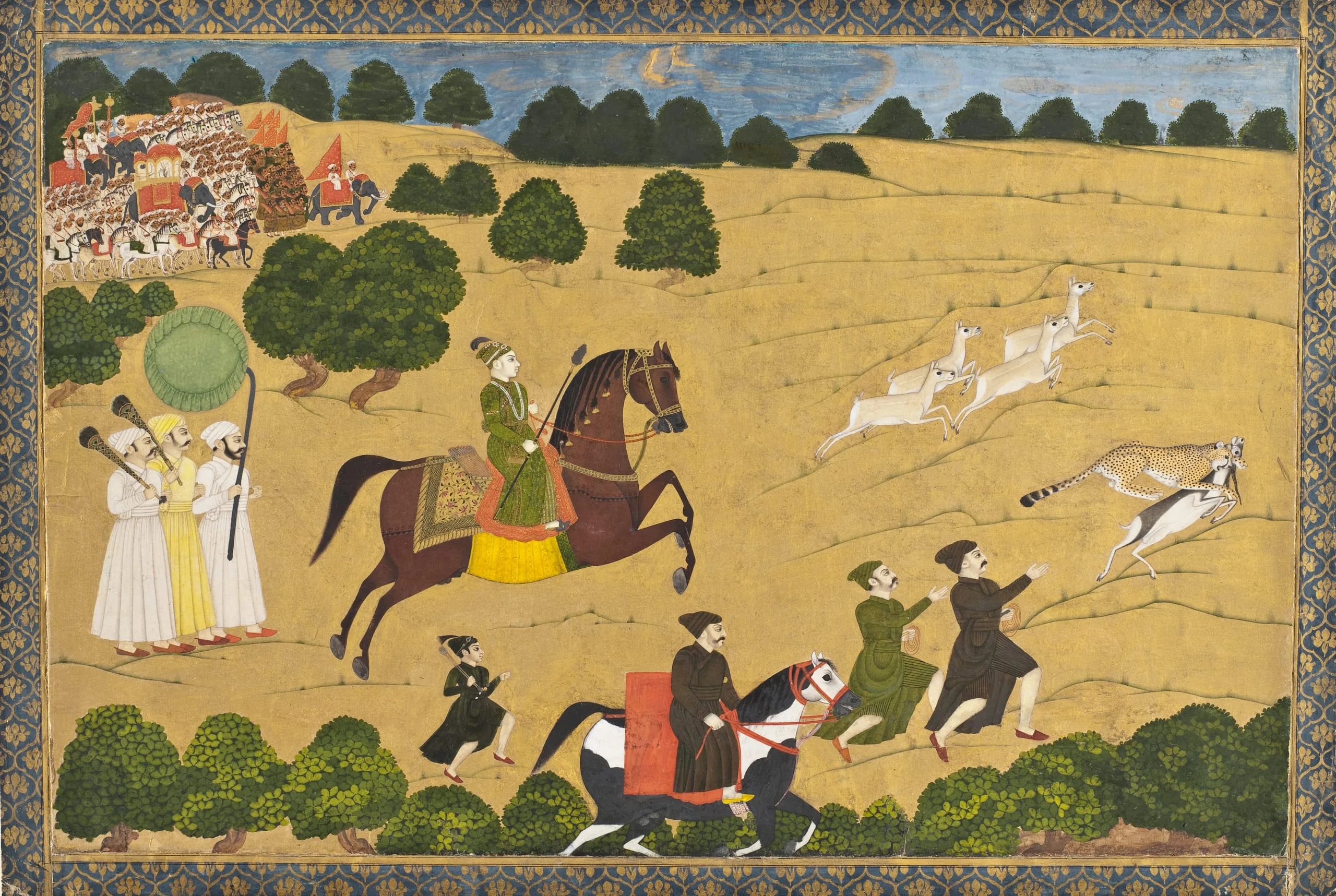
Hunting wild animals was a favored pastime of Indian royalty. The hunt provided entertainment for the court and demonstrated the bravery and prowess of the rulers, thereby attesting to their right of leadership. Depictions of the hunt are among the most dynamic action scenes in Indian painting. Here, a young prince wielding a lance gallops on his charger towards a blackbuck, or Indian antelope, being felled by a trained cheetah while retainers with coils of ropes chase after it. Following the royal hunter are three attendants, one holding aloft a sunshade and two carrying peacock feather fans (morchals). In the upper left corner, the royal entourage advances, including an elephant with an empty howdah and standard bearers on elephant back holding the Mughal insignia of exalted rank known as the mahi-ye maratib (Fish of Dignity).
An Arabic inscription on the reverse identifies the subject as Mirza Muhammad Sahibzada of Sikandarabad, near Delhi. (Translation by Z. A. Desai.) Also on the reverse are the initials of a European owner and the date of the painting’s acquisition, “W.F. 1764.” Robert Skelton (1956) has identified the initials W.F. inscribed on a painting of Emperor Aurangzeb (r. 1658-1707), now in the Victoria and Albert Museum, London (D.1205-1903), as William Fullarton (d. 1805), a Scottish surgeon with the East India Company in Bengal and Bihar in 1744-1766 and a prominent collector of paintings.