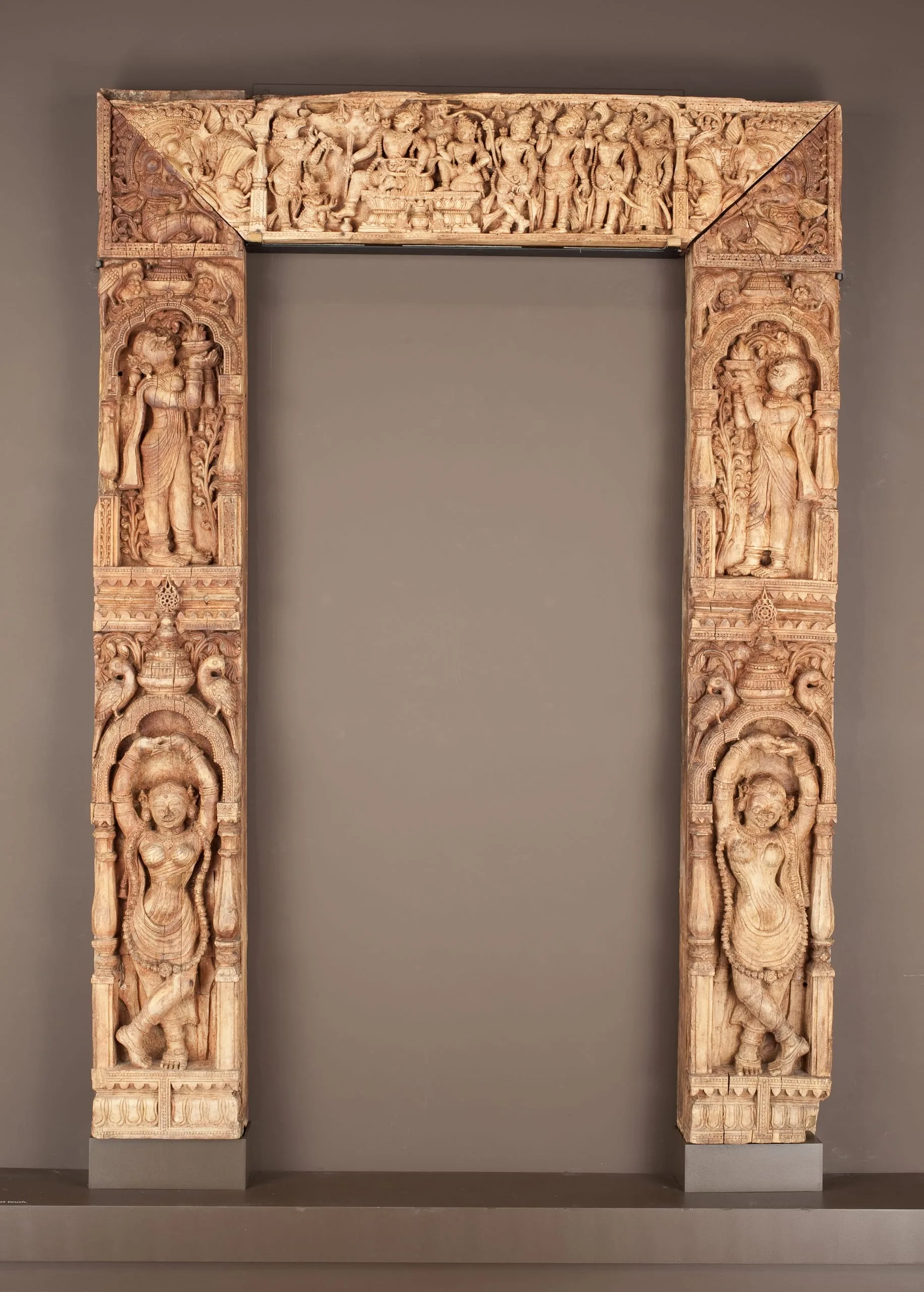
The Ramayana (Adventures of Rama) narrates the epic saga of the valiant Prince Rama and his dutiful wife, Princess Sita, who was abducted by Ravana, the arrogant ten-headed King of Lanka (probably modern Sri Lanka), during Rama's unjust fourteen-year forest exile. To rescue Sita, Rama and his faithful brother Lakshmana assembled a great army of monkeys and bears led by the Monkey-King Sugriva, his Monkey-General Hanuman, and the divine Bear-King Jambavan who was the minister of Sugriva.
The scene represented on the lintel occurred after the coronation (pattabhisheka) and celebrations for Rama following his defeat of Ravana and return to his capital of Ayodhya where he was coronated by the Vedic sage Vasishtha (Ramayana 6:116:54-56). In the center, Rama holds a bow and arrow and sits enthroned with his wife Sita under the royal parasol held by Lakshmana. Behind them are Bharata, who served as Rama’s regent during his exile; Shatrughna, who was Lakshmana’s twin and Bharata’s acolyte; and King Vibishana, the younger brother of Ravana who defected to Rama’s side and provided strategic advice. See also M.79.252.3.
In front of Rama, the kneeling Hanuman is devoutly washing his master’s feet with consecrated water from a water pot. Jambavan, envisioned as an Indian sloth bear, is holding a manuscript and gesticulating to indicate his learnedness. This scene likely represents Rama granting Jambavan’s request after the coronation for a boon to test his strength in physical combat with Rama. Although it is not recorded in the classical Ramayana, the battle between Jambavan and Krishna (secretly in place of Rama) is later found in the Bhagavata Purana (10:56:19-32), Garga Samhita (6th canto), and oral folklore. This portrayal of Jambavan and Hanuman may represent an Odissi regional tradition, as it is also found in later Odisha patachitra paintings ("Coronation of Lord Rama," https://hansavedas.org/portfolio/coronation-of-lord-rama/). For a study of the over three hundred Ramayana variants, see Paula Richman, ed. Many Ramayanas: The Diversity of a Narrative Tradition in South Asia (Delhi: Oxford University Press, 1992).
In each corner junction of the lintel and posts is an apotropaic "Face of Glory" (kirttimukha). Both of the posts are in the form of a double-stacked pillared archway (torana). Each of the upper enclosures depicts an elegant woman offering a lotus to Rama. The lower spaces portray a graceful female dancer with her hands joined above her head with the fingers intertwined and the palms facing upwards, known as the gesture of Dawn (ushas mudra), and her feet crossed (pada-svastika).