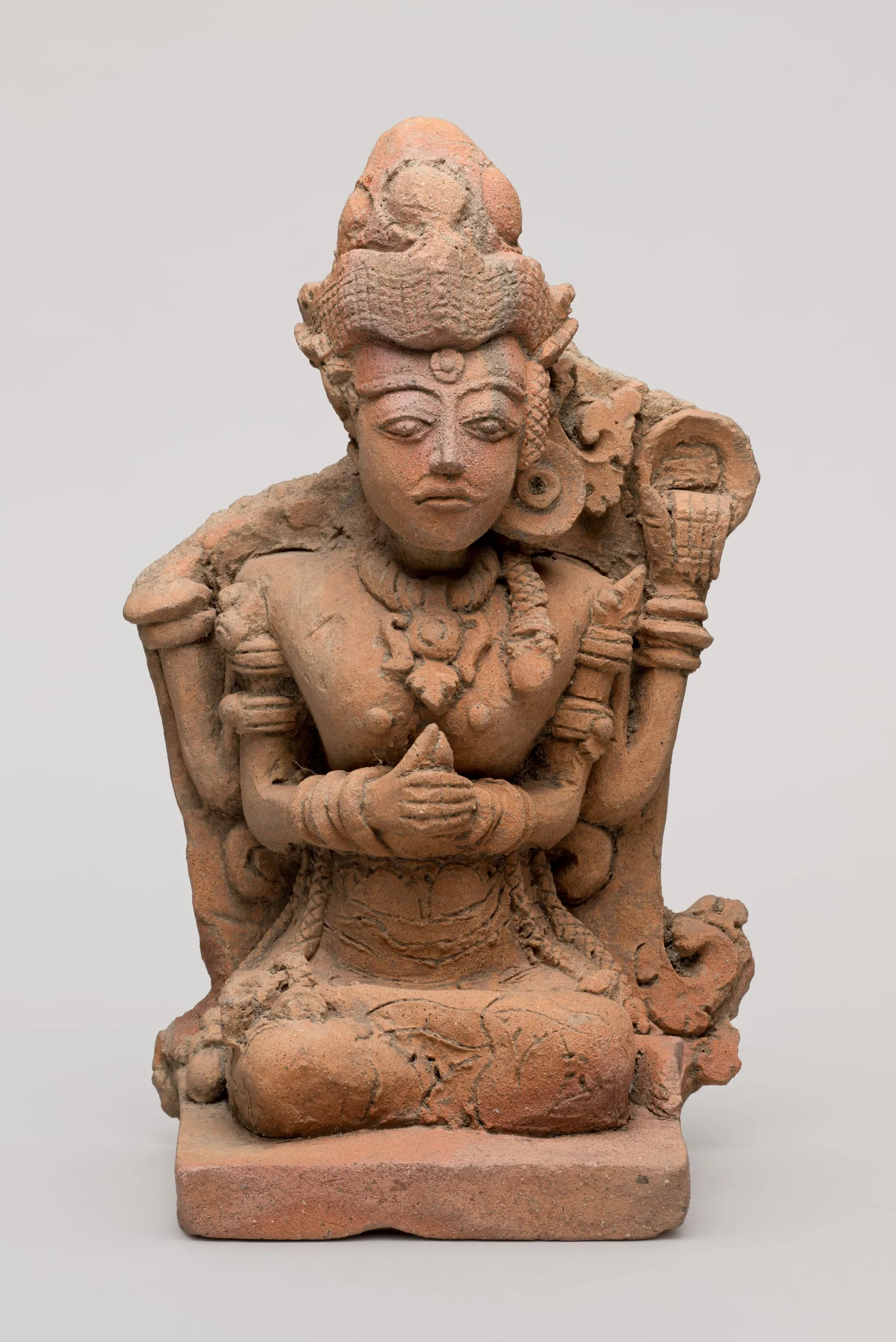
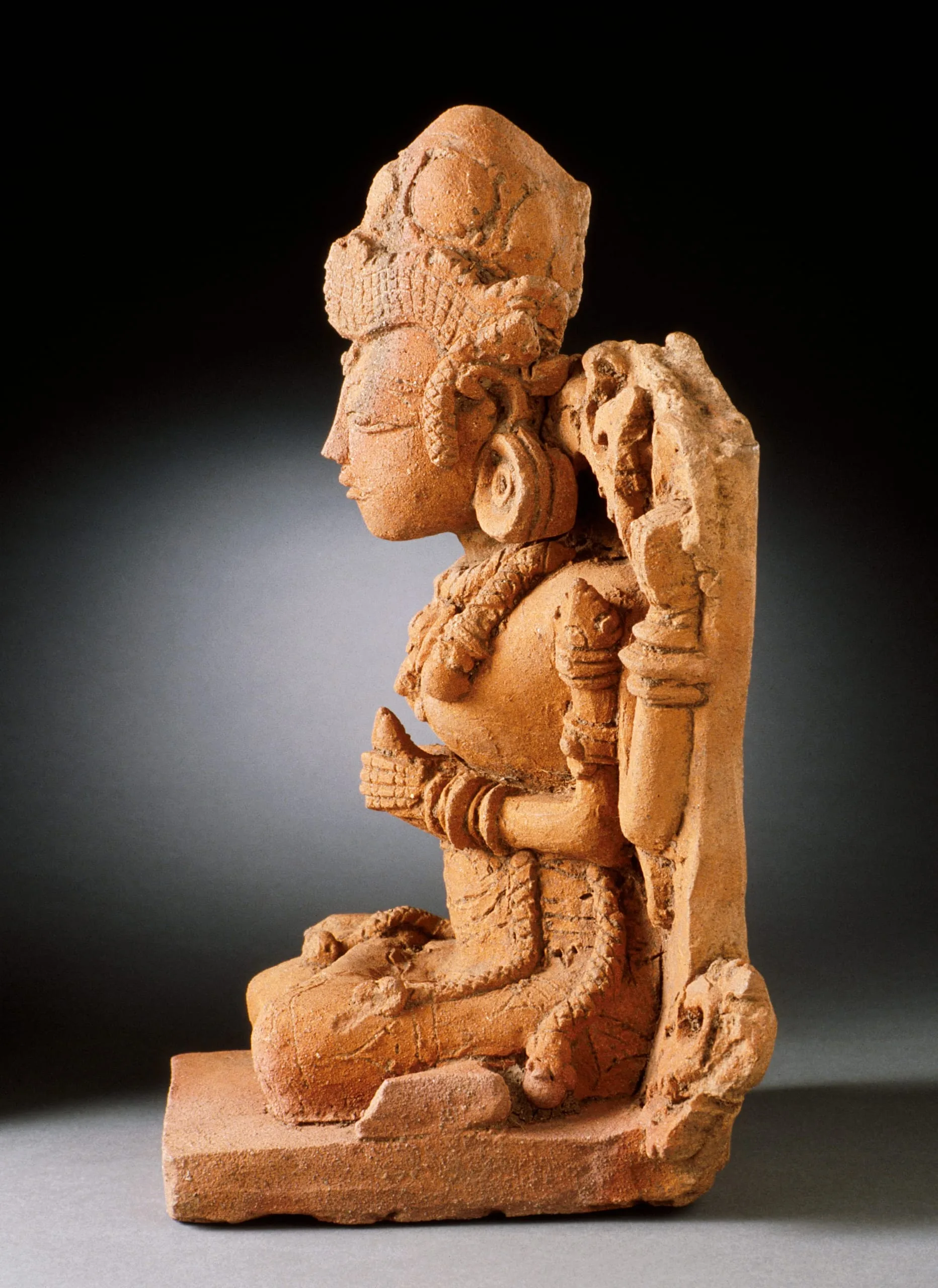
This earthenware sculpture has iconographic parallels with both the Hindu goddess Parvati, wife of Shiva, and the Buddhist goddess of wisdom Prajnaparamita. More likely, however, is that it is a memorial statue of a deified queen similar to M.81.273. The latter represents the development of a cult in which deceased royalty were believed to merge with a Supreme Divinity.
In the eastern Javanese kingdom of Majapahit (1293-1527), the stylistic aesthetic moved away from naturalistic South Asian prototypes: figures became more attenuated and angular, and curvilinear background floral forms became common. Stone and earthenware were the preferred media for sculpture.
She is crowned and wears heavy jewelry. She has four arms. In her upper left hand she holds a rosary. Her upper right hand is missing, but may have originally held an honorific fly whisk made from the white tail-hairs of a yak (cauri or chowri). She is seated in a meditative posture known as ‘hero sitting’ (vira asana) with the left foot resting on the right thigh and the right foot lying flat on the ground underneath the left thigh. Her hands are held in the esoteric ‘gesture of the inner bonds’ (Pal 1987, 76) with the palms joined, fingers interlocked, and the thumbs joined and pointed upward. She wears floral garlands around her waist and one that extends up along her left side and its tail hangs over her left shoulder. There are no lotuses growing out of vases, as seen in M.81.273.
A comparable idealized portrait of a Majapahit deified queen is in the Metropolitan Museum of Art, New York (2001.407). See also AC1994.234.3.