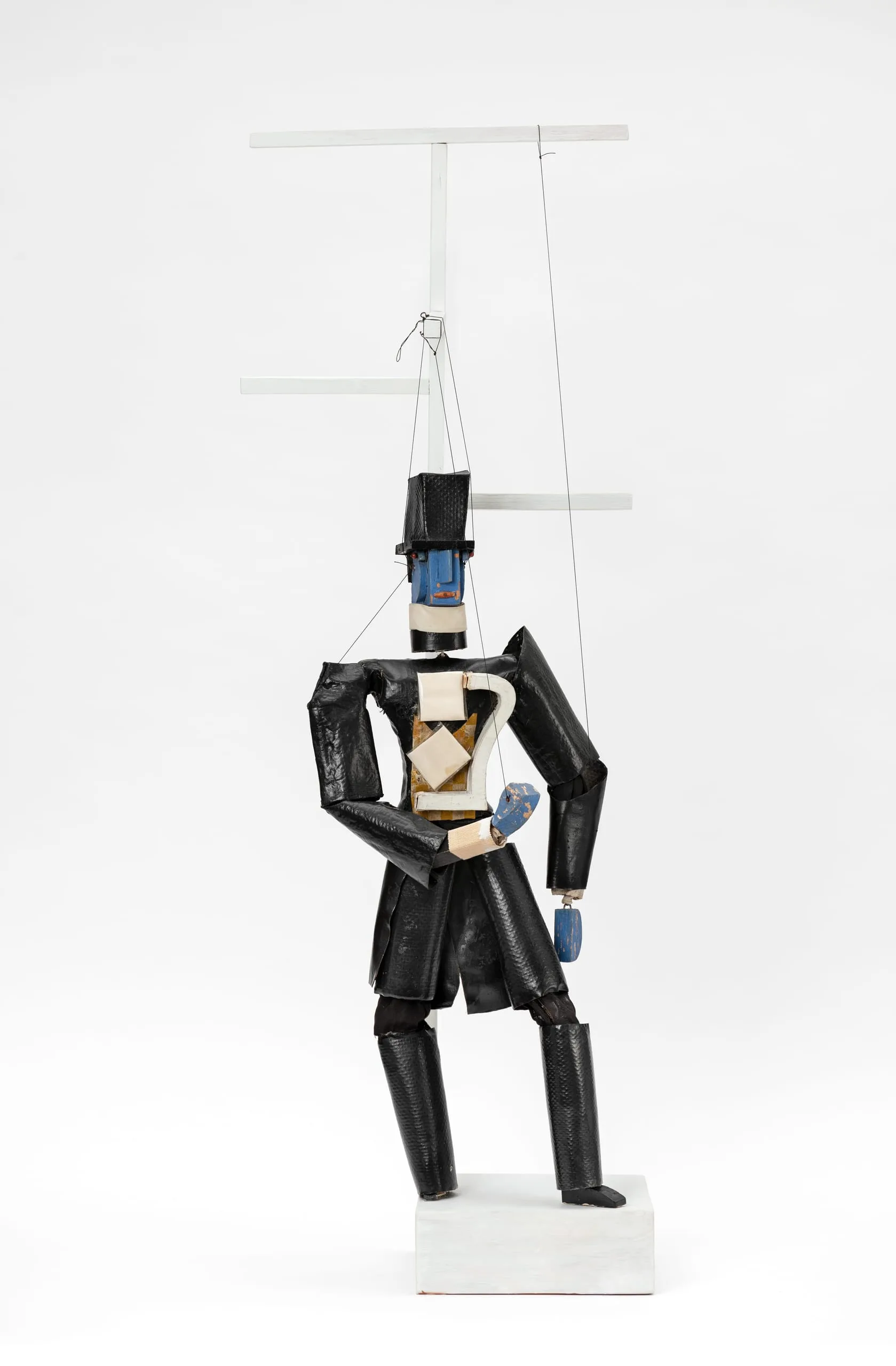
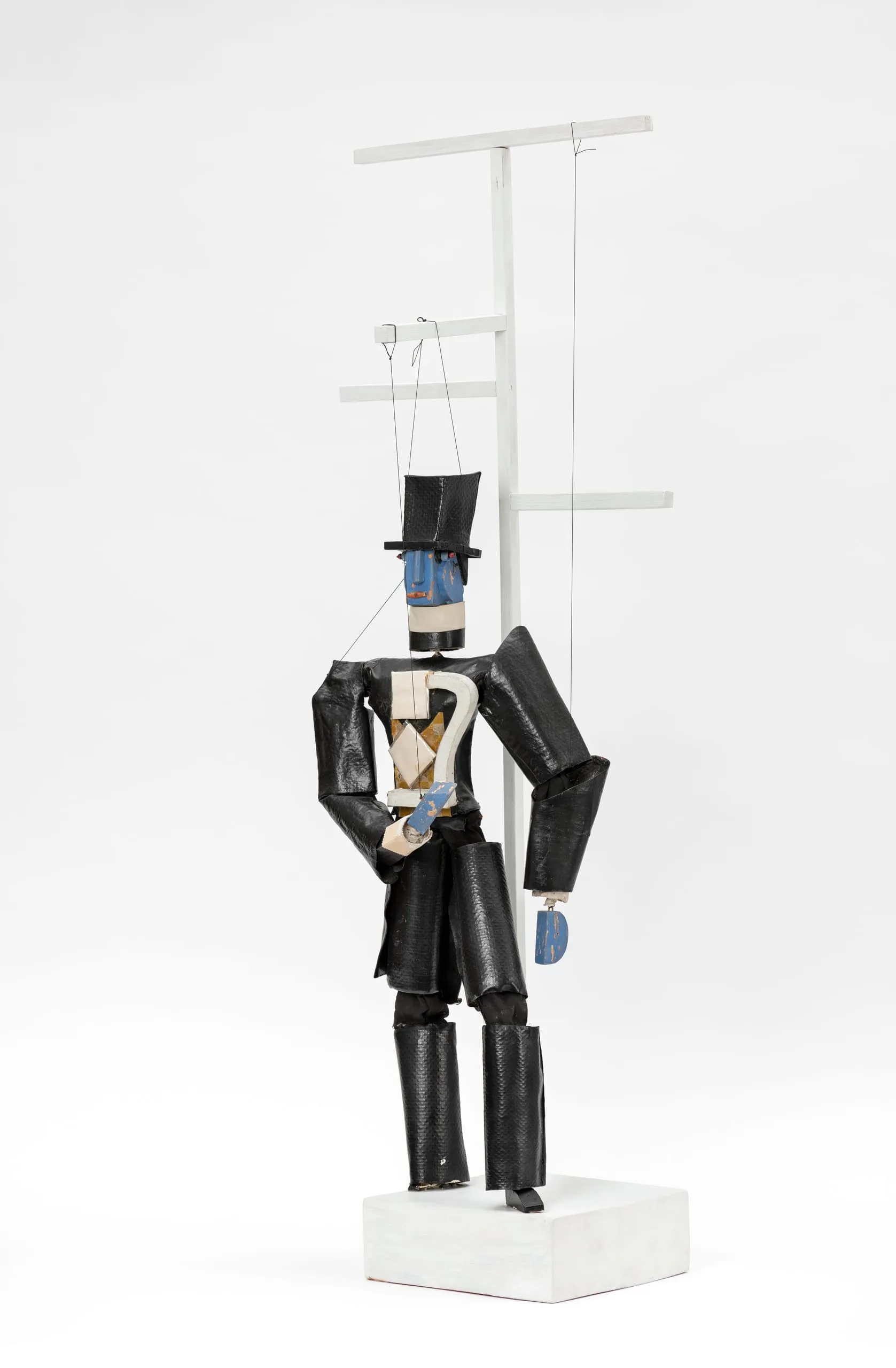
After moving to Paris (from the Russian Empire) in 1924, Alexandra Exter created at least twenty marionettes to “star” in an unrealized film by Peter Gad. Exter’s marionettes are “types,” rich in popular culture references from commedia dell’arte to futuristic fantasies. The gentleman with the top hat in Evening Dress may appear less outlandish at first, but the artist’s conceptual and aesthetic concerns are fully present in the details. In this work, black, textured plastic is folded into irregular conical limbs, while a semi-transparent dark fabric peeks through the gaps in between, covering the mannequin’s inner structure. On the squared-off wooden head, the gentleman’s eyes jut out from the sides of the face like an insect, and a toggle button becomes the mouth. The torso of the construction is perhaps the most abstracted feature: a white curving piece of wood bends around the body in relief to exaggerate the torso’s already distorted, triangular shape, whereas two white squares wrapped in clear plastic emerge against the backdrop of a waistcoat—a rectangular piece of yellow and white checkerboard-patterned fabric or paper with a triangle cut-out. Just as these squares may be interpreted as a glimpse of the gentleman’s (deconstructed) white shirt in motion beneath the tailcoat, their dynamic stacking constitutes a nod to Kazimir Malevich’s paintings of squares.