- Title
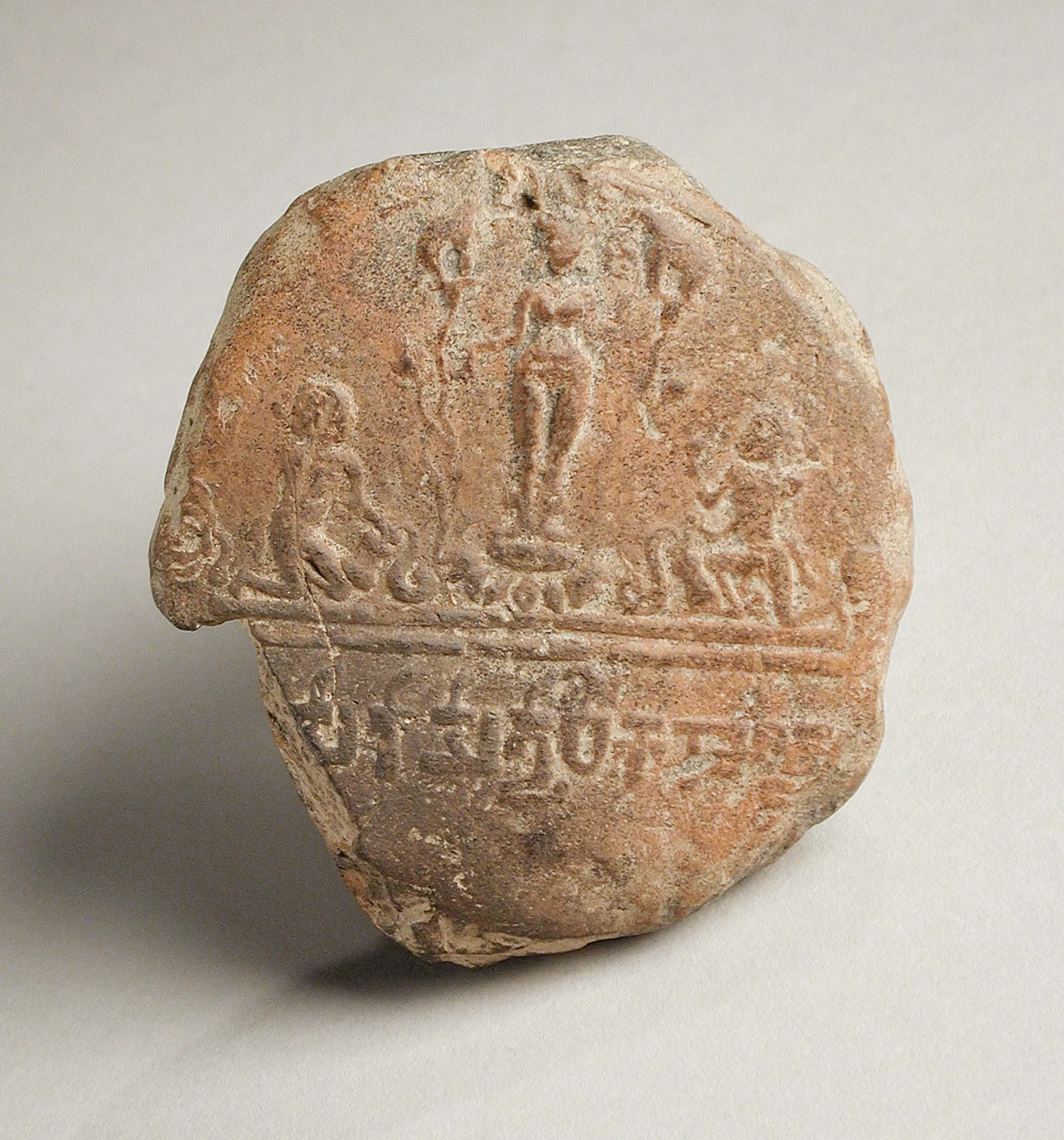
- Seal Impression with Shri Lakshmi Lustrated by Elephants (Gaja-Lakshmi)
- Date Made
- 5th century
- Medium
- Ocher earthenware
- Dimensions
- 3 1/4 x 3 x 1 in. (8.26 x 7.62 x 2.54 cm)
- Accession Number
- AC1993.239.7
- Curatorial Notes
This seal impression was used to authenticate documents and goods by a minister or district officer of the Gupta Empire (circa 240- 579) in the Gupta administrative center of Vaishali near Patna, Bihar. The seal impression is of the type excavated from the village of Basarh that is today located on the ancient site of Vaishali, which was abandoned in circa 600. The inscription in Gupta-period Brahmi script also records that the seal’s Authorized Signatory was a junior member of the royal family.
The presentation scene on the seal features Shri Lakshmi, the Hindu Goddess of Prosperity, represented as Gaja-Lakshmi (Elephant Lakshmi). She is being lustrated by elephants grasping an upside down ‘full vase’ (purna ghata) of sacred water. This iconographic form emphasizes Lakshmi as a mother goddess and fertility divinity. The crowned goddess has four arms. In her upper hands, she supports the lustrating elephants standing on lotus bases connected by a long lotus stalk to the lotus base on which the goddess stands. Her lower right hand is held in the gesture of charity (varada mudra). Her lower left right hand is now effaced but may have been held in the gesture of reassurance (abhaya mudra). See also M.74.40.1 and M.85.62. Flanking the goddess are two kneeling male figures who have been interpreted as extracting money from bags of riches (Pal 1987, p. 62, no. 25).
- Selected Bibliography
- Pal, Pratapaditya. Icons of Piety, Images of Whimsy: Asian Terra-cottas from the Walter Grounds Collection. Los Angeles: Los Angeles County Museum of Art, 1987.