LACMA

ShopMembershipMyLACMATickets
LACMA
Los Angeles County Museum of Art
5905 Wilshire Blvd.
Los Angeles, CA 90036
info@lacma.org
(323) 857-6000
Sign up to receive emails
Subscribe
© Museum Associates 2025

Museum Hours

Monday

11 am–6 pm

Tuesday

11 am–6 pm

Wednesday

Closed

Thursday

11 am–6 pm

Friday

11 am–8 pm

Saturday

10 am–7 pm

Sunday

10 am–7 pm


  • About LACMA
  • Jobs
  • Building LACMA
  • Host An Event
  • Unframed
  • Press
  • FAQs
  • Log in to MyLACMA
  • Privacy Policy
© Museum Associates 2025
Collections

Unknown
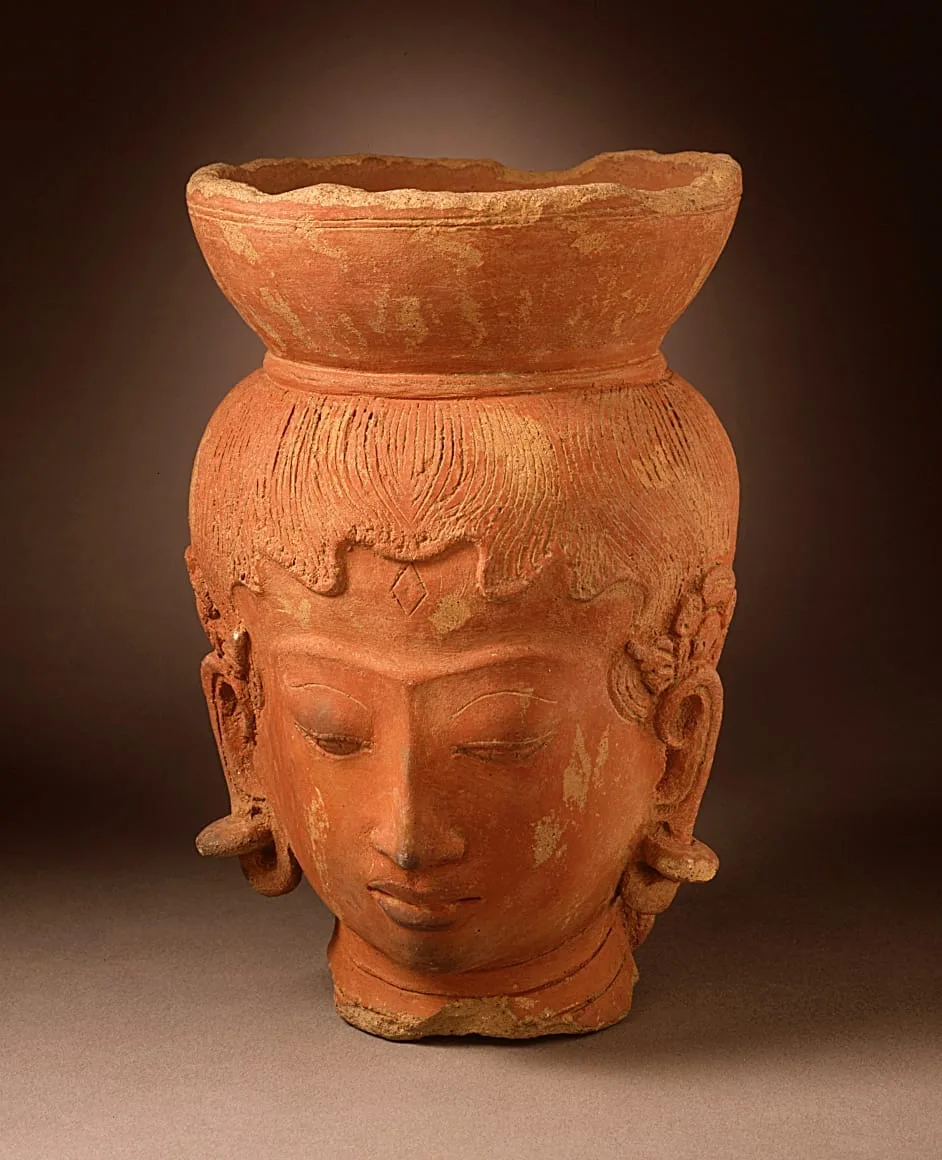
Offering Vessel in the Form of a Female Head14th-15th century

Not on view
Terracotta sculpture of a human head with a wide bowl-shaped vessel rising from the crown, featuring incised hair, low-relief facial features, and decorative ear ornaments
Artist or Maker
Unknown
Title
Offering Vessel in the Form of a Female Head
Place Made
Indonesia, Eastern Java, Trowulan region
Date Made
14th-15th century
Medium
Red earthenware
Dimensions
8 5/8 x 5 3/4 x 6 in. (21.8 x 14.5 x 15.2 cm)
Credit Line
Gift of Marilyn Walter Grounds
Accession Number
AC1993.239.3
Classification
Furnishings
Collecting Area
South and Southeast Asian Art
Curatorial Notes

Although previously attributed stylistically to the "11th century (?)" (Pal 1987, p. 50, no. 13), this Offering Vessel in the Form of a Female Head more likely dates from the 14th-15th century and was made in the region of Trowulan (or Trawulan), the former capital of the Majapahit Empire (1292–1527) in Eastern Java. The treatment of the eyebrows, eyes, lobed hairstyle, and lozenge-shaped forehead marking (bindu) are closer to the female heads from Trowulan than the previously suggested stylistic comparison of the female spout head at the bathing place of Djalatunda dated 977. See A. J. Bernet Kempers, Ancient Indonesian Art (Cambridge: Harvard University Press, 1959), pp. 67 and 95, pls. 189 and 289-290; and John N. Miksic, ed. The Legacy of Majapahit (Singapore: National Heritage Board, 1995), p. 166, no. 79.

The LACMA head is surmounted hunted by a shallow bowl. It was probably originally atop a short column or pot and functioned as an offering stand for flowers or fruit. See H. R. A. Muller, Javanese Terracottas: Terra Incognita (Lochem, The Netherlands: Tijdstroom, 1978), pp. 86 and 105, pl. 164.

See also M.83.117.1–.2, M.85.279.2, and M.86.345.17.
Selected Bibliography
  • Pal, Pratapaditya. Icons of Piety, Images of Whimsy: Asian Terra-cottas from the Walter Grounds Collection. Los Angeles: Los Angeles County Museum of Art, 1987.