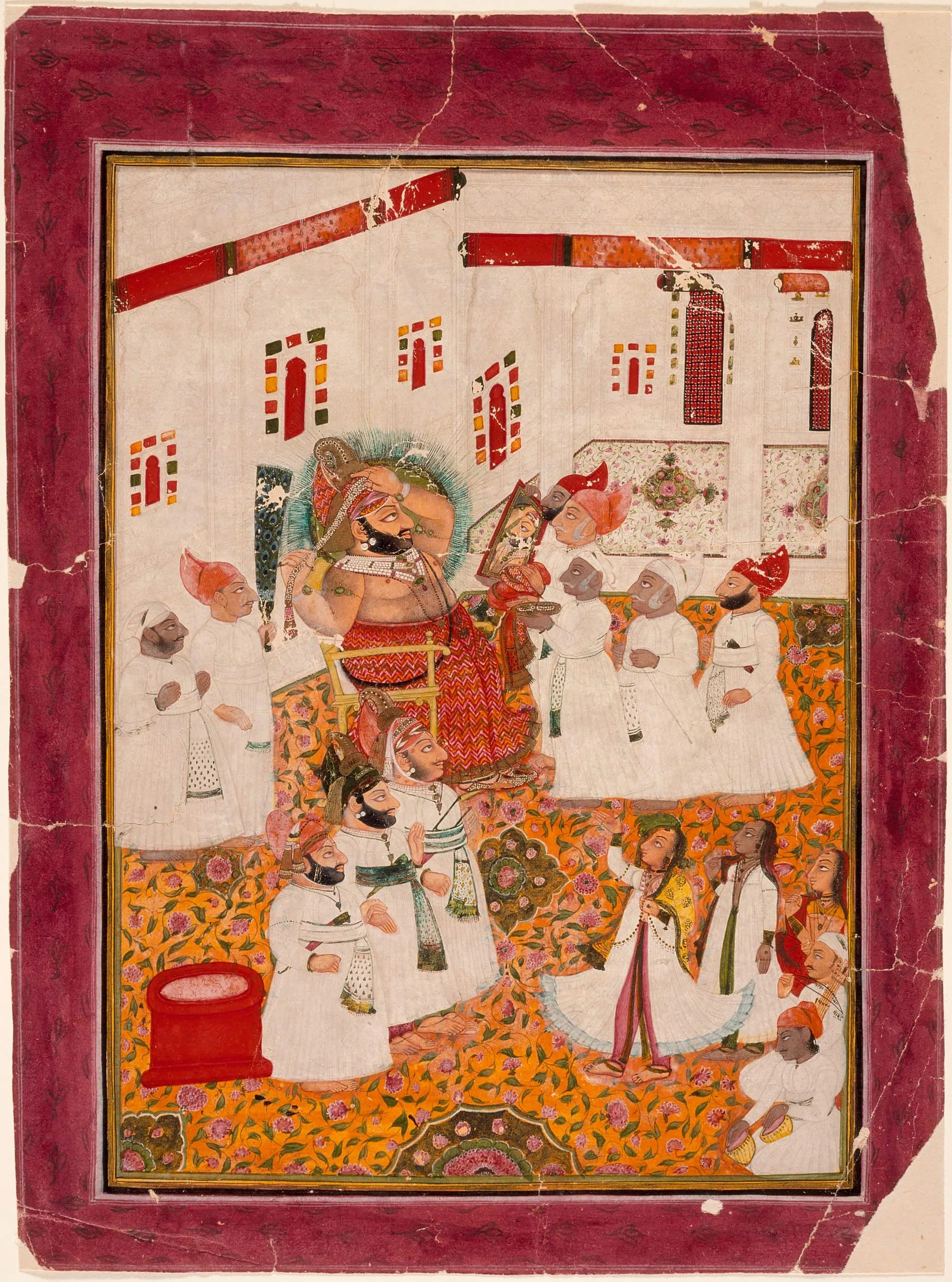
Maharana Bhim Singh of Udaipur (r. 1778-1828) was born in 1768, ascended the throne at age ten in 1778 under the regency of his mother Sadar Kanwar, and died in 1828. He was the 26th Maharana of Mewar (r. 1778-1818) and, after politically aligning Mewar with the English East India Company in 1818, the 1st Maharana of the Princely state of Udaipur (r. 1818-1828). Early in his reign Bhim Singh primarily commissioned portraits of himself hunting and in royal processions, but by circa 1800 his portraits were predominantly in palace settings attended by court women and servants. Here, he is shown seated in front a mirror held by a servant while tying his elaborate turban in preparation for the Teej Monsoon Festival. Mirrors are often represented in Bhim Singh portraits, both in mundane and erotic situations. European mirrors (called “looking glasses”) were imported in significant quantities for use in Mughal and Rajput courts.
According to the lengthy devanagari inscription on the reverse, the undated painting is by the renowned Udaipur and Devgarh artist Chokha (active circa 1799-1826), the son of the artist Bagta (active circa 1761-1814). The inscription also names several of the functionaries standing before Bhim Singh, including the jeweler, clothier, bard, and the two nauch dancers performing near the lower right corner. (Translation by Sridhar Andhare.) Slightly behind Bhim Singh, an attendant waves an honorific peacock feather fly whisk (morchal), a symbol of royalty.