- Title
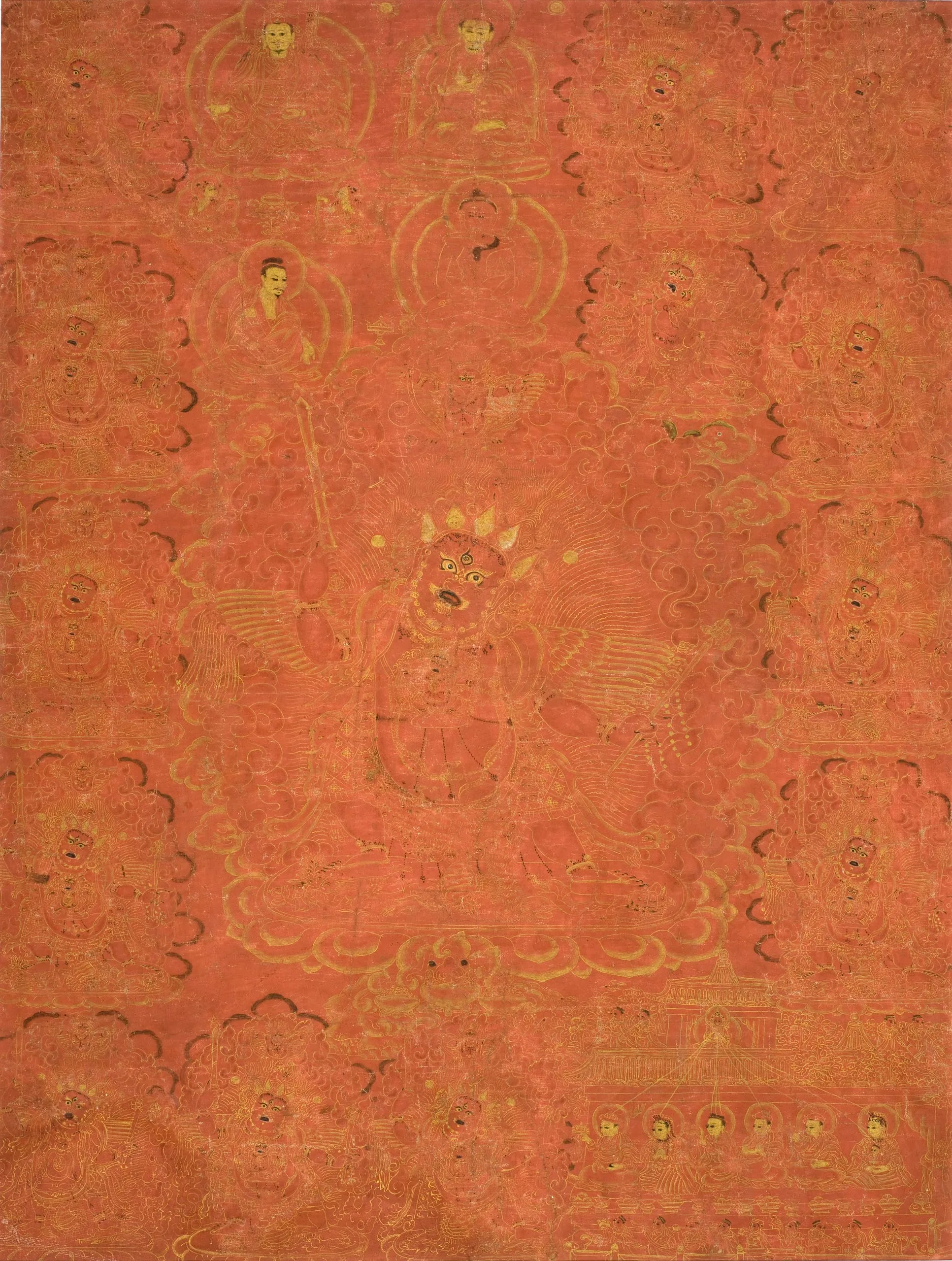
- Garuda-Feathered Hayagriva
- Date Made
- circa 1800
- Medium
- Mineral pigments and gold on cotton cloth
- Dimensions
- 29 1/2 x 22 1/4 in. (74.93 x 56.52 cm)
- Accession Number
- AC1993.190.1
- Curatorial Notes
The central subject of this red-field painting is an important meditational and protective deity of Vajrayana (esoteric) Buddhism, Hayagriva (Horse-Necked One), who is recognizable by the small horse’s head surmounting his crown. Thirteen smaller representations of Hayagriva surround him. Other personages include Padma Sambhava, the founder of the Nyingma (Old) order; a mahasiddha (perfected being); an embracing couple, probably the Primal Buddha Samantabhadra (Universal Goodness) embracing his consort Samantabhadri; and the mythical half-avian Garuda. In the bottom right corner is the Buddha Amitabha in a celestial palace connected with lines of radiance to the donor of the painting and his family, along with monks and religious figures.
This type of Tibetan painting (thangka) in which the figures are rendered in a linear technique drawn in gold against a red or black background is known in Tibetan as gser thang (a thangka in which the color gold predominates). See also M.83.253 and M.84.224.1.