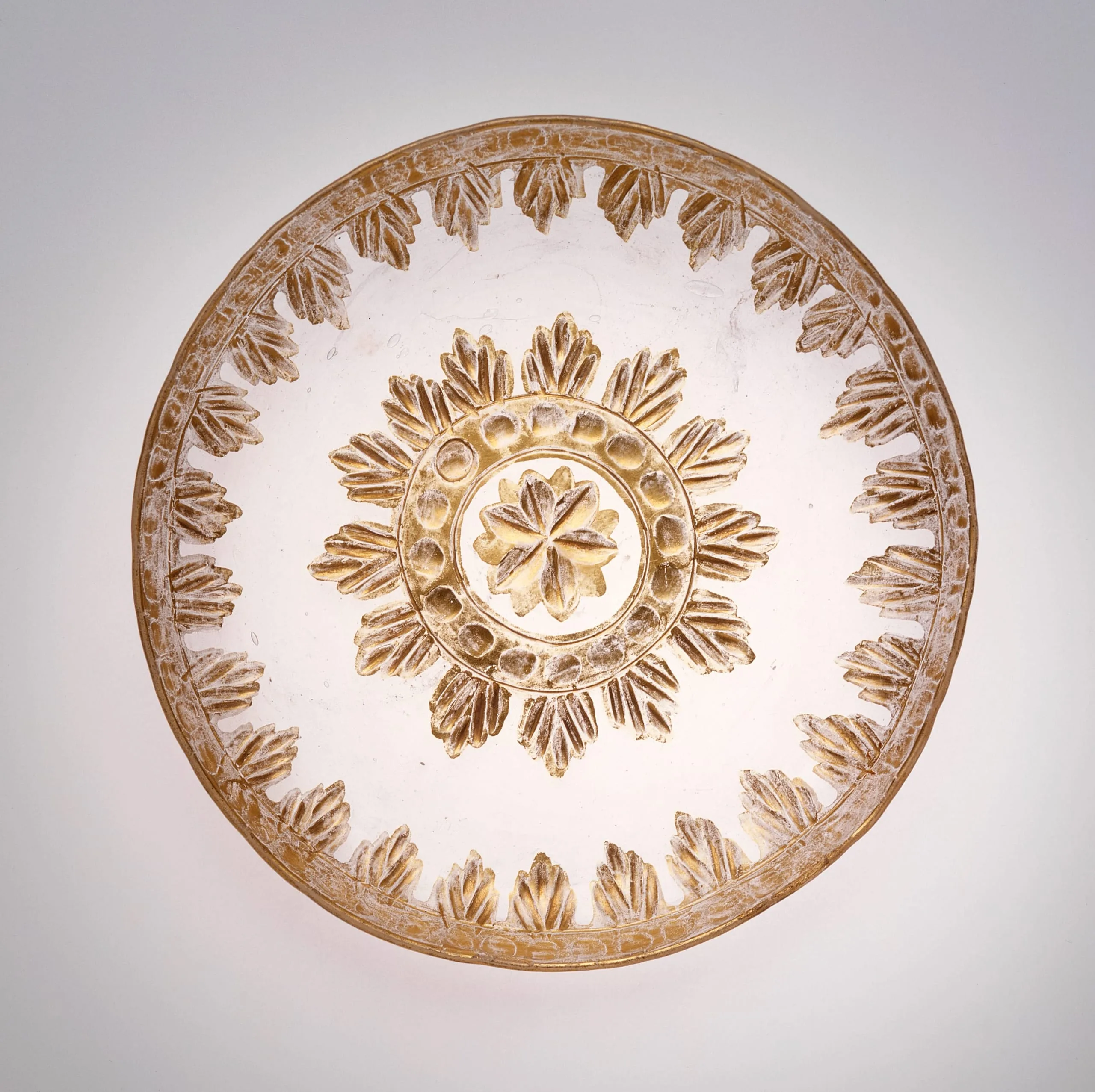
This small dish is made of colorless glass, which has inclusions of variously sized air bubbles. Its decoration consists of wheel-cut designs and partial gilding. In the center is a twelve-petaled blossom, perhaps intended as a lotus flower. It is surrounded by concentric band of concave roundels with an outer border of acanthus leaves. The acanthus leaf border is repeated on the inner edge of the rim, which is a band of concave ovals. Dishes with similar decoration are now in the National Museum, New Delhi (57.21/26) and the Bharat Kala Bhavan, Varanasi (9905).
Mughal and European historical accounts and extant examples document the production of glassware in Bihar, Gujarat, Lucknow, and Alwar, near the early Mughal capital of Agra. European glassworks from several centers of production were also imported in significant numbers (for example, see M.76.2.11 and M.2002.7.1).