LACMA

ShopMembershipMyLACMATickets
LACMA
Los Angeles County Museum of Art
5905 Wilshire Blvd.
Los Angeles, CA 90036
info@lacma.org
(323) 857-6000
Sign up to receive emails
Subscribe
© Museum Associates 2025

Museum Hours

Monday

11 am–6 pm

Tuesday

11 am–6 pm

Wednesday

Closed

Thursday

11 am–6 pm

Friday

11 am–8 pm

Saturday

10 am–7 pm

Sunday

10 am–7 pm


  • About LACMA
  • Jobs
  • Building LACMA
  • Host An Event
  • Unframed
  • Press
  • FAQs
  • Log in to MyLACMA
  • Privacy Policy
© Museum Associates 2025
Collections

Unknown
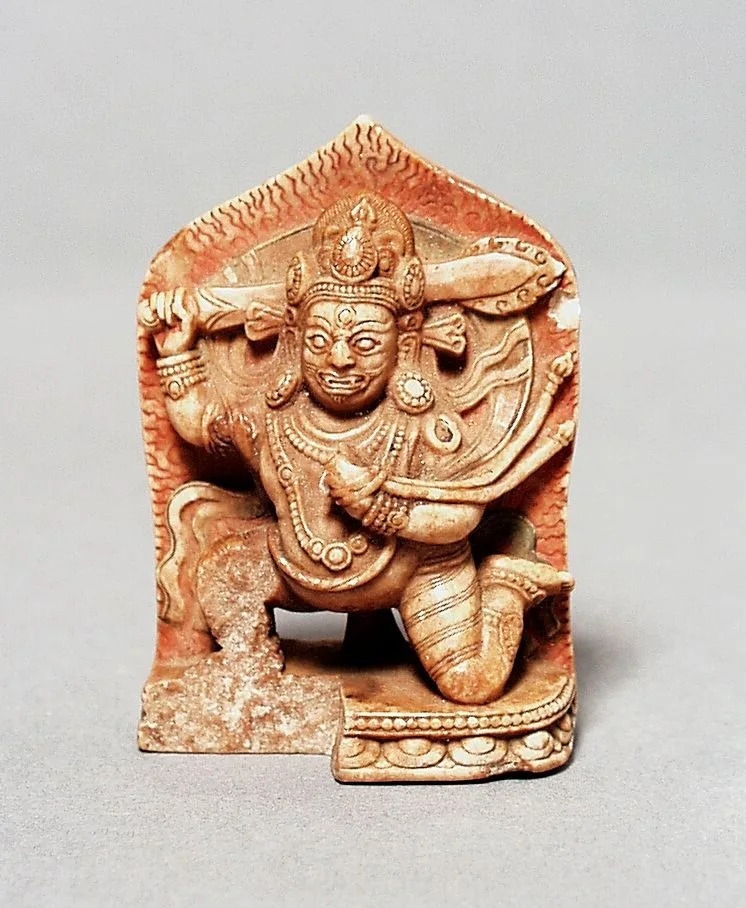
The Buddhist Protective Deity Achala13th century

Not on view
Small terracotta-toned relief sculpture of a crouching deity figure with a snarling face, crown, and beaded jewelry, set within a pointed arch niche on a lotus base
Artist or Maker
Unknown
Title
The Buddhist Protective Deity Achala
Place Made
Tibet
Date Made
13th century
Medium
Massive gypsum with paint
Dimensions
2 1/2 x 1 7/8 x 1 1/8 in. (6.35 x 4.76 x 2.86 cm)
Credit Line
Purchased with funds provided by Phil Berg Collection and the Indian Art Special Purpose Fund
Accession Number
AC1994.13.1
Classification
Sculpture
Collecting Area
South and Southeast Asian Art
Curatorial Notes

Achala (Immovable One), also known as Chandamaharoshana (Fierce and Great Wrathful One), is an angry manifestation of the Jina Buddha Akshobhya and his female aspect Mamaki in Vajrayana Buddhism in Tibet and Nepal. He is also the Regent of the North-East Direction (dikpala) and one of the major exoteric forms of Chakrasamvara in Nepal. Achala is believed to destroy all evil forces and obstructions (mara) with his anger (krodha). He typically holds in his right hand the flaming sword of wisdom, used to cut all obstacles and to purify all offerings.

Here, Achala wears a thunderbolt (vajra) in his crown. Besides his sword in his right hand held behind his head, he also holds a now-damaged wishing gem (chintamani) in his left hand. He has a ferocious visage and a flaming aureola (prabhavali). He stands in a variant of the militant posture (alidha asana) with his right leg bent forward and supported by his left knee.

See also M.71.98.1, M.84.171.1, and AC1995.39.1. See Himalayan Art Resources, no. 85773, https://www.himalayanart.org/items/85773