- Title
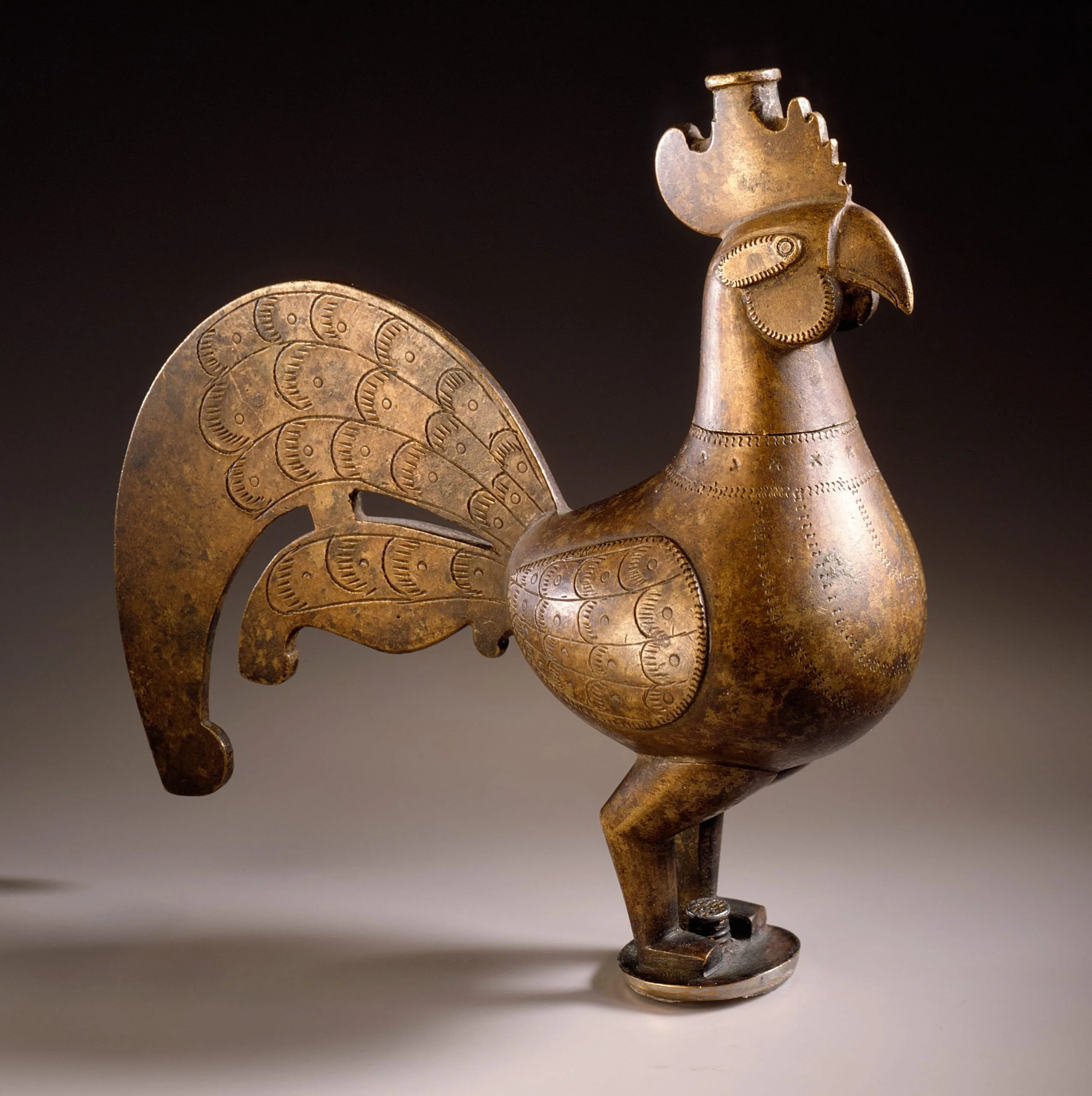
- Oil Lamp (samai) Finial in the Form of a Rooster
- Date Made
- 17th century
- Medium
- Copper alloy
- Dimensions
- 6 1/4 x 2 1/2 x 6 3/4 in. (15.88 x 6.35 x 17.15 cm)
- Accession Number
- AC1993.152.1
- Curatorial Notes
This zoomorphic finial from an oil lamp is fashioned in the form of a rooster. Although similar in appearance to a peacock, it is differentiated anatomically by the presence of the fleshy growth on top of his head called a comb or cockscomb, and by the long curved tail feathers cascading downward, called sickle feathers. In place of these features, a peacock has a crest of upright feathers atop his head and a long horizontal tail of covert feathers called a train, which is fanned laterally during courtship rituals (see AC1995.152.1). In terms of its chased details, however, the pattern depicted on its tail and wing feathers resembles the eyespots or ocelli on a peacock’s tail feathers. This anomaly may represent artistic ambiguity or a fanciful hybridity.
The body of the rooster serves as the fuel reservoir, which could be filled with an animal fat such as ghee or a plant-based oil. It is accessed by unscrewing the rooster’s head, which is joined at the base of the neck. The wick from the reservoir would pass through the nozzle protruding vertically out of the comb. The rooster stands on a flat disk with a threaded screw for mounting it on a base or columnar lamp (see M.84.227.8 and AC1995.152.1).