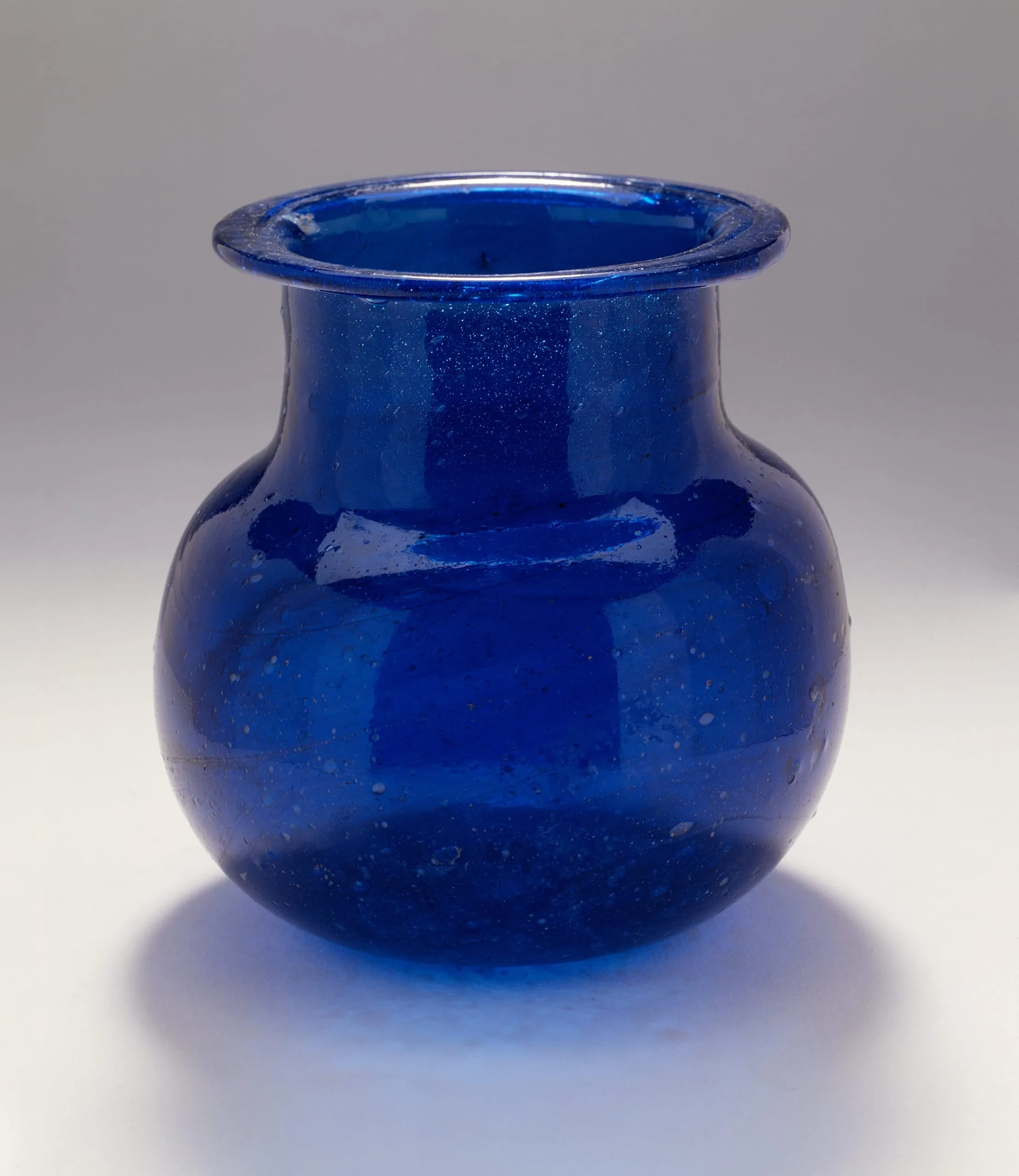
The ubiquitous South Asian water vessel or lota can take several morphological forms, including spherical, oblate or compressed spheroid, and bulbous. Typically made of metal, glass, or earthenware, lotas are chiefly distinguished by a thick or moderate neck, a wide mouth, and a flaring or flat rim. They can also have a spout, handle, and/or foot. This example has a spherical body, rounded shoulders, a thick vertical neck, and a flat rim.
Large numbers of rich monochrome glass vessels were produced in the city kilns of Kapadwanj near Ahmedabad during the 17th through early 19th centuries. The most common colors are peacock blue, dark blue, and deep green, with amber, violet, and wine red also featured. Kapadwanj glass is characteristically opaque or translucent with noticeable impurities. The glass is brittle and often comparatively thick, even though the vessels are blown rather than molded. Elegant and lyrical forms distinguish Kapadwanj glass, with rosewater sprinklers, wine cups, water tumblers, spouted pouring vessels, and bird-shaped inkwells being the most popular. The glass vessels typically derive their shapes from forms found in earlier Timurid and Mughal metalware and hardstone carving. Extensive glass production continued at the site until the early 19th century when technically superior English lead glass began to be favored in the Indian marketplace. See M.89.83.1a-b–.10.