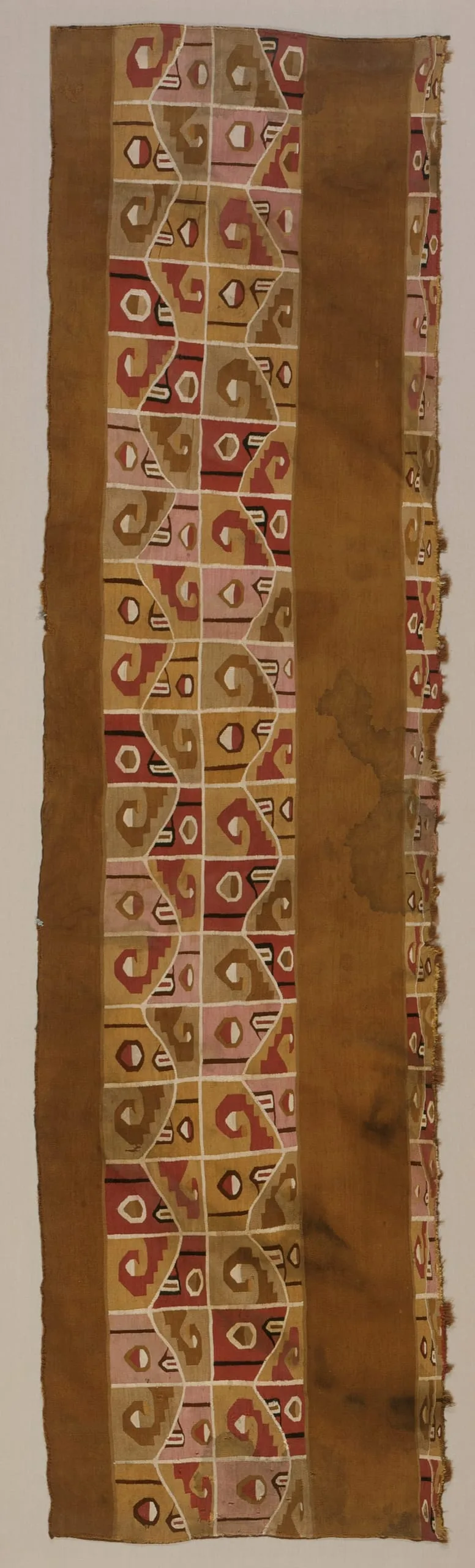
Tunics were constructed from two long lengths of tapestry woven on a horizontal stake loom. The pieces were whipstitched together down the center leaving an opening for the head, then folded over and sewn up the sides leaving the sleeve openings free. On a man about 5 feet 7 inches tall, a tunic reached the knees and extended over the shoulders to just above the elbows.
This woven pattern is a variant on the abstracted human-feline, with the N-shape representing pointed teeth replaced by a horizontal U-shape to indicate a human rather than animal mouth. Like the “eye” in the keyhole, the curl of the stepped fret is split into two colors, blurring the distinction between the “real” eye and the curl pattern and giving abstracted form equal importance with recognizable content.
Viewing the tunic in a horizontal format literally brings a new perspective to the compression of motifs as they progress toward the tunic’s sides. Wari weavers, along with Wari architects, shared a fascination with their landscape’s horizon. Observed horizontally, the motifs condense and diminish in size as they move “away” toward the top of the loom—the weaver’s conceptual horizon.
Only one-half of the tunic made it into the collection, and it is not known what happened to the other half. It may have been damaged and was removed by an early owner or dealer, or perhaps the garment was deliberately split in two by a thrifty dealer to sell as separate items.
Nicole LaBouff via Kaye Spilker
2009