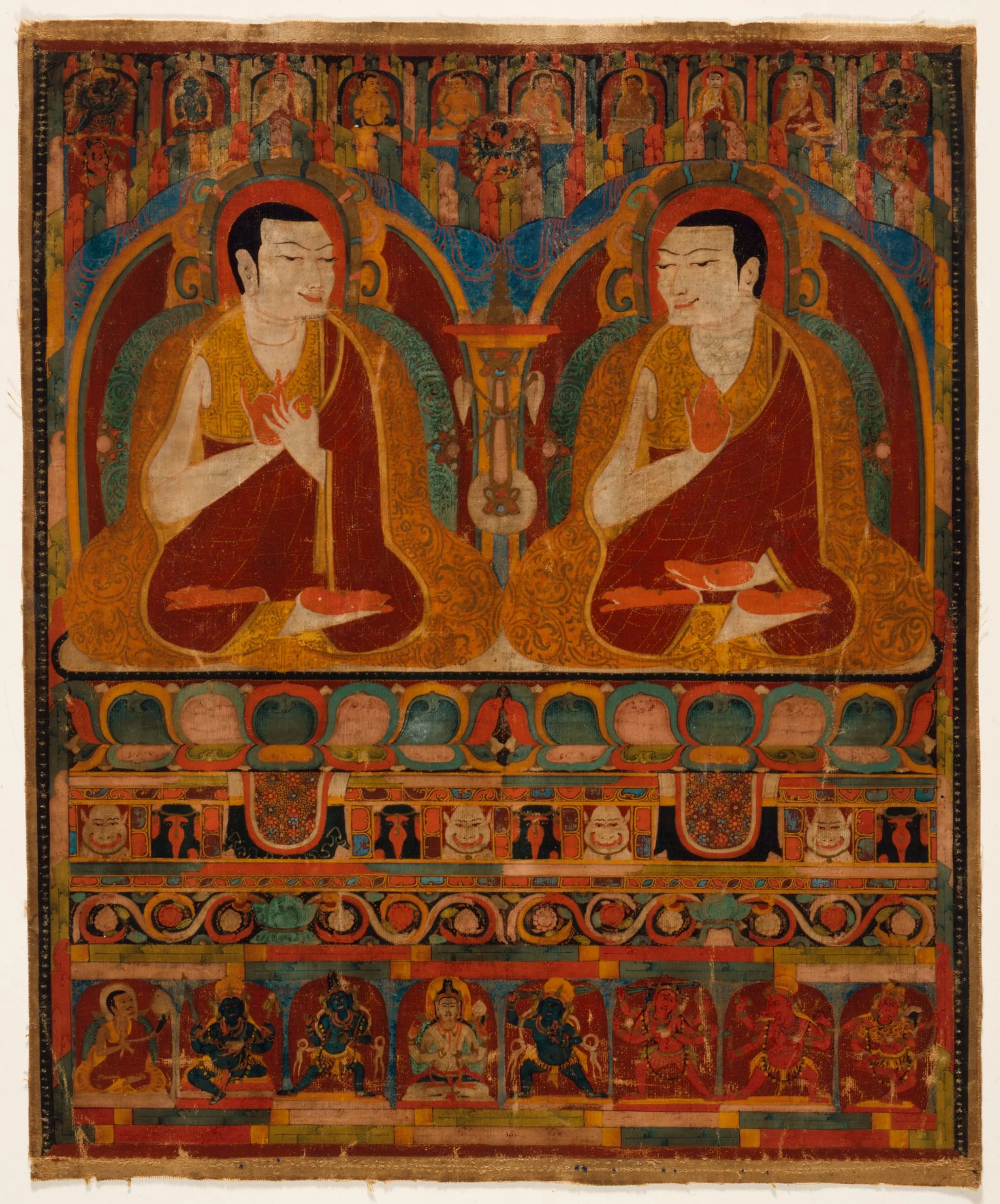
These portraits of the Second and Third Taklung Abbots engaged in a religious debate are from a set of paintings illustrating the lineage of the Taklung branch of the Kagyupa order, which had been founded in central Tibet in the 11th century by the Indian-trained Tibetan monk Marpa (1012–1097). As competition for patronage and political power rose between the different Tibetan religious institutions, lineage paintings were created to illustrate the unbroken chain of transmission of their sect's teachings back to the historical Buddha Shakyamuni (563-483 BCE). Each monk is seated in a meditative posture upon a lotus throne in a stylized mountain cave created from multicolored "mountain-staves" derived from the painting tradition of eastern India. Patron deities and the lineage of the Taklung teachers are depicted in the upper registrar. The chronological lineage begins with Vajradhara, the celestial progenitor of the order's teachings in the upper left corner, followed by Tilopa, Naropa, Marpa, Milarepa, and Gampopa. The lineage is interrupted by the figures of Phakmodrupa (1110-1170), the founder of Densatil monastery (left), and Tashipel (1142-1210), the founder of Taklung (right), directly above the heads of the two monks. It was customary to depict the immediate teacher directly above the head of the individual honored in the painting. The monk patron and the sect's guardian deities are portrayed in the lower registrar. See Jane Casey, Taklung Painting: A Study in Chronology (Chicago: Serindia Publications, 2023), pp. 431-432, no. 60.