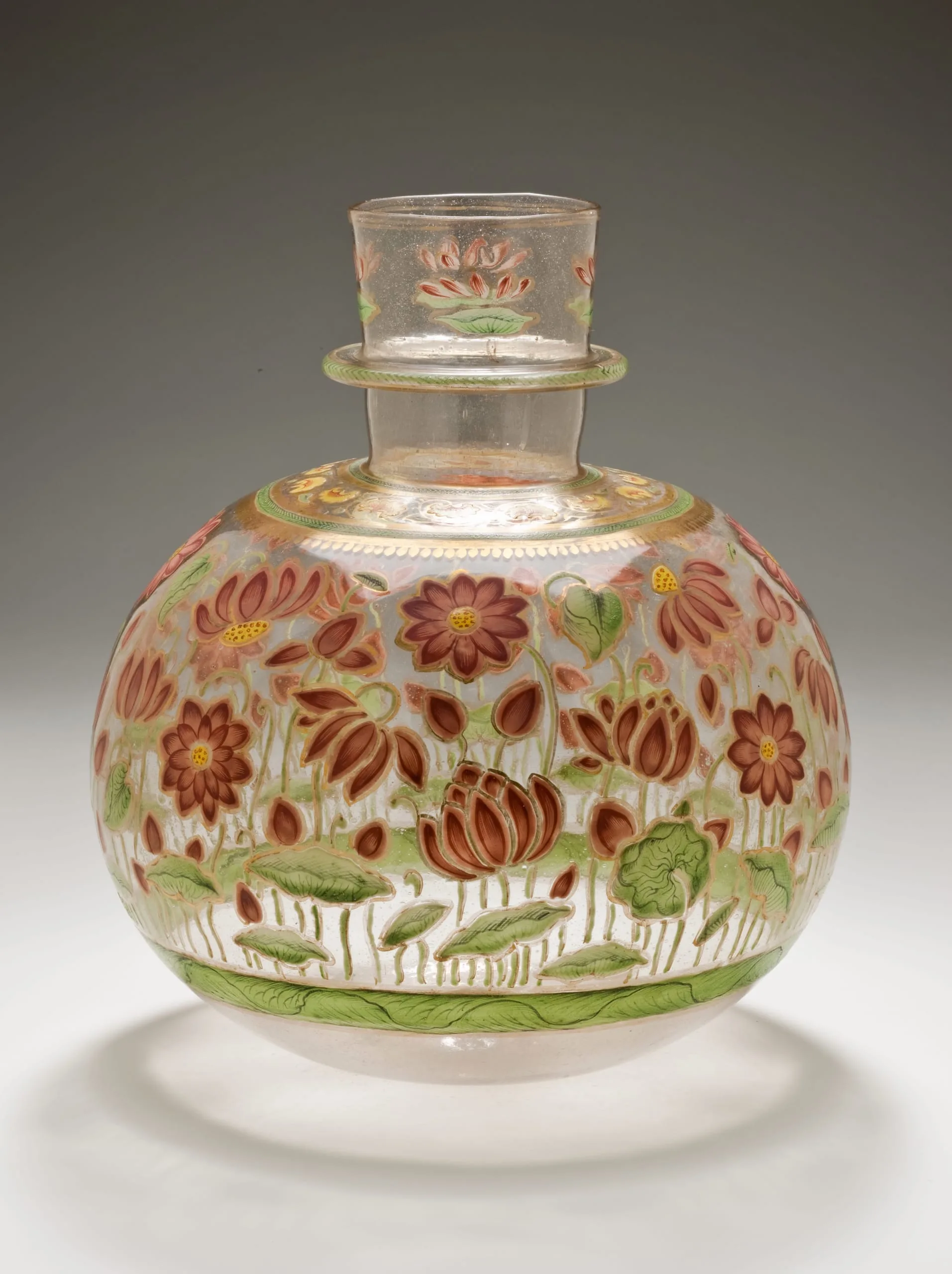
The most often published South Asian decorative art object in LACMA’s renowned collection is a glass hookah base emblazoned with a lush lily pond blooming over the surface of the clear glass vessel in a riot of vegetation and color. Brilliant red, pink, and yellow enamel lotus blossoms atop graceful green and gold stems and light green lily pads and leaves with dark green veins rise from a tubular curled leaf motif that forms a ground line along the bottom of the body. Chevrons and a lotus leaf creeper accent the neck and shoulder, and four flowering lotuses appear on the upper neck.
The LACMA hookah base was presumably made in Lucknow, the capital of the Mughal province of Awadh in the present-day state of Uttar Pradesh. Its Lucknow genesis is suggested by the identical stylistic treatment of the lotuses on a flat-bottomed hookah base in the Indian Museum, Calcutta (14051/282), which is recorded as being from Lucknow. Whereas the denseness of the lotuses precludes an attribution to the 17th-century heyday of the Mughal artistic tradition of individual flowering plants, the verticality and repetition of the motifs equally belie their placement within the distinctive corpus of Lucknow’s mature floral decoration that bloomed in the late 18th century. Hence, the vessel can be plausibly attributed on stylistic grounds to the first half of the 18th century, which accords well with parallel depictions of lotuses found in contemporaneous album paintings and an enameled and partially gilded silver betel box from Lucknow in the Victoria and Albert Museum, London (IM.30-1912). The close stylistic relationship of Lucknow’s early floral imagery to the Mughal artistic repertoire is to be expected given the many years of high-level service at the Mughal court in Delhi by the early governors of Lucknow and their adoption of Mughal royal symbolism and patronage patterns.
See Stephen Markel, Molten Treasures. Review of Mughal Glass: A History of Glassmaking in India, by Tara Desjardins (New Delhi: Roli Books, 2024) in Marg 76:2 (September – December 2024): p. 111, fig. 7.