- Title
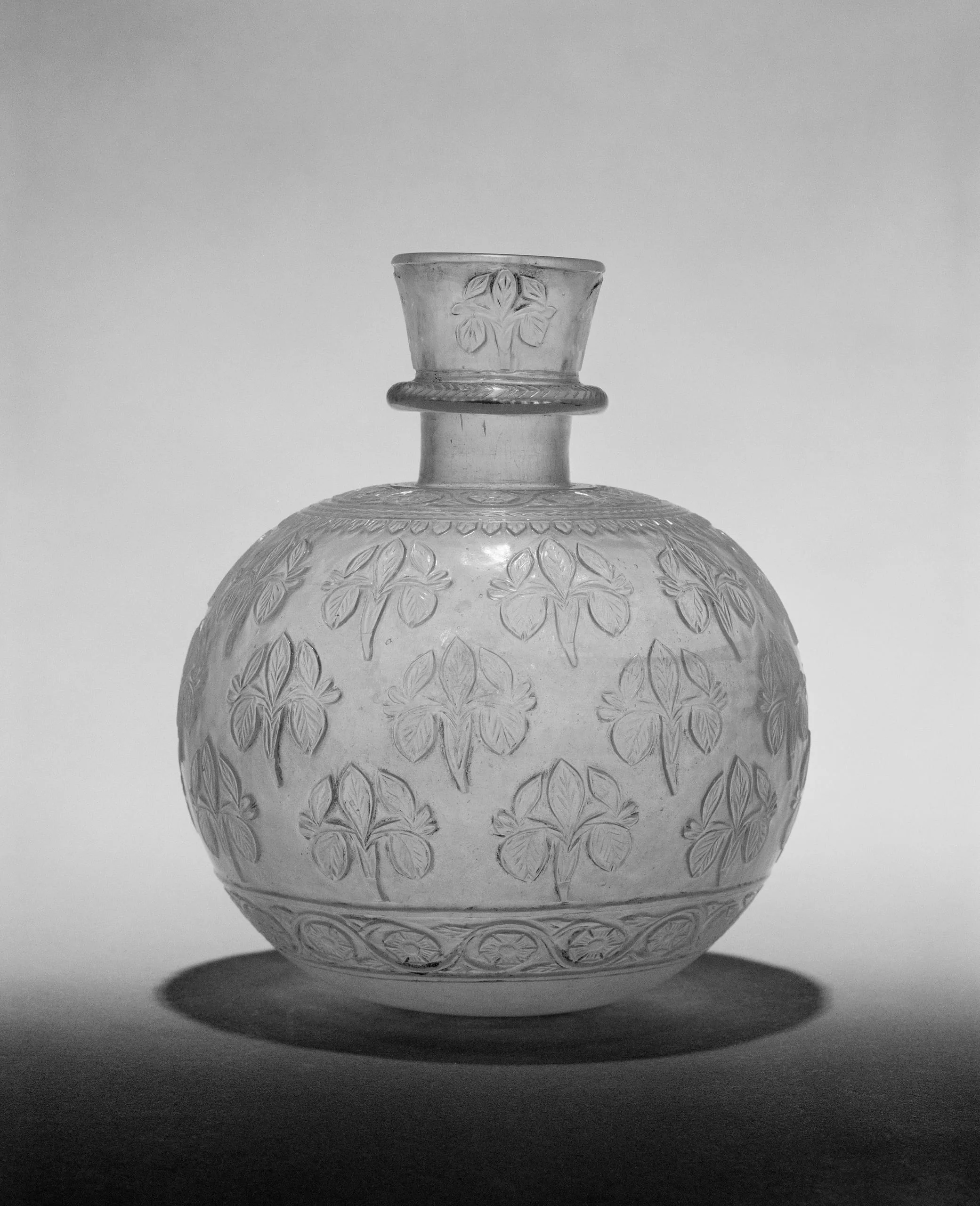
- Hookah Base
- Date Made
- circa 1700-1750
- Medium
- Translucent glass with molded and wheel-cut decoration
- Dimensions
- 7 1/2 x 6 3/8 in. (19.05 x 16.19 cm)
- Accession Number
- M.76.2.22
- Curatorial Notes
The slightly milky translucent glass hookah base has molded and wheel-cut decoration. It is enlivened with a diaper pattern of iris or champak sprays on the body and four similar sprays in the arcade above the projecting molding in the neck. Bands of scrolling vines with open poppy blossoms serve as matching borders on the shoulders and beneath the central field of flowers. Additional concentric bands of decoration on the shoulder include marching chevrons and pendant acanthus leaves. The edge of the projecting molding is embellished with marching chevrons.
Irises are perennial plants with dramatic lobed flowers. The genus has some 300 species, with Iris kashmiriana and Iris hookeriana among the most prolific in South Asia. Irises have long been used in India for medicinal purposes and were favored flowering plants in the Mughal artistic repertoire. Champaks (Magnolia champaka) are the highly fragrant flowers of an evergreen tree in the Magnolia family. They have been used in South Asia since ancient times for garlands and religious offerings, and are particularly associated with the worship of Maitreya in Buddhism and Krishna in Hinduism. Their essential oils are used in creating fragrances.
- Selected Bibliography
- Rosenfield, John. The Arts of India and Nepal: The Nasli and Alice Heeramaneck Collection. Boston: Museum of Fine Arts, Boston, 1966.
- Markel, Stephen. "Indian and 'Indianate' Glass Vessels in the Los Angeles County Museum of Art." Journal of Glass Studies 33 (1991): 82-92.
- Desjardins, Tara. Mughal Glass: a History of Glassmaking in India. New Delhi: Roli Books, 2024.