- Title
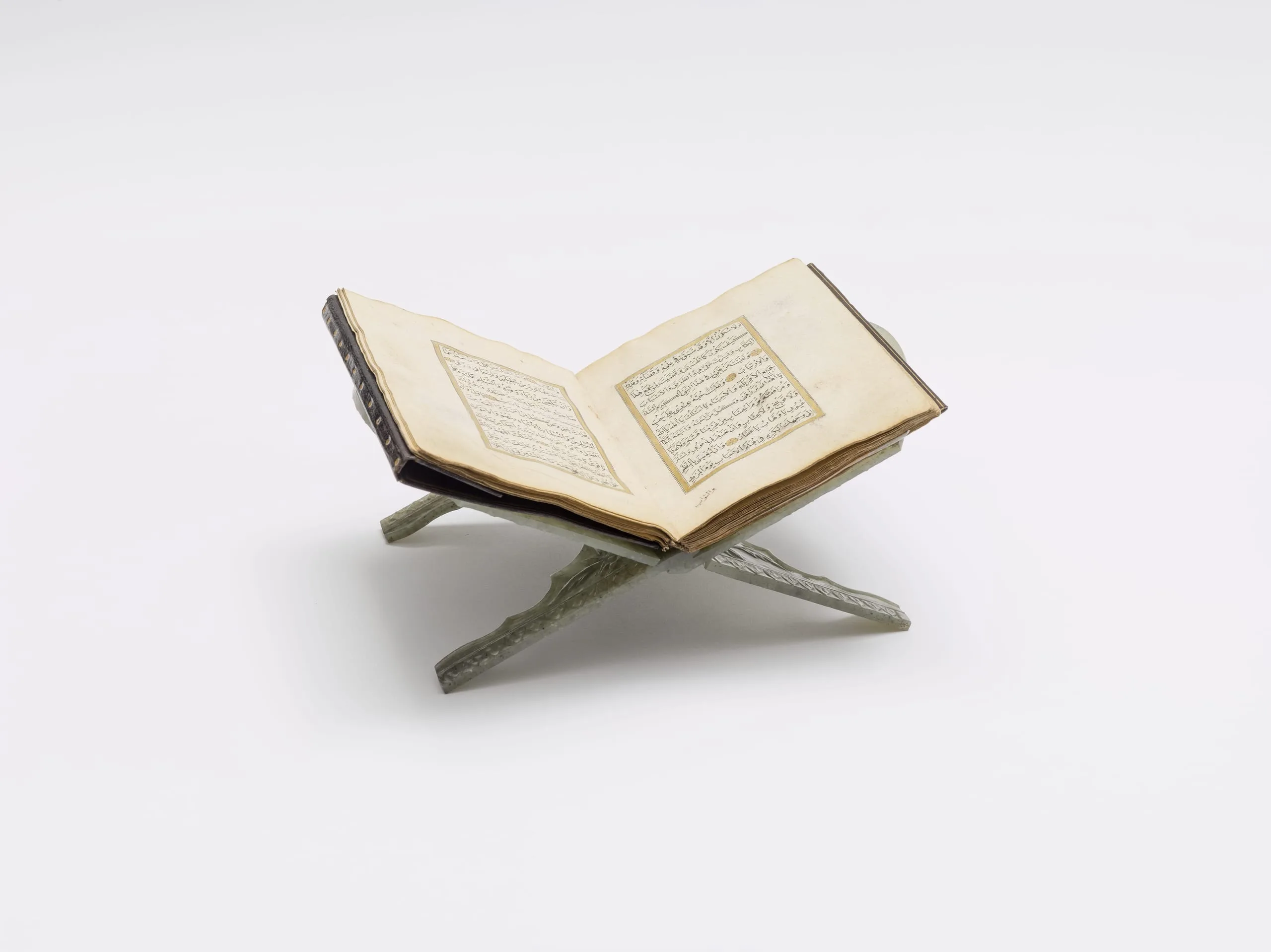
- Qur'an Stand (rehal)
- Date Made
- 19th century
- Medium
- Light green nephrite jade
- Dimensions
- 9 1/2 x 6 3/16 x 3/8 in. (24.13 x 15.72 x .95 cm)
- Accession Number
- M.76.2.19
- Curatorial Notes
Ingeniously fashioned from a single slab of jade, this Qur’an stand features a hinge made of interlocking tabs, known as knuckles, rather than pivoting on an inserted pintle. The leaves of the opened joint form a V-shaped support for a book, which was used during reading and reciting scripture. The exterior upper surfaces are embellished with low relief representations of a stylized flowering plant with a broad overhang of fronds and fruit, and Mughal-style folded-over ground leaves growing out of a rocky mound. It is perhaps intended as a Tree of Life. The bookstand’s hemispherical top and vertical sides have an outer border of upright triangles with solid interstices. The basal border of the upper section is a horizontal row of linked lozenges. The feet of the stand are in the form of a lobed ogival arch with a blossom and splayed foliage in the interstices.
Qur’an stands and bookstands for Hindu and Sikh religious texts have been made in a range of materials. The most common is wood, sometimes inlaid with mother-of-pearl and/or lacquered. Additional mediums include jade, jade simulants, precious metals, and monolithic stone. For a jade simulant example, see M.73.5.118.
- Selected Bibliography
- Rosenfield, John. The Arts of India and Nepal: The Nasli and Alice Heeramaneck Collection. Boston: Museum of Fine Arts, Boston, 1966.
- Komaroff, Linda. Beauty and Identity: Islamic Art from the Los Angeles County Museum of Art. Los Angeles: Los Angeles County Museum of Art, 2016.