- Title
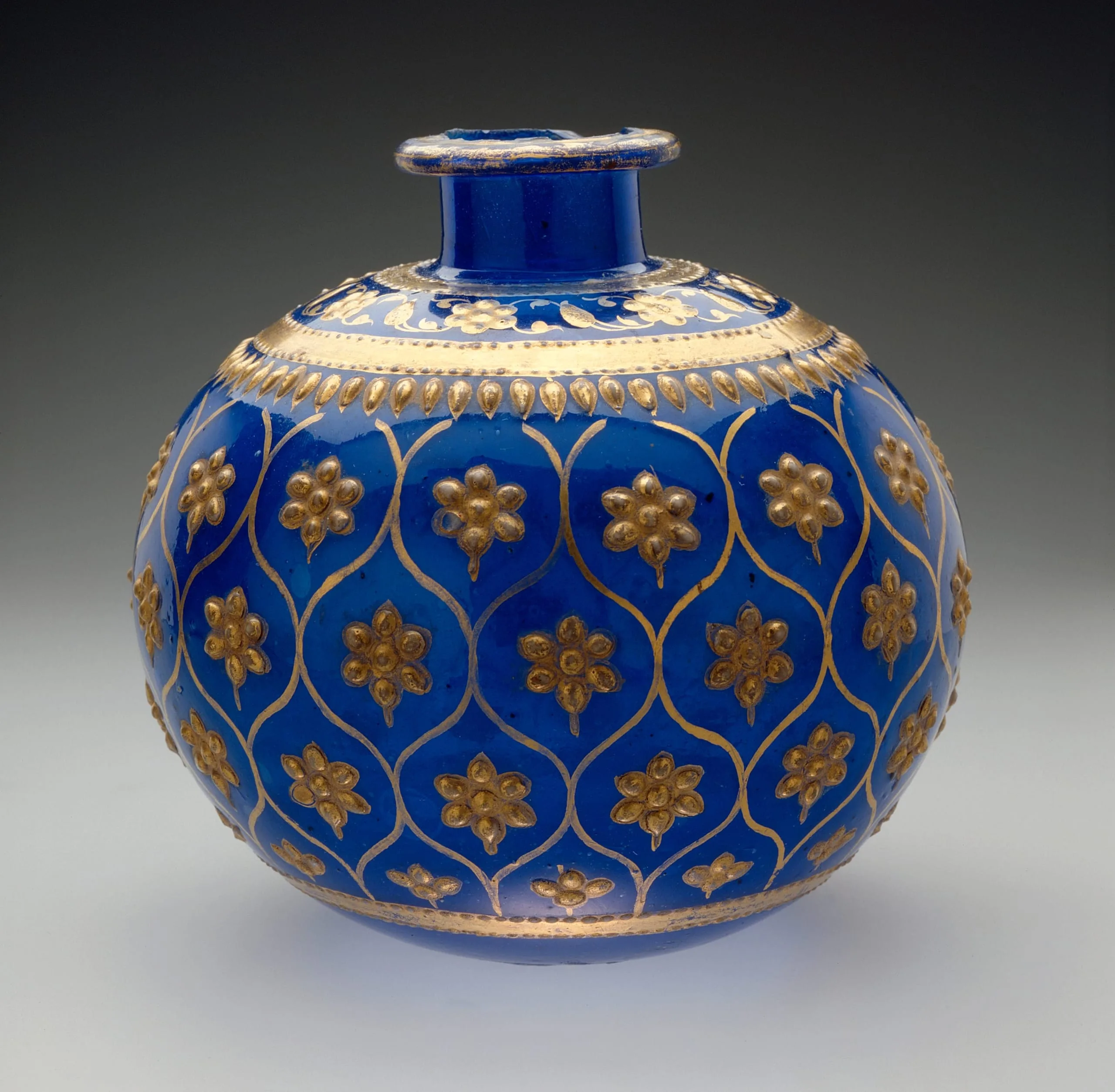
- Hookah Base
- Date Made
- circa 1725-1775
- Medium
- Cobalt blue glass with gilding over appliqué glass pieces
- Dimensions
- 6 x 6 3/16 in. (15.24 x 15.72 cm)
- Accession Number
- M.76.2.20
- Curatorial Notes
This hookah base is fashioned from cobalt blue glass with partial gilding. The primary decoration consists of stylized seven-point floral sprays formed with appliqué glass pieces set in a diaper pattern within a painted lattice. The shoulder is embellished with two plain bands of gilding bordered by small appliqué glass beads. Between the bands is a scrolling vine with blossoms. Beneath the lower band are pendant ovate leaves. An identical plain band of gilding with bead borders forms the basal border. The atypical truncated form of the mouth terminating unevenly above the projecting molding is due to breakage and the subsequent removal of the remainder of the upper neck.
Cobalt blue glass is made by introducing a cobalt compound, typically cobalt oxide, into the molten glass mixture. The resultant deep blue glass was ground and used as a distinctive blue pigment, known as smalt, since ancient times in the West and South Asia. Smalt was used to make the blue underglaze on Chinese ceramics as early as the 11th century. European cobalt blue glassware is traditionally regarded as originating in Bohemia in the 16th century. The heyday of cobalt blue glassware made in India was during the 18th century in the Mughal dominions, particularly in Gujarat, and in the Deccan.
- Selected Bibliography
- Rosenfield, John. The Arts of India and Nepal: The Nasli and Alice Heeramaneck Collection. Boston: Museum of Fine Arts, Boston, 1966.
- Markel, Stephen. "Indian and 'Indianate' Glass Vessels in the Los Angeles County Museum of Art." Journal of Glass Studies 33 (1991): 82-92.
- Desjardins, Tara. Mughal Glass: a History of Glassmaking in India. New Delhi: Roli Books, 2024.