LACMA

ShopMembershipMyLACMATickets
LACMA
Los Angeles County Museum of Art
5905 Wilshire Blvd.
Los Angeles, CA 90036
info@lacma.org
(323) 857-6000
Sign up to receive emails
Subscribe
© Museum Associates 2026
  • About LACMA
  • Jobs
  • Building LACMA
  • Host An Event
  • Unframed
  • Press
  • FAQs
  • Log in to MyLACMA
  • Privacy Policy
© Museum Associates 2026
Collections

Master of the Fiesole Epiphany
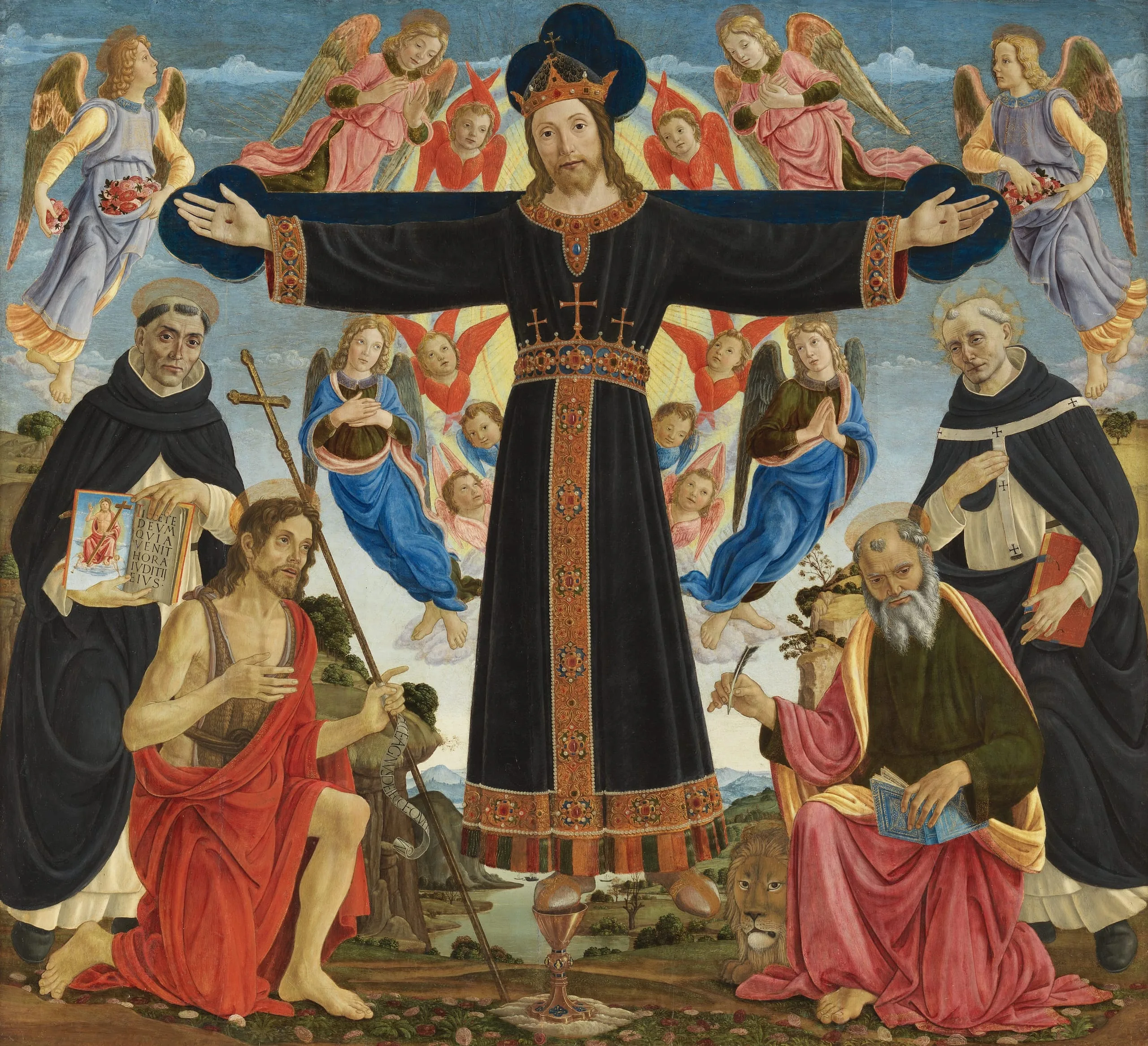
Christ on the Cross with Saints Vincent Ferrer, John the Baptist, Mark and Antoninuscirca 1491-1495

On view:
Geffen Galleries, floor 2
Renaissance panel painting, central crowned figure in jeweled black robe with arms outstretched, surrounded by angels, flanked by four saints in a landscape setting
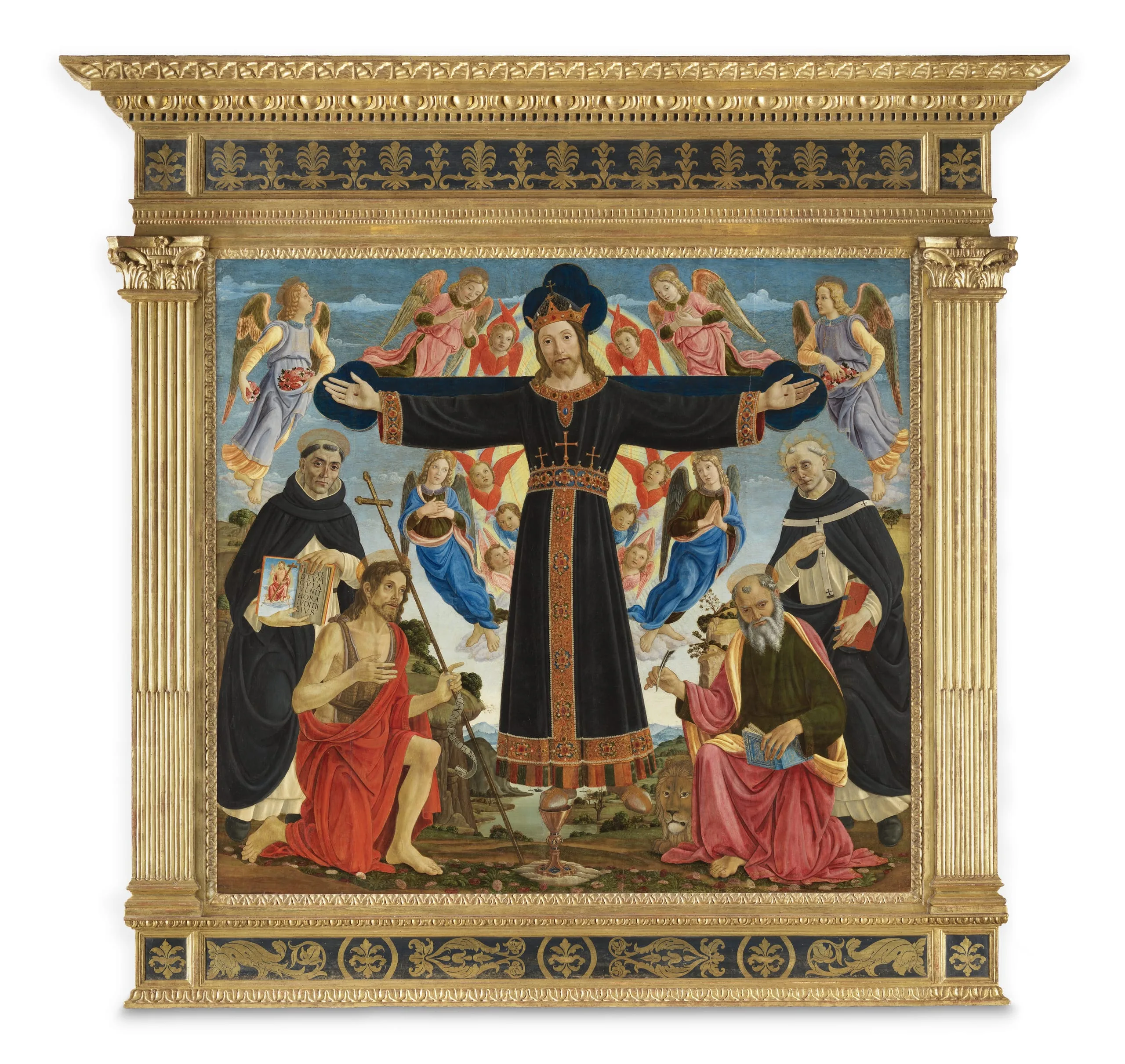
Tempera panel painting in an elaborate gilt frame with fluted pilasters and foliate frieze. A crowned central figure in dark blue robes with gold embroidery stands with arms outstretched, flanked by two standing figures in black habits and two seated figures in red and pink robes. A choir of angels in blue, pink, and red fills the upper register against a light sky.

Master of the Fiesole Epiphany, Christ on the Cross with Saints Vincent Ferrer, John the Baptist, Mark and Antoninus, circa 1491-1495, Los Angeles County Museum of Art, Gift of The Ahmanson Foundation, photo © Museum Associates/LACMA

Artist or Maker
Master of the Fiesole Epiphany
Italy, Florence, active circa 1450-1500
Title
Christ on the Cross with Saints Vincent Ferrer, John the Baptist, Mark and Antoninus
Date Made
circa 1491-1495
Medium
Tempera and oil (?) on panel
Dimensions
72 3/4 x 79 3/4 in. (184.79 x 202.57 cm) Framed: 120 × 101 × 15 in. (304.8 × 256.54 × 38.1 cm)
Credit Line
Gift of The Ahmanson Foundation
Accession Number
M.91.242
Classification
Paintings
Collecting Area
European Painting and Sculpture
Curatorial Notes

The Master of the Fiesole Epiphany depicts Christ affixed to a cross and flanked by four saints specific to the Dominican church of San Marco, Florence, for which the artwork was intended. The portrayal of Christ references the Holy Face of Lucca (Volto Santo di Lucca), an ancient wood sculpture attributed to Nicodemus, a Pharisee who, according to legend, assisted in the burial of Christ. After contemplating the Holy Face, Nicodemus purportedly sculpted the body of Christ as he remembered it, with angels completing the head while he slept. The Volto Santo, reportedly discovered in a Holy Land cave in the late eighth century, was miraculously transported to the port of Luni on a crewless boat. Installed in Lucca’s San Martino cathedral in 780, the oversized sculpture became a pilgrimage site for European devotees. It was particularly revered by the Cloth Makers’ Guild of Lucca, which adorned it with a richly lined ankle-length tunic (colobrium) and an imperial crown. The textile is meticulously rendered in the present altarpiece.

Although the patronage of the altarpiece remains uncertain, its iconography closely aligns with the church and the guild, reflecting Lucca’s history as a thriving silk center before its annexation by Florence. This prompted many weavers to relocate to Florence, where the Silk Weavers’ Guild took over the care of San Marco from August 5, 1427. Completed in the late fifteenth century, the altarpiece would have made a profound impression on worshippers entering San Marco, serving as a testament to the guild’s legacy and a reminder of the vibrant artistic culture of Lucca.

2024

Provenance

San Marco, Florence, until ca. 1582. Compagnia della Santa Croce, parish of San Michele Bisdomini, Florence, probably until ca. 1796–98. William Young Ottley (1771–1836), London, probably by 1798, and sold by his estate to; (1) Edward Solly (1776–1844), (2) London and Berlin (estate sale, London, Christie’s, 8 May 1847, lot 13, as Cosimo Rosselli, “formerly in the collection of the late Young Ottley, Esq.,” sold to); [B. J. Smith]. (3) William Fuller Maitland (1813–1876), Stansted House, Essex, by 1854, by inheritance to his son; William Fuller-Maitland (1844–1932) Stansted House, Essex (sale, London, Christie’s, 10 May 1879, lot 106, as Cosimo Rosselli. (Sale, London, Christie’s, 14 July 1922, lot 69, to); Leopold Hirsch (1857–1932), London (estate sale, London, Christie’s, 11 May 1934, lot 132, to); [J. Howard, London, for]; Benjamin Seymour Guinness (1868–1947),(4) New York, Mignano, Italy, and Switzerland, by descent to his son; (5) Capt. Thomas Loel Evelyn Bulkeley Guinness (1906–1988), (6) London and Epalinges, Switzerland, sold in 1991 by his estate through; [Harrari and Johns, Ltd., London, sold 1991 to]; LACMA.

Footnotes

(1) Regarding the art historian, writer, collector, and dealer William Young Ottley, see Waagen 1838, pp. 121–26, Geer 1953, and Waterhouse 1962.

(2) Edward Solly was an English timber merchant living in Germany. In 1821 the Prussian State purchased three thousand paintings from his collection, which became the nucleus of what is now the Gemäldegalerie in Berlin. Solly made his fortune in timber but later, in London, was a dealer in paintings, saving, however, the best, including the Volto Santo for himself. For Solly, see Herrmann 1967–68.

(3) According to an annotated sale catalogue quoted by the Getty Provenance Index, Sales Catalogues Database. One catalogue notes "Smith of Bond St."

(4) Lieut. Benjamin Seymour Guinness RN was trained as a lawyer and made a fortune as director of the New York Trust Co., Lackawanna Steel Co., Kansas City Southern Railway, Seaboard Air Line, Duquesnie Light Co., and United Railroads of San Francisco. He was the younger brother of Arthur Guinness, the Guinness brewery’s founder.

(5) Guinness took the painting to his home in Mignano about 1936, when he married Marchesa Maria Nunziante di Mignano, the daughter of Mariano Nunziante, duke of Mignano. The altarpiece was stored in Leghorn during World War II and thus avoided destruction with the house in Mignano in 1943. About 1950, following Benjamin Guinness’s death in 1947, the painting was taken to a Guinness home in Switzerland, where it was kept in storage until it was discovered in 1991, following the death of Thomas Loel Evelyn Bulkeley Guinness and the assessment of his estate.

(6) Thomas L. E. B. Guiness, Benjamin’s son and heir from his first marriage (1902) to Bridget Williams Bulkeley, was a member of Parliament for Bath (1931–45), a businessman, and a philanthropist.
Selected Bibliography
  • Caroselli, Susan L. Italian Panel Painting of the Early Renaissance. Los Angeles: Museum Associates, Los Angeles County Museum of Art, 1994.

  • Guggenheim, Barbara. Art World: the New Rules of the Game. Beverly Hills: Marmont Lane Books, 2016.
  • Lehmbeck, Leah, editor. Gifts of European Art from The Ahmanson Foundation. Vol. 1, Italian Painting and Sculpture. Los Angeles: Los Angeles County Museum of Art, 2019.
  • Exhibition of Early Italian Art: From 1300 to 1550. London: The New Gallery, Regent Street, 1893.
  • Migliore, Ferdinando Leopoldo del. Firenze città nobilissima. Firenze: Nella stamp. della Stella, 1684.

Related Unframed

Related Unframed

Design Inspiration
Design Inspiration
  • December 26, 2013