- Title
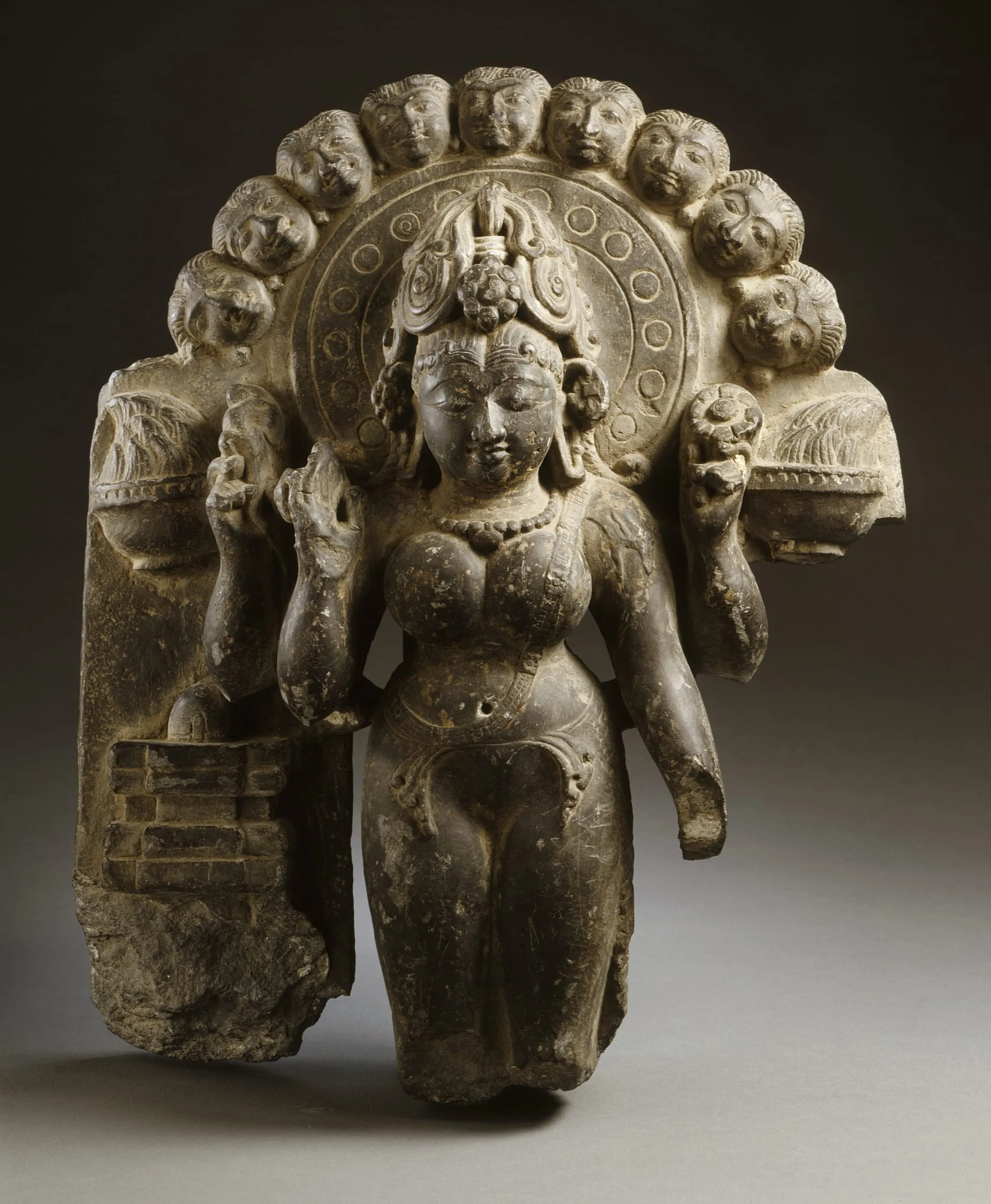
- Parvati Performing the Pancha Tapas (Five Austerities) Ritual
- Date Made
- 7th century
- Medium
- Black stone
- Dimensions
- 15 x 12 1/2 x 5 in. (38.1 x 31.75 x 12.7 cm)
- Accession Number
- AC1992.209.1
- Curatorial Notes
The Hindu Goddess Parvati is depicted here performing the austerity of five fires (pancha tapas or pancha agni). In this ritual, an ascetic sits in meditation all day surrounded by four burning fires oriented to the four cardinal directions. The midday sun burning overhead is the fifth fire. Parvati undertook this severe penance in order to convince her future husband Shiva of her spiritual worthiness to marry. See also M.82.226.
Parvati’s ascetic nature is expressed by her piled hair (jata mukuta), distended earlobes, and ascetic’s sash (yoga patta) worn across her left shoulder. She has four arms. Her upper left hand holds a lotus, while her lower left hand hangs by her side and is now missing. Her lower right hand is held in the gesture of reassurance (abhaya mudra). Her upper right hand holds a pomegranate (jambhira). On either side of her head are two flaming torches (agni kunda) referring to her austerities. A Shivalinga beside her conveys her association with Shiva. The nine heads gracing the top of her nimbus represent the nine Indian planetary deities (nava graha). They are depicted as identical disembodied heads following a western Indian iconographic tradition (see M.67.72.17 and M.71.26.38).