- Title
- Kubera, The God of Riches
- Date Made
- early 9th century
- Medium
- Copper alloy
- Dimensions
- 4 3/4 × 3 1/4 × 2 3/4 in. (12.07 × 8.26 × 6.99 cm)
- Accession Number
- AC1992.204.1a-b
- Curatorial Notes
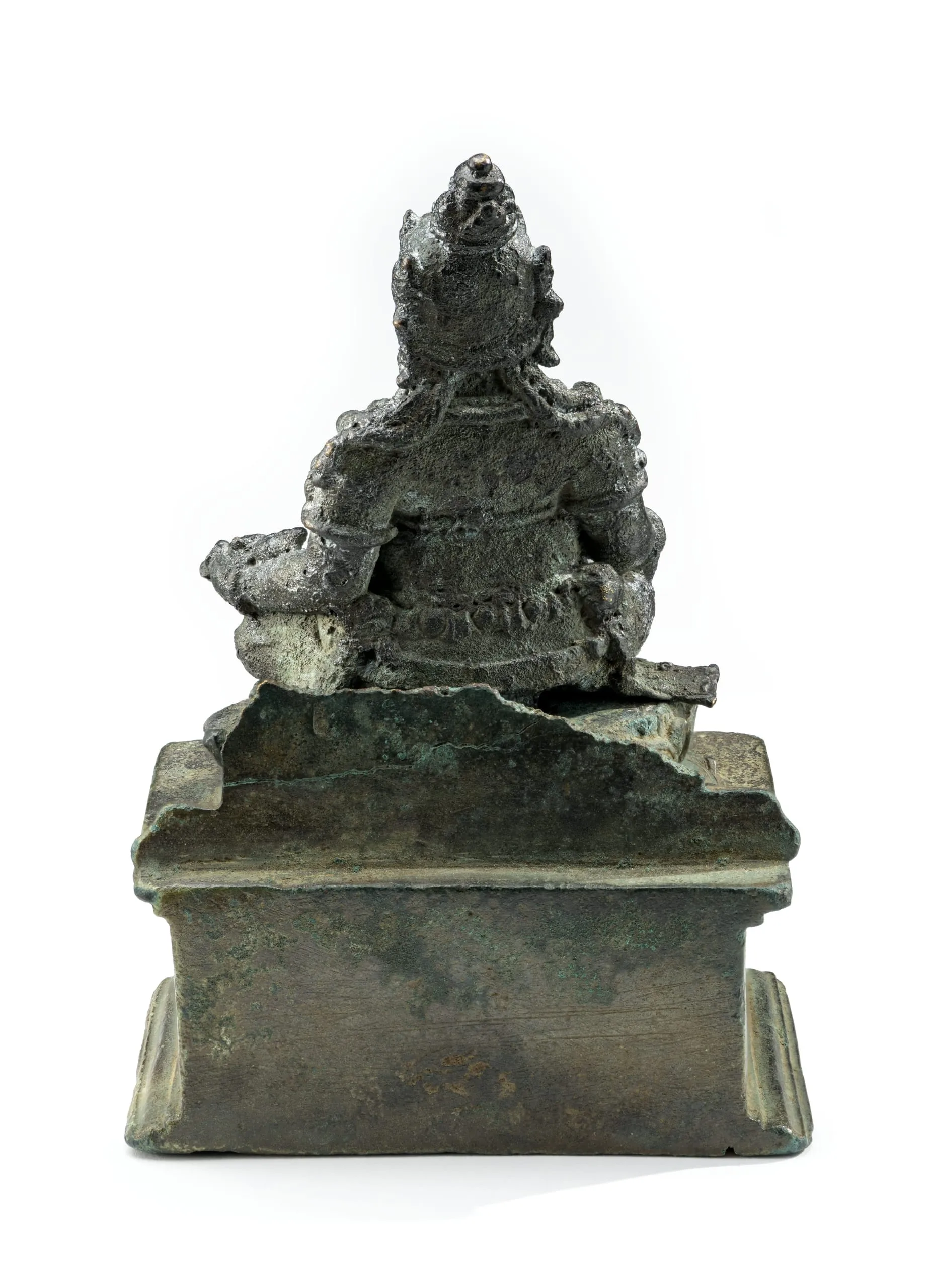
Kubera, The God of Riches, is also known as Vaishravana or Jambhala. He is venerated by Hindus, Buddhists, and Jains. Kubera was originally the chief of the demigods and guardians of treasures (yakshas). He is also the Regent of the Northern Direction (dikpala).
This Central Javanese representation of Kubera exhibits his characteristic iconography of being potbellied (tundila) and wearing princely ornaments (bodhisattva abharana). He is seated on a lotus base in a relaxed posture (lalita asana) with his right leg pendant and supported by the pericarp of a lotus flower (karnika). His left hand is held in the gesture of charity (varada mudra) carrying his attribute of a pomegranate (dadima) or citron (jambhira). The attribute held in his right hand is now damaged but was likely a mongoose (nakula) spewing jewels or the stalk of a lotus (padma). Jars of treasures (nidhis) are displayed at the base of his separately cast rectangular pedestal.
Comparable Javanese bronze images of Kubera are in the Metropolitan Museum of Art, New York (1980.527.1 and 1995.257.30) and the Musée Guimet, Paris (3814).
- Selected Bibliography
- Little, Stephen, Tushara Bindu Gude, Karina Romero Blanco, Silvia Seligson, Marco Antonio Karam. Las Huellas de Buda. Ciudad de México : Instituto Nacional de Antropología e Historia, 2018.
- Little, Stephen, and Tushara Bindu Gude. Realms of the Dharma: Buddhist Art across Asia. Los Angeles: Los Angeles County Museum of Art, 2025.