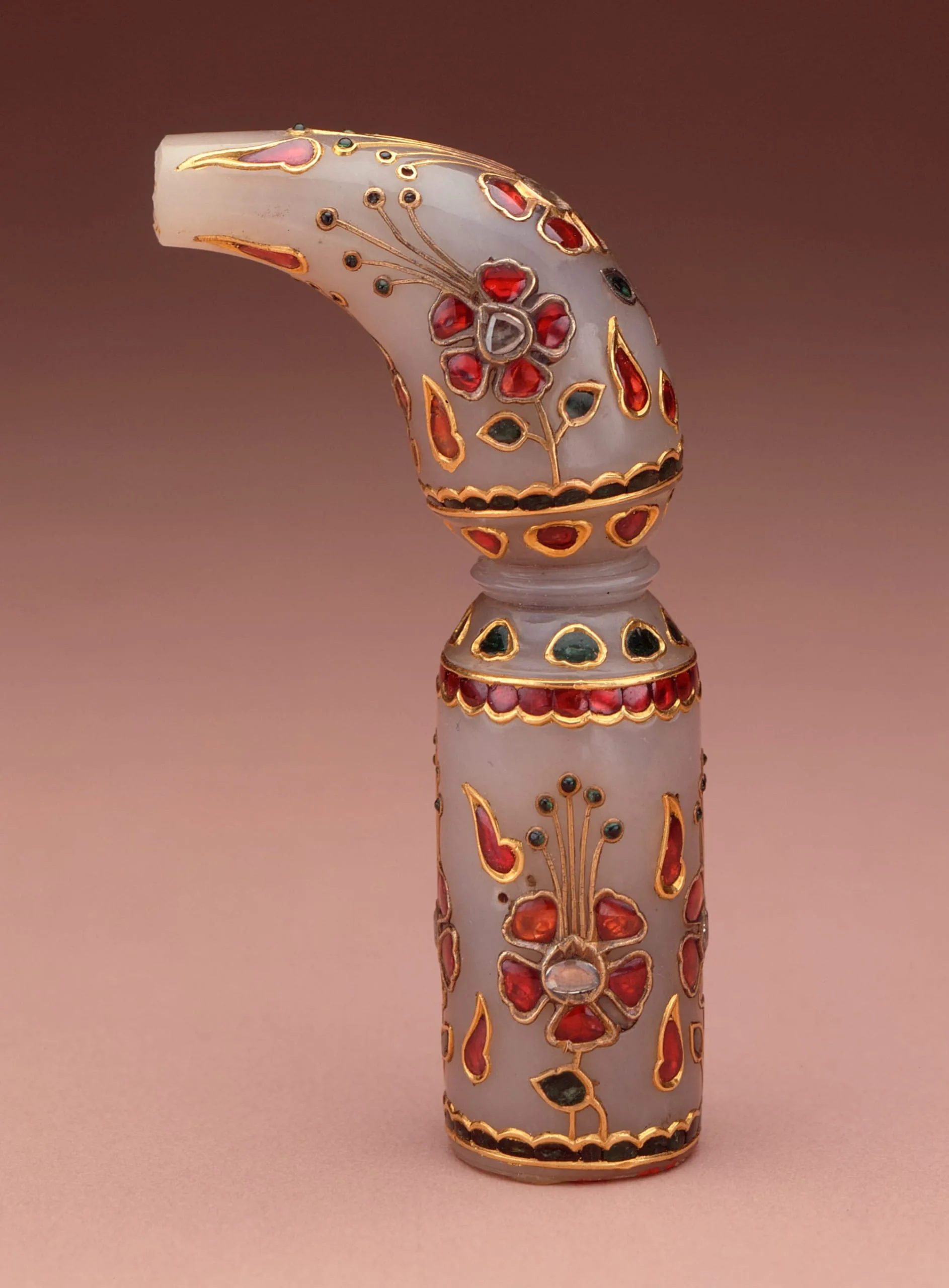
This lavishly decorated hookah mouthpiece is fashioned from white jade inlaid with diamonds, rubies, and emeralds set with gold wire in the form of blossoming flowers with prominent stamens fashioned out of gold and emeralds. Introduced into the Mughal artistic vocabulary via Chinese painting, Chinese-style clouds made of rubies float around the flowers. Although made from a single block of jade, this sophisticated mouthpiece is curved away from its chamfered junction to angle it and help facilitate its use.
A hookah, also known as a waterpipe or "hubble-bubble" as it was called by the early European visitors to India, cools the tobacco smoke by drawing it from a hot bowl in which it was burned through cold water in a vase; the smoker then inhaled it through a long tube fitted with a mouthpiece. Originally, the tube was a stiff reed. By the late 17th century, tubes were constructed to be flexible for ease of use and porous for additional filtration. stiff reed or flexible tube fitted with a mouthpiece. Mughal nobles preferred to use their own mouthpieces; consequently, large numbers of individual mouthpieces have survived. Mouthpieces were made in a variety of materials, particularly ivory, glass, jade, rock crystal and other hardstones, or precious and base metals. Most were plain or with modest decoration, but high-end works such as the present example could be ornately decorated with inlaid or carved floral motifs.
The practice of smoking tobacco was introduced into India in the late 16th century by Portuguese traders in the Deccan. It reached the Mughal court in 1604 through its well-known importation by Asad Beg, a noble in service of the Mughal Emperor Akbar (r. 1556-1605). Although popular among the nobility, the Mughal emperors themselves frowned on the practice for health reasons and are not shown smoking in painted portraits until the early 18th century.