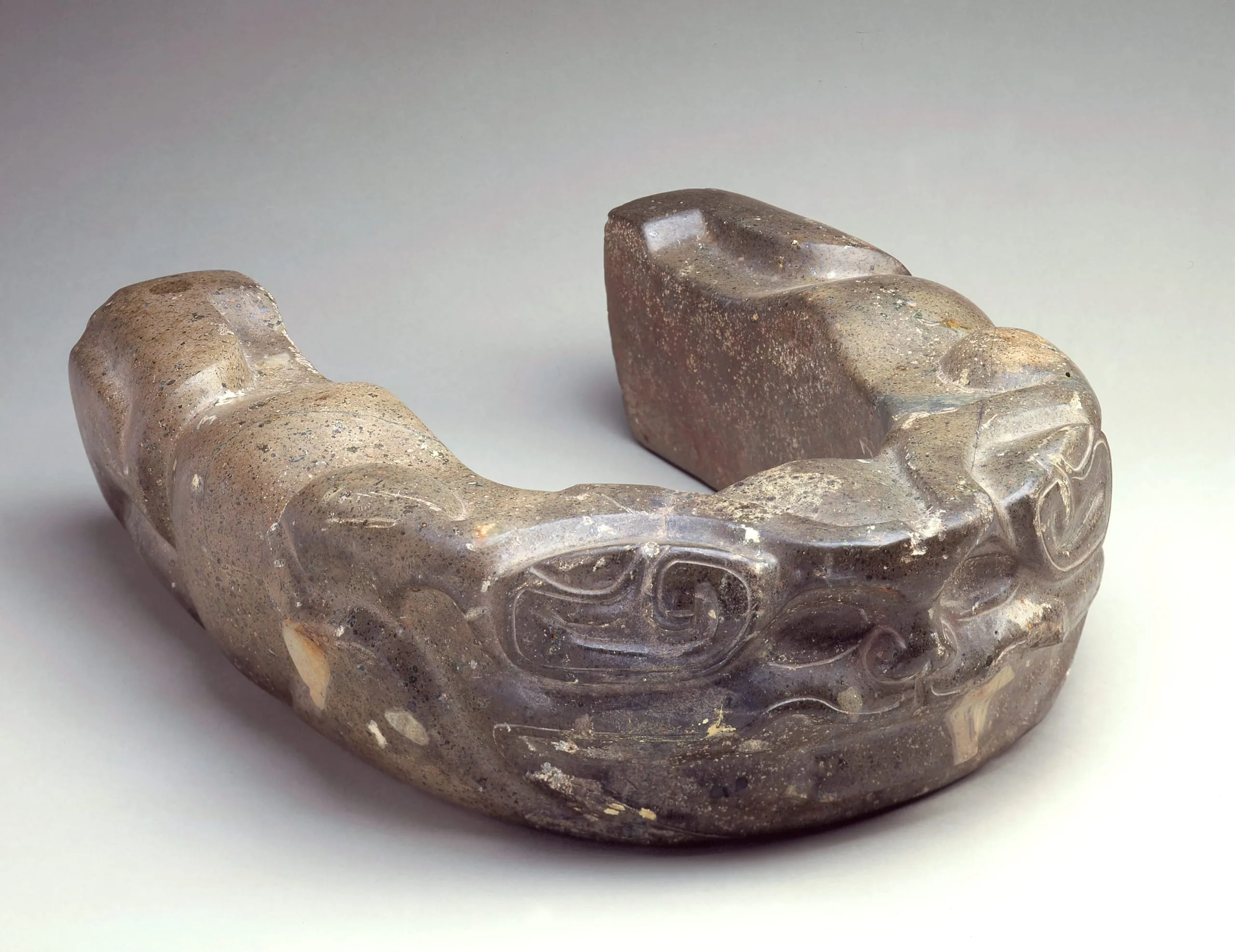
Today erroneously known as “yokes” (for their resemblance to equipment used on European draft animals for plowing fields), this U-shaped carving represents the belt worn as a torso and hip protector during the Mesoamerican ballgame. The goal was to propel a heavy rubber ball toward/through stone hoops or markers attached to the side walls of ballcourts, and rules stipulated which parts of their bodies players were allowed to use, be it hips, shoulders, elbows, or knees. In order to protect themselves from injury, they wore thick padded gear.
Ancient ballgame paraphernalia was made of perishable materials—possibly leather or textile stuffed with cotton or straw—so none survives. But artists sculpted stone representations of some gear, such as this belt, particularly in Veracruz on the Gulf of Mexico. Too heavy for actual use, these stone versions were probably ceremonial, given or flaunted as trophies, or buried as grave goods. The rendering of such items in stone is testimony to the ballgame’s importance in Mesoamerican society. As is the case here, they often feature carved images of toads, as well as serpents and jaguars (see M.2010.115.692), all of which are symbols of the underworld, reinforcing the mythical or supernatural associations of the ballgame, and of the ballcourt as an opening into the place of the dead.
Julia Burtenshaw
2024