- Title
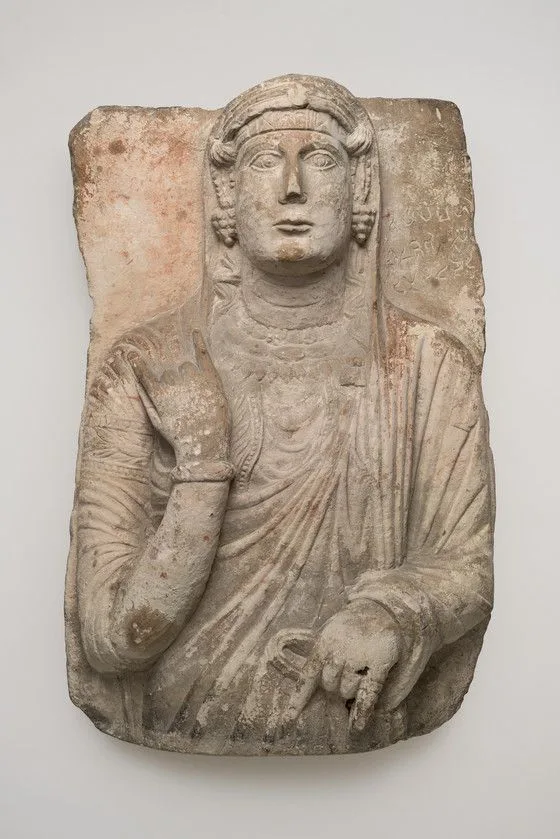
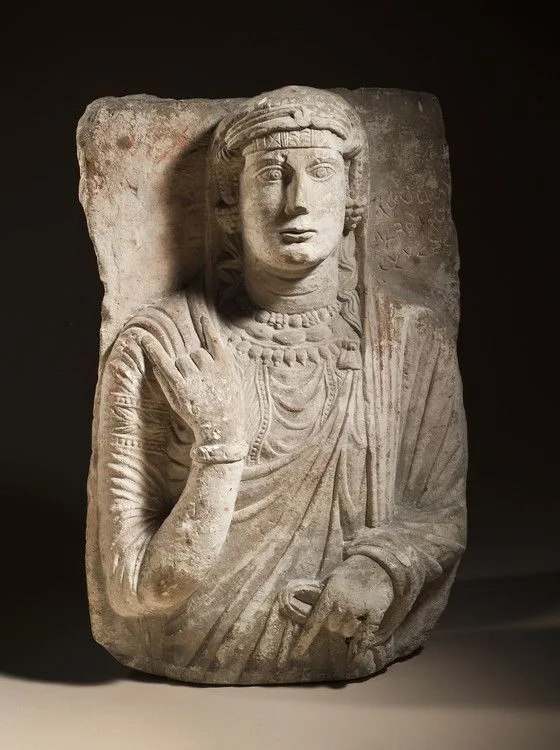
- Funerary Bust from Palmyra
- Date Made
- 3rd century
- Medium
- Limestone
- Dimensions
- 21 × 14 × 6 in. (53.34 × 35.56 × 15.24 cm)
- Accession Number
- M.76.174.249
- Curatorial Notes
The ancient oasis city of Palmyra in Syria was an important waypoint along caravan trade routes between the Persian Gulf and the Mediterranean Sea. As the wealth of the city grew during the first and second centuries, local citizens built four major necropolises to commemorate the dead, which included communal burial towers with stacked burial niches (loculi). These loculi were decorated with high-relief portraits of the deceased and short dedicatory inscriptions, as in the case of this bust. Clothing, text, gesture, and color (remnants of polychromy indicate that the sculptures were once painted) capture the individuality of the deceased. In this instance, the woman wears several layers of garments, including an underrobe with an embroidered armband topped with a loose overrobe pinned at her shoulder with a brooch. Her curled hair is covered with a scarf and a patterned diadem, and she is adorned in jewelry, including several necklaces, bracelets, and earrings. As with other funerary portraits of this kind, the elaborate finery of the woman’s dress and accessories is a lasting testament to the status and wealth of the deceased.
2024
- Selected Bibliography
- Ancient Bronzes, Ceramics, and Seals: The Nasli M. Heeramaneck Collection of Ancient Near Eastern, Central Asiatic, and European Art. Los Angeles: Los Angeles County Museum of Art, 1981.
- Mousavi, Ali. Ancient Near Eastern art at the Los Angeles County Museum of Art. Los Angeles: Los Angeles County Museum of Art, 2012.