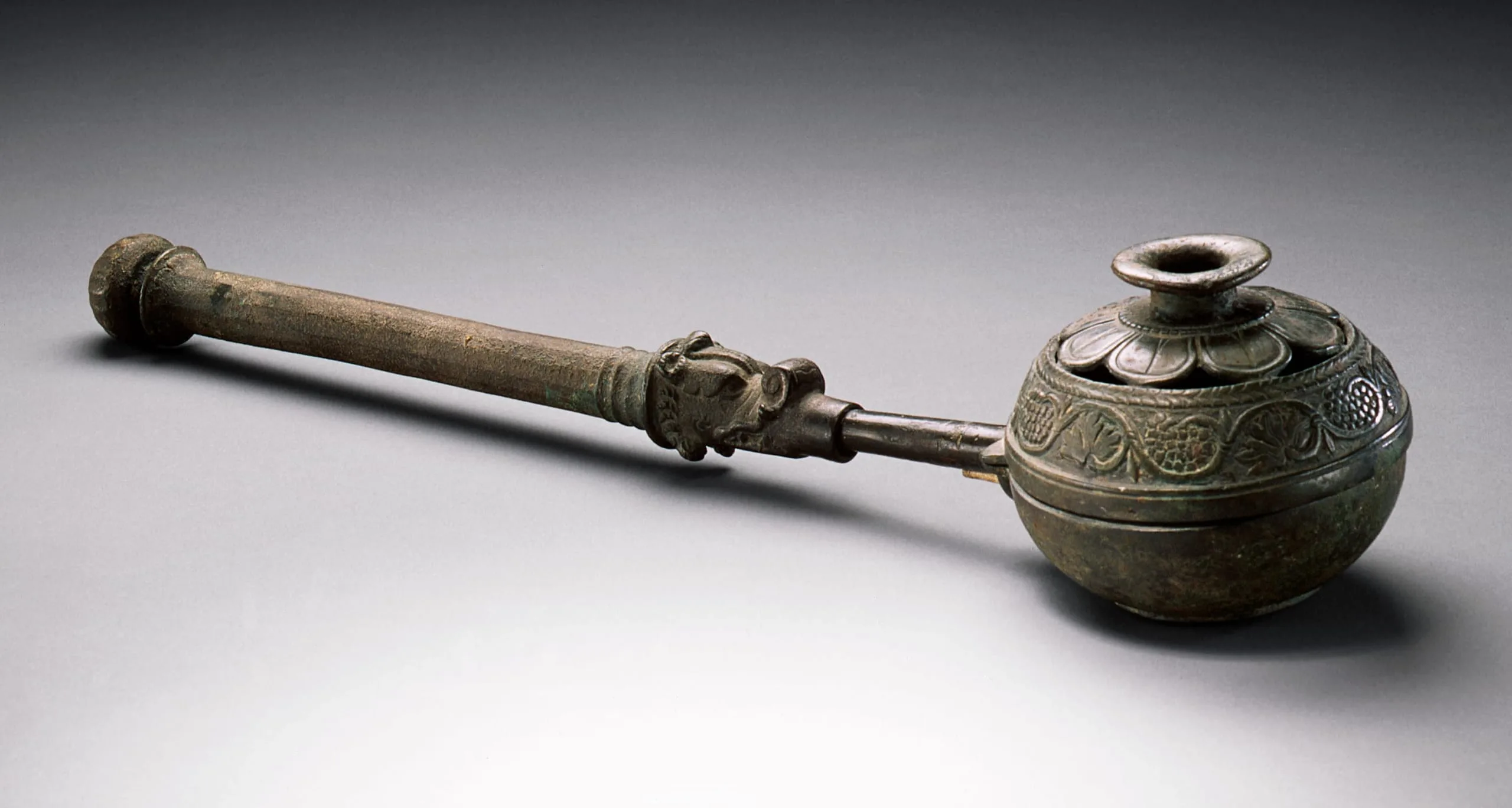
This copper alloy censer was likely made around the 4th century in ancient Gandhara, a region located in present-day northern Pakistan and eastern Afghanistan. It is one of a small corpus of Gandharan copper alloy censers. One is now in the Metropolitan Museum of Art, New York (1987.218.8a-c). For the remaining censers, see Martin Lerner and Steven Kossak, The Lotus Transcendent: Indian and Southeast Asian Art from the Samuel Eilenberg Collection (New York: Metropolitan Museum of Art, 1991), p. 102, no. 71; and Richard Pegg, Passion for Form: Selections of Southeast Asian Art from the MacLean Collection (Chicago: MacLean Collection; Honolulu: Honolulu Academy of Arts, 2007), pp. 61, 72-73, no. 28. The censer in the MacLean collection is chiefly distinguished by the presence of small support feet and a different method of hinging the lid. It has been published as a 5th or 6th-century Vietnamese copy of a Gandharan censer. Alternatively, it may be a slightly variant style of Gandharan censer that made its way along the pilgrimage and trade routes and was then "found" in Vietnam.
The LACMA censer is made in three parts: bowl, lid, and handle. The bowl and the lid together form a combustion chamber shaped like a lota. The lid has a flat flared mouth on a short neck, which functions as the primary escape channel for the smoke. The upper shoulder of the lid features a radiant register of lotus petals with pierced interspaces, which served as subsidiary escape passages for the smoke. Adjoining the lotus petals is narrow band of marching chevrons that functions as the border for a broad register of a scrolling grape vine with alternating bunches of fruit and clusters of leaves. A narrow plain border completes the cast decoration of the lid. The bowl is unadorned apart from a shallow foot. The lid is secured to the bowl by a pendant loop that is locked into place when a tang extending from the bowl is inserted through the loop and into the mouth of a mythical aquatic animal (makara) that forms a spout at the near end of the handle. The tang cannot be inserted completely, however, which suggests that the current handle may have once belonged to a different but apparently contemporaneous combustion bowl. The handle has four parallel ribs immediately behind the makara head, and then a long fluted shaft that terminates in a flared collar and a mace-like knob terminus.
See Stephen Markel, "Metalware from Pakistan in the Los Angeles County Museum of Art," Pakistan Heritage 2 (2010): p. 99, fig. 1.