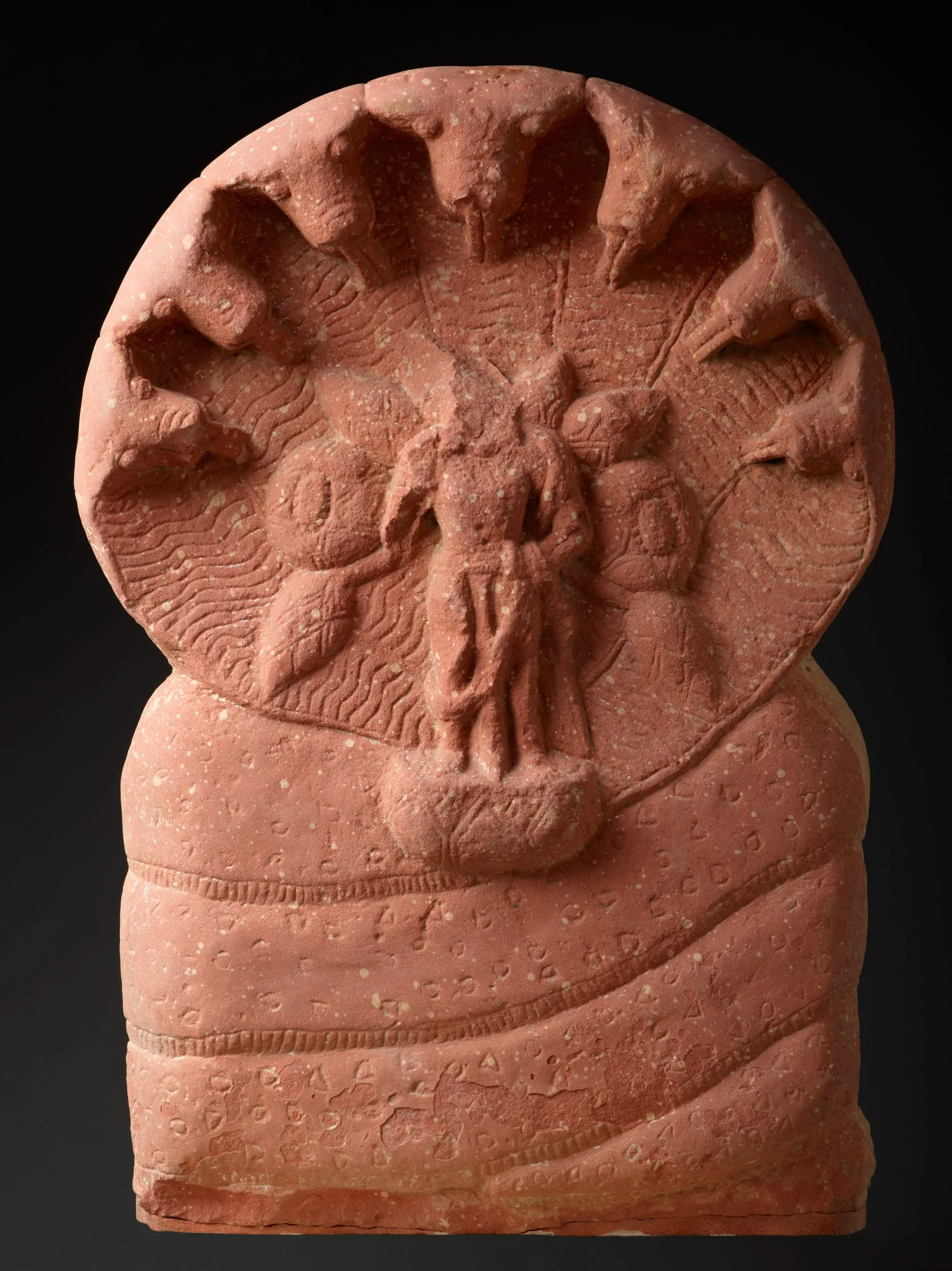
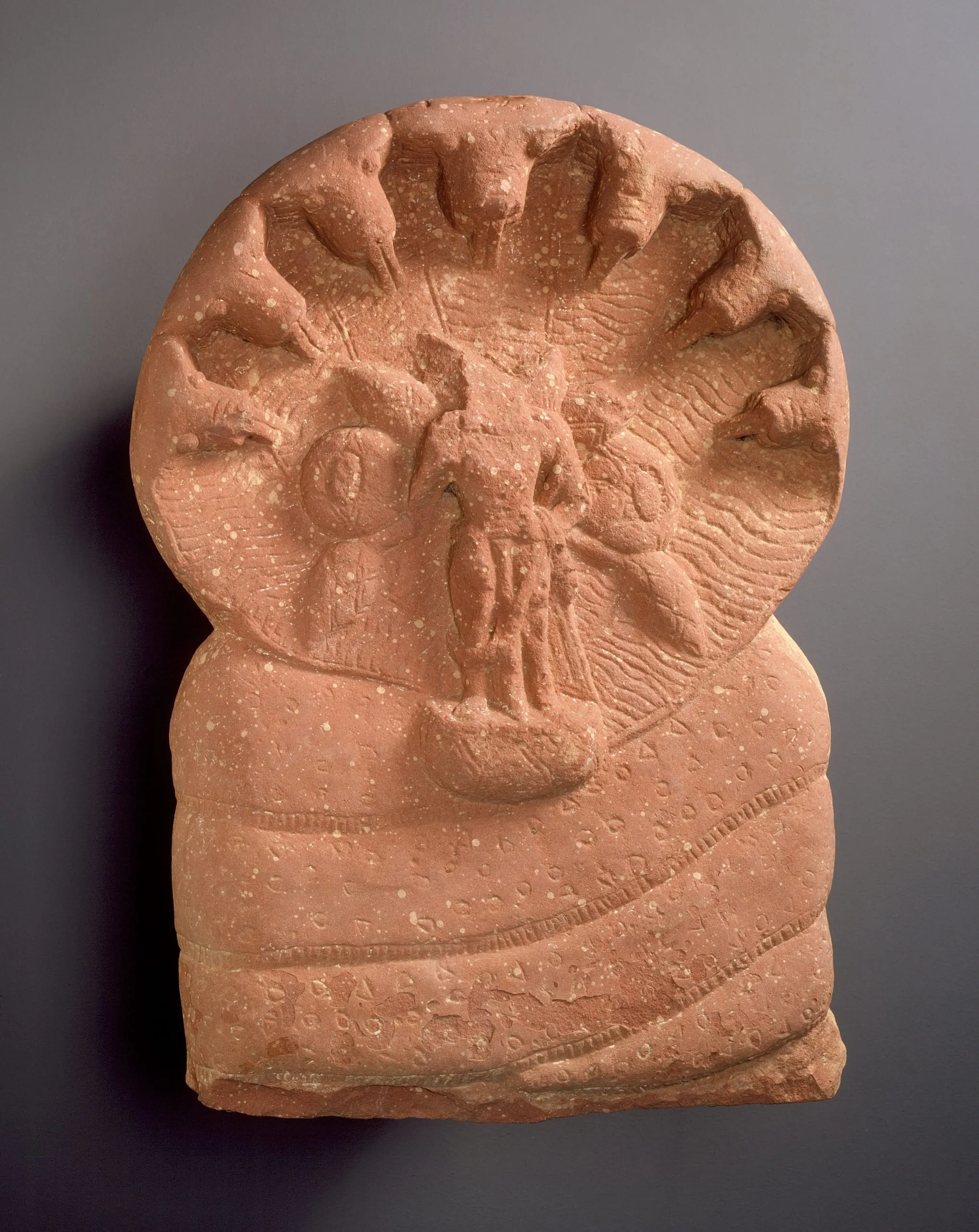
Serpents (male: nagas, female: naginis) have been revered in India for over 2000 years. They are venerated for protection from snakebite, to enhance fecundity, and to increase prosperity as the guardian of gems. Steles portraying a serpent or serpent families were erected as fertility icons under trees in village shrines (see M.87.17). Lifesize images of a Serpent King (Nagaraja) or Serpent Queen (Nagarajñi) standing under a seven-hooded cobra are among the most impressive of the sculptural masterworks of ancient Mathura. Based on contemporaneous royal imagery and garb, the personified serpent kings represent a dual manifestation of the supernatural cobra. Similar serpentine iconography is utilized in depictions of Balarama (see M.73.4.7).
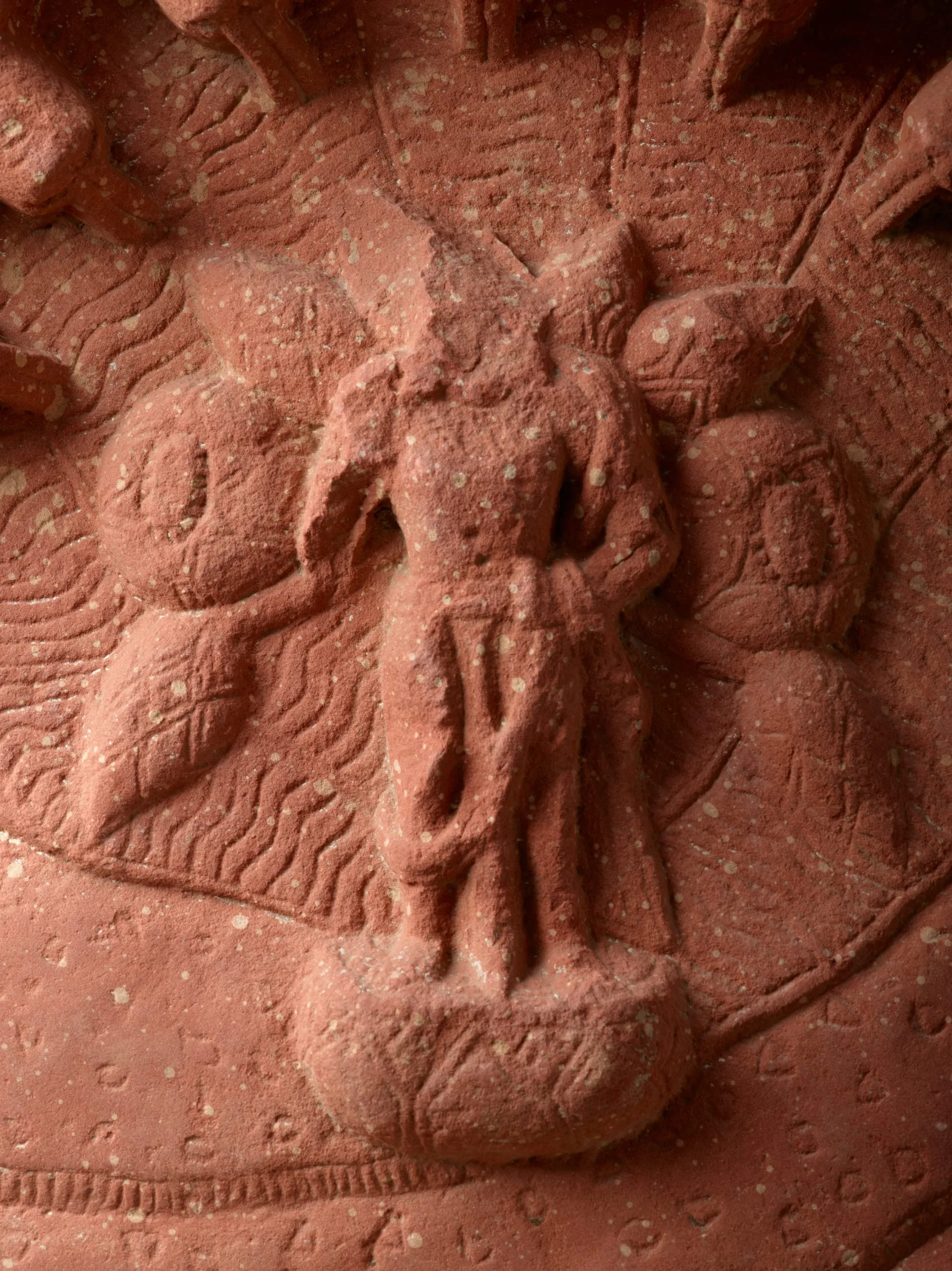
Serpents’ potent association with the life-giving waters is symbolized here by the lush lotus blossoms and buds forming a burgeoning archway (torana) around the serpent king. The now-headless Nagaraja has two arms. His now-damaged right hand originally displayed the gesture of reassurance (abhaya mudra). His left hand rests on his ornate hip belt (katibandha). He stands in a stiff, frontal pose (samapada sthanaka) on a lotus base. A long scarf loops over his left shoulder, around the back to the right calf, up to form a pendant coil dangling over his left wrist, and a striped tail that hangs down to a point.
Iconographically comparable but proportionally distinct Mathura Nagarajas are in the Asian Art Museum, San Francisco (B86S4), Norton Simon Museum, Pasadena (F.1972.22.2.S), and Penn Museum, Philadelphia (29-64-5).