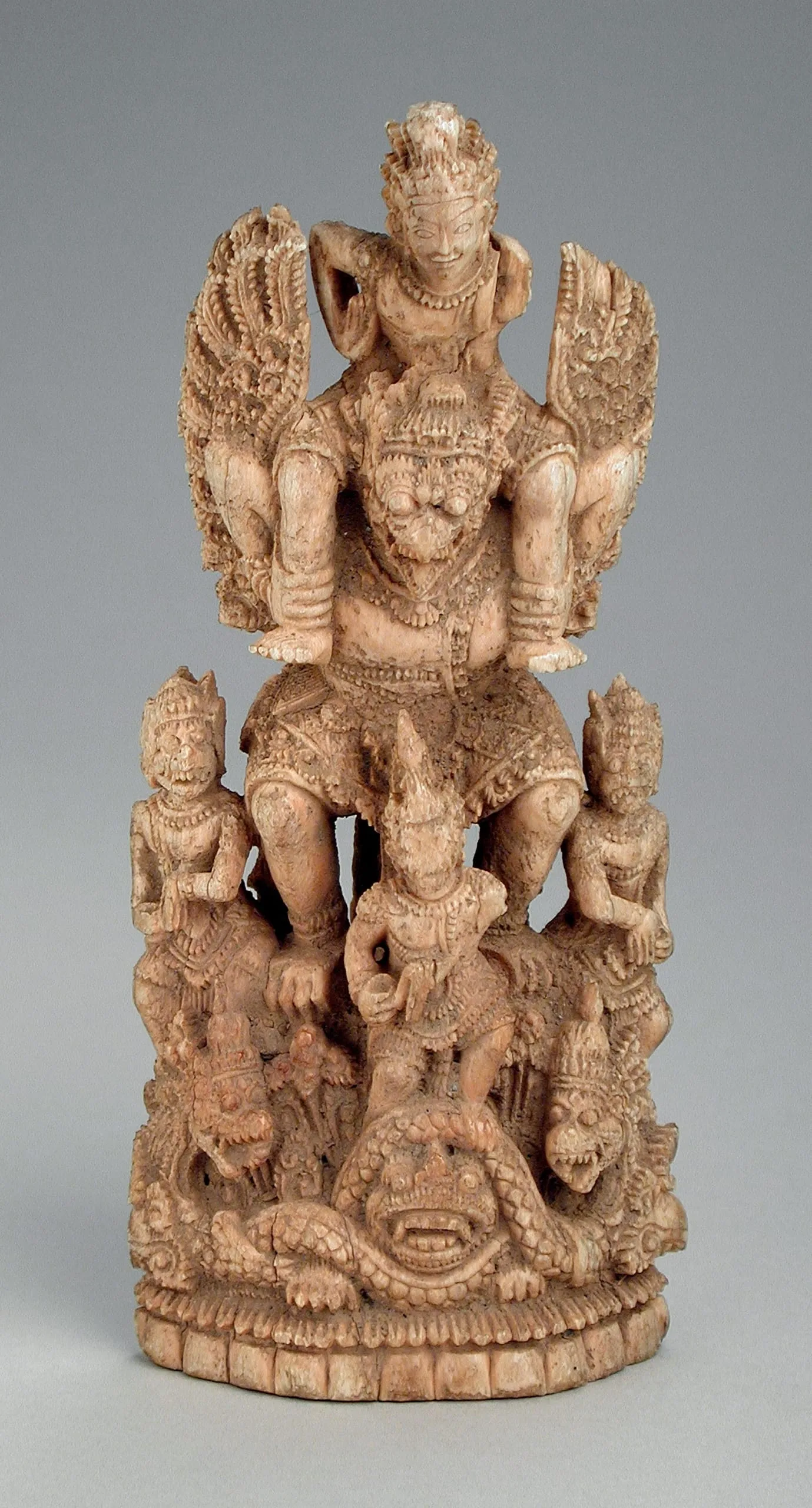
Images of Vishnu, the Hindu God of Preservation, riding the sunbird Garuda, his half-avian, half-human mount (vahana) abound in South and Southeast Asian art (see also M.73.4.10, M.82.145, M.86.247.2, and AC1999.127.32). Most representations until the 19th-20th centuries were symbolic of Vishnu’s role in preserving the cosmic order and the socio-religious concept of divine kingship in which earthly rulers identified themselves with Vishnu and his avatars to proclaim their right to rule. By the 19th century in Java and Bali, wooden and ivory sculptures and paintings began to impart a greater emphasis on Garuda and stylistically accentuated his appearance with a dynamic expressiveness and expanded iconography that stressed his mythological narrative over Vishnu’s dominion. As is often the case in Hindu lore, multiple biographical legends developed over time. What they shared, however, was the enmity between Garuda and the semi-divine serpents (nagas) because of the rivalry of Garuda's mother, Vinata, and the serpents’ mother, Kadru, who were sisters and co-wives of the sage Kashyapa. Following a dishonest wager, Kadru tricked Vinata into a life of forced servitude. To free his mother, Garuda was coerced by the nagas to steal the nectar of immortality (amrita) from the gods. But he swore vengeance for his mother’s harsh treatment and became a mortal enemy of serpents.
In LACMA’s Balinese ivory carving, Vishnu rides Garuda in his customary pose atop his shoulders. But the emphasis here is on the larger figure of Garuda who is triumphing over two fierce undulating nagas. The serpents are accompanied by four demonic Bhuta-Kala spirits (three are on the front of the sculpture, the fourth is on the back). The Bhuta-Kala (‘demonic spirits-time’) are supernatural entities in Balinese Hinduism that represent chaotic cosmic forces. They are complex beings of the underworld that can be either malevolent or benevolent and require ritual offerings to maintain harmony with the human world.