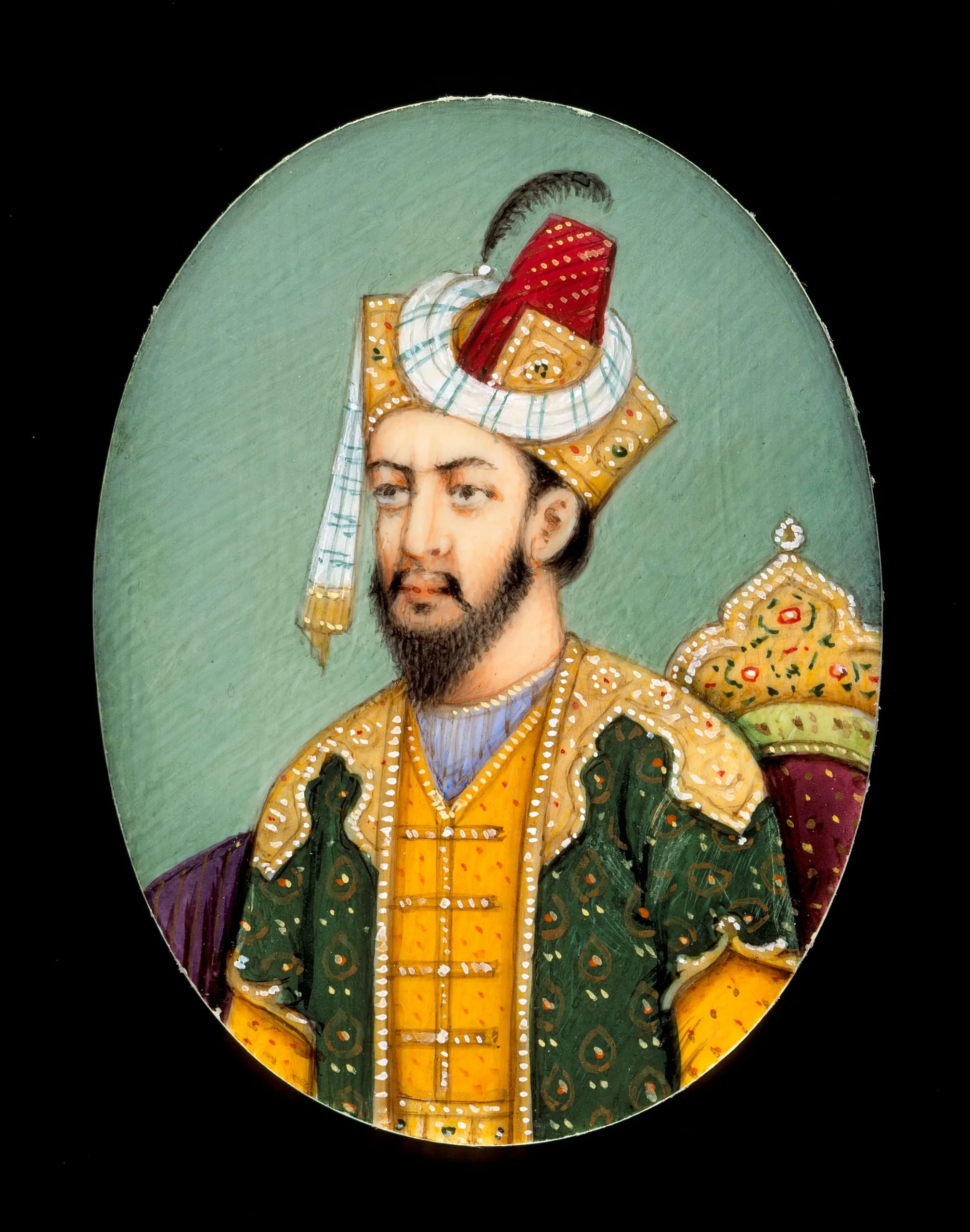
Emperor Humayun (r. 1530-1540/1555-1556) was born in 1508. His birth name was Nasir ud-Din Muhammad. His father was Babur, the founder of the Mughal dynasty (r. 1526-1530). Humayun first ruled the Mughal Empire in 1530-1540 but was defeated and routed from Delhi in the battle of Kannauj in 1540 by the Afghan Sher Shah Sur (r. 1540-1545). Humayun regained the throne in 1555 with the aid of Safavid Persian forces, but died one year later, after falling down the stairs of his library. Throughout his life Humayun maintained a deep interest in painting and calligraphy. During his exile from Delhi he spent time at the Iranian court of Shah Tahmasp (r. 1524-1576), where he was exposed to a renowned painting atelier. In 1555 three of Shah Tahmasp’s artists accompanied Humayun back to Delhi and established an imperial painting atelier that blended Iranian and Indian stylistic features.
The enthroned Humayun wears the distinctive Chaghatai-style headgear known as a Crown of Power and Glory (Taj-i ‘Izzat) with a feather plume (kigal), and a bejeweled and embroidered cloak over his outer garment.
This miniature portrait on ivory of Humayun, along with images of other Mughal emperors and possibly empresses, would originally have been mounted on a wooden frame (see 34.13.965) or inset into an ebony, sandalwood, or ivory jewelry box with carved and sometimes inlaid hardstone decoration.