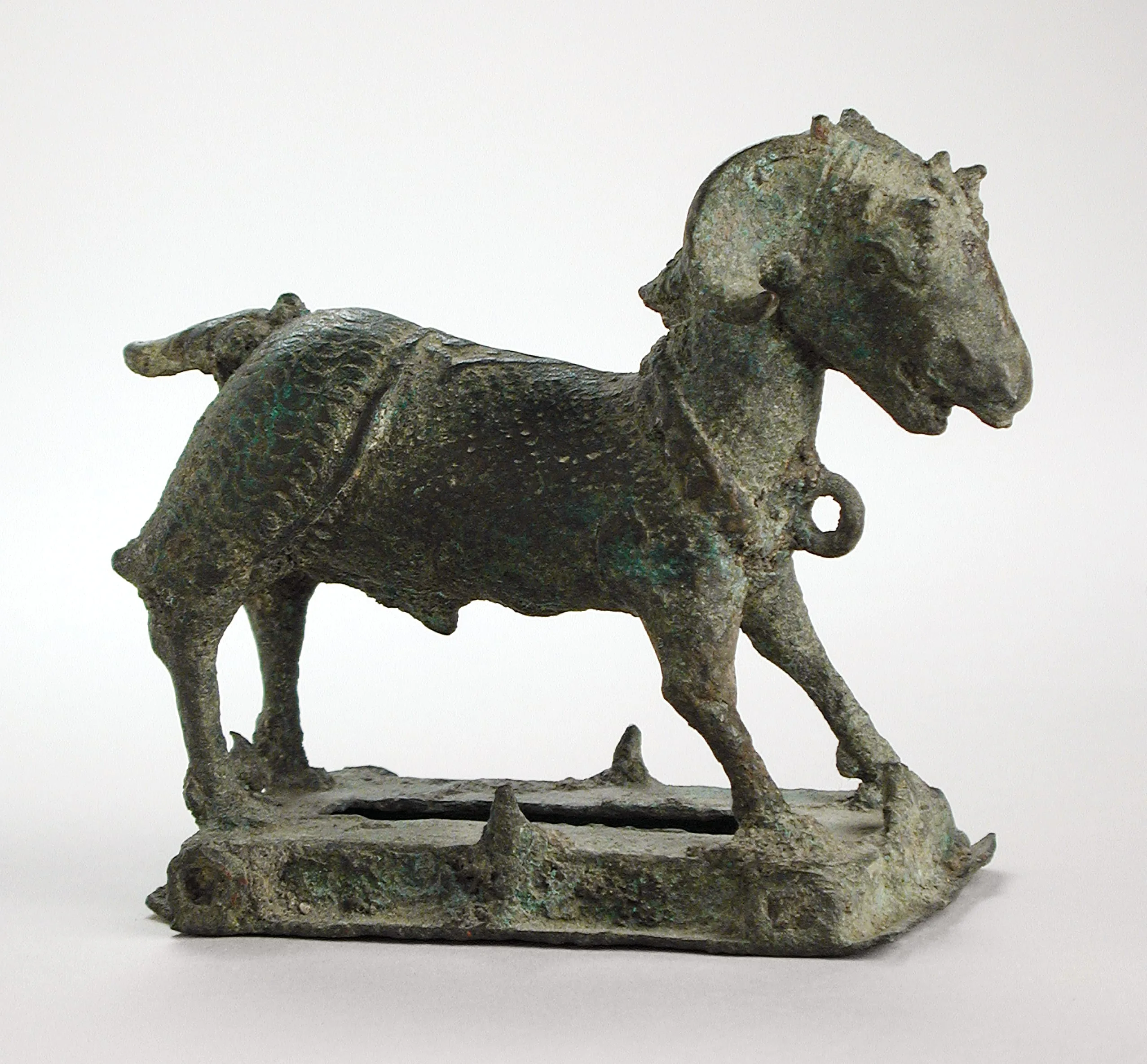
This Eastern Javanese copper alloy sculpture of a ram and its counterpart image of another ram (M.86.225.2) were presumably fashioned as toys. This is suggested by the pull rings on their chest to which a cord for pulling the toy would have been attached. Based on comparisons to other depictions of toy rams, goats, and horses, there would have originally been axle holes in the bases for inserting now-missing axles and wheels. The bases of such toys also typically have a stepped lozenge cut into the center (see M.86.225.2) and upright floral motifs at the four sides (see M.91.232.2). The rams are sheered so as to have a thicker coat on their hind quarters.
See J. E. van Lohuizen-de Leeuw, Indo-Javanese Metalwork (Stuttgart: Linden-Museum, 1984), pp. 162-163, nos. 139-140 [wheeled horse-ram]; and Pauline Lunsingh Scheurleer and Marijke J. Klokke, Divine Bronze: Ancient Indonesian Bronzes from A.D. 600 to 1600 (Leiden: E. J. Brill, 1988), pp. 160-161, nos. 108-109 [goat-horse]. A comparable wheeled ram is in Asian Art Museum, San Francisco (F2003.34.13).