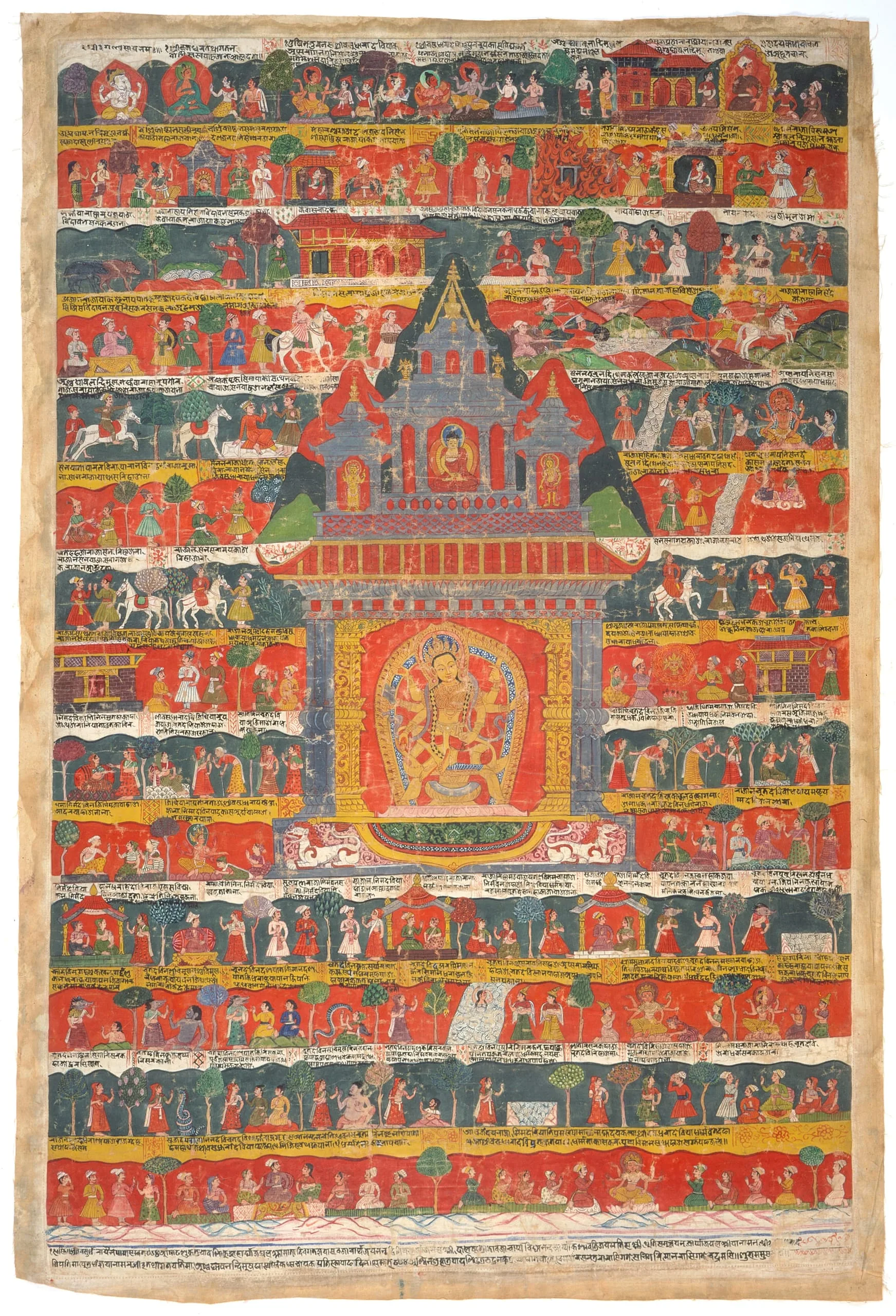
Vasundhara (Bearer of Treasure) is the Newari Buddhist epithet of Vasudhara (Stream of Treasure), the Bodhisattva of wealth, prosperity, and abundance. This painting depicts one of the popular stories about Vasundhara and narrates the origin and benefits of her worship. The nimbate and crowned goddess emerges from the Vase of Abundance (purna ghata) in a multistory shrine in the center of the painting with representations in the upper registers of the Buddha flanked by Prajnaparamita and Avalokiteshvara (viewer’s left and right respectively). Vasundhara has golden skin and six arms. Her right hands (upper to lower) are held in the gesture (of salutation) of a Buddhist monk (buddha shramana mudra); holds the Buddhist wishing gem (chintamani) with tripartite flames symbolizing the Buddha, Dharma (Buddhist law), and Sangha (community of monks); and held in the gesture of charity (varada mudra). Her left hands (upper to lower) hold a sacred manuscript (pustaka), an ear of rice (kanisha), and a Vase of Immortality (Tshe-bum; see M.83.2.1a-b and M.2011.157.3a-c). She sits in the ‘royal ease’ posture (rajalila asana) in front of a flaming aureola (prabhavali) on a lotus base.
The narrative begins at the top left of the painting with an invocation to Ganesha. Then Vajradhara recounts the Legend of Vasundhara (Ashvaghosha Avadana) to the seated Bodhisattvas in the Akanishta Paradise. A detailed synopsis of each event with Newari captions continues in fourteen horizontal registers, finally ending with a major puja in honor of the goddess. See Huntington and Bangdel 2003, pp. 414-416, no. 127.
The Newari inscription states that the painting was completed in 1744 (N.S. 864) in the thirteenth day of the bright half of the lunar month Ashvin (September–October). It was commissioned by Jayanana Vajracharya in memory of his deceased mother.
See also M.75.17, M.77.19.7, M.79.9.5, M.81.8.2, and M.84.221.1, and Himalayan Art Resources, no. 857458, https://www.himalayanart.org/items/85745