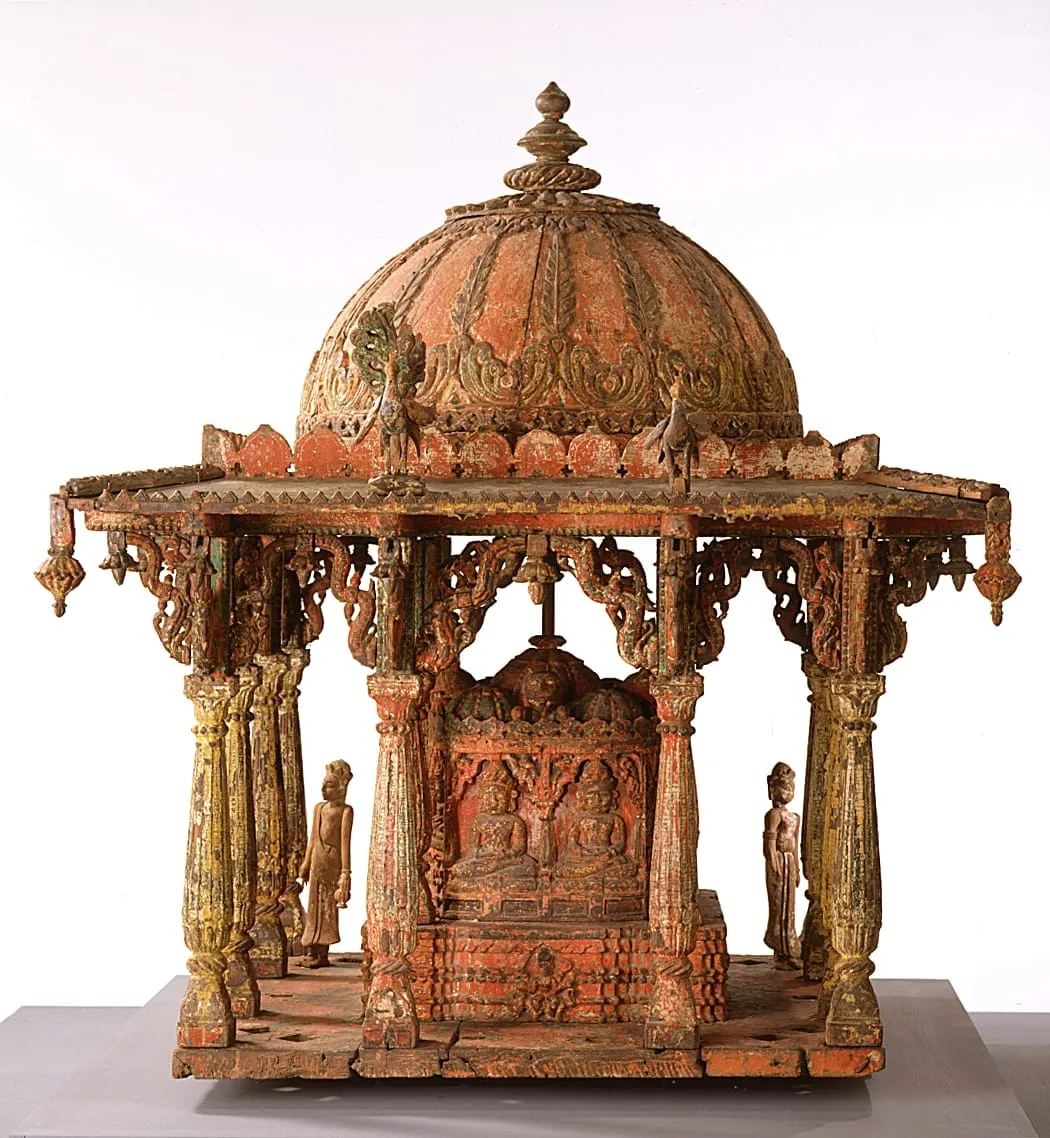
Jainism was particularly strong in Rajasthan and Gujarat where Jain ministers served as advisors to several Hindu kings and Jain merchants dominated the maritime trade with Africa and the Middle East. Jain patrons erected numerous sandstone and white marble temples, many of which had a pillared hall (mandapa) with an ornamental, corbelled domical ceiling or vault (vitana). They also commissioned domestic shrines and shrine facades made of wood, usually teak or Indian rosewood (sheesham), embellished with brilliant polychromy. Known as a home temple (ghar mandir or ghar derasar), they replicated the architectural forms of full-size western Indian temples.
This wooden Jain shrine is a pillared hall with a ribbed dome (shikhara) demarcated by vegetal motifs and crowned with a segmented disc (amalaka) and pointed finial spire (kalasam). The dome is supported by twelve slender pillars with undulating wave-like brackets (taranga-potika). Peacocks adorn the roof edge. The heart of the shrine is a smaller multi-domed structure that mimics a temple's inner sanctum (garbhagriha). The front facade has large representations of two undifferentiated crowned Jinas (Jain saviors) sitting in the lotus posture (padma asana) and holding their hands in the gesture of meditation (dhyana mudra). They are likely intended to represent Neminatha, the 22nd Jain savior, and Mahavira, the 24th Jain savior. Two male crowned royal worshippers, one of whom still carries a water vessel (kamandalu), circumambulate the central shrine. Judging by the number of mortise holes, there were originally fourteen figures. In the center of the plinth is a four-armed image of Sachiya Mata or Sachika Mata (Truthful Mother) riding her lion mount (sinha vahana). She holds a sword and shield in her upper hands and may hold a discus and conch in her lower hands. She is worshipped as a powerful form of Shakti (Durga) and is the ancestral tutelary goddess (kuldevi) to many Rajput clans and Jain communities, especially in the Osian region of Rajasthan.
Comparable Jain shrines or shrine facades are in the Cincinnati Art Museum (1962.459), Dayton Art Institute (1945.66), Chhatrapati Shivaji Maharaj Vastu Sangrahalaya, Mumbai (38.14), and Victoria and Albert Museum, London (IM.342-1910). See Pratapaditya Pal, ed. The Peaceful Liberators: Jain Art from India (Los Angeles: LACMA and London: Thames and Hudson, 1994), pp. 108-116, nos. 5-8.