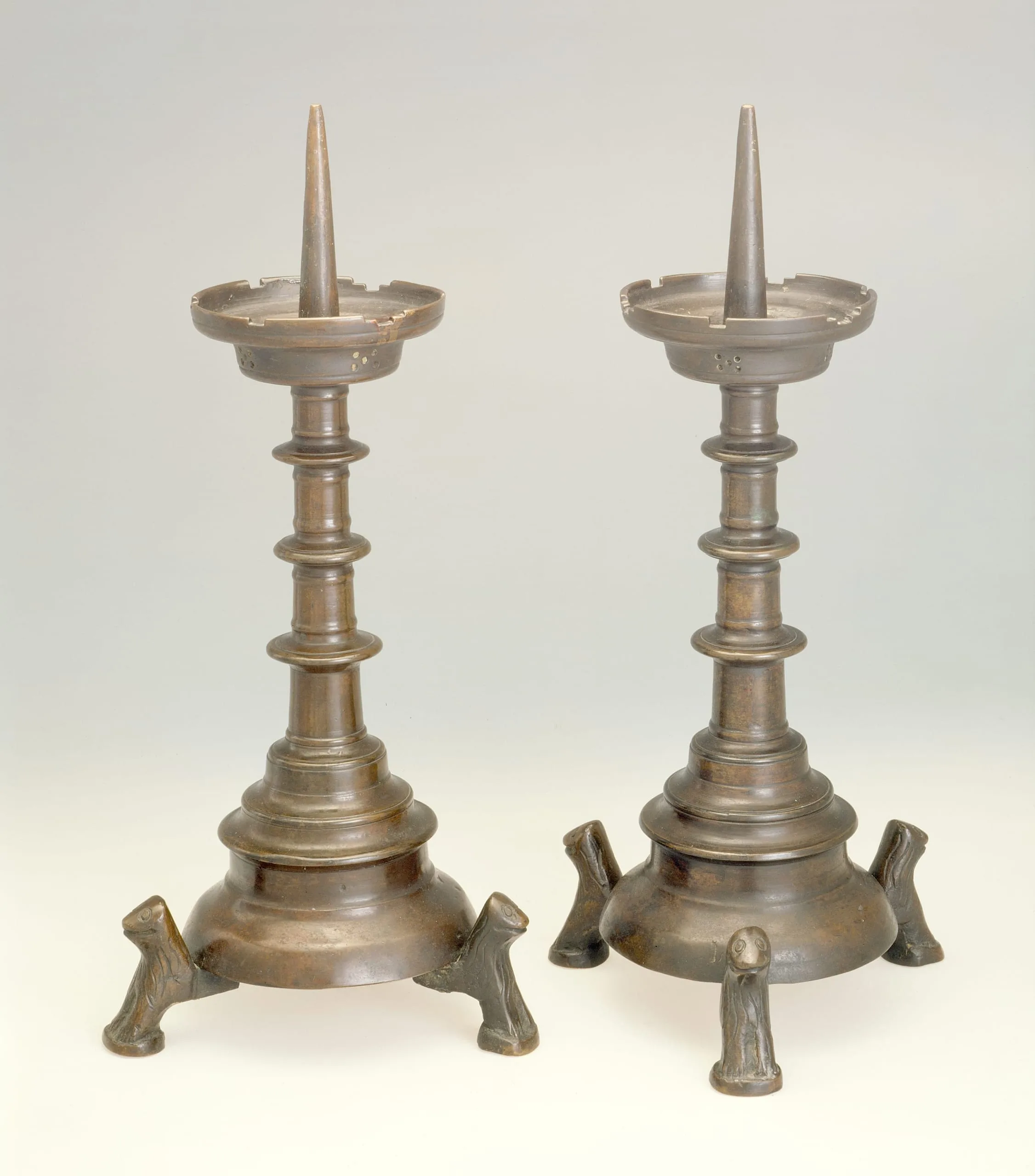
- Title
- Pair of Candlesticks
- Date Made
- end of the 14th century
- Medium
- Cast brass
- Dimensions
- .1) Height: 17 3/8 in. (44.2 cm); Diameter: 7 7/8 in. (20 cm); .2) Height: 17 1/2 in. (44.4 cm) Diameter: 7 7/8 in. (20 cm)
- Accession Number
- AC1992.152.102.1-.2
- Curatorial Notes
In the late medieval era, the Netherlands was unrivaled as the center of brass production in Europe. Plentiful deposits of copper and zinc ores, essential to making brass, attracted skilled braziers to the region, and Flemish brass objects, such as these candlesticks, were widely exported throughout Europe. Rarely marked, they are difficult to attribute to specific makers or towns, although the city of Dinant on the Meuse River in Belgium became the hub of the medieval brass trade. These candlesticks were cast from molds based on wood balusters turned on a lathe. Their tapering shafts with graduated rings rising from a stepped base were among the most elaborate design options available at the time. Three cast feet in the form of lions provide maximum stability. The central pricket, or spike, is set in a broad drip pan that would catch melting wax and contain the outer edge of a large candle. Candles of that size would burn for a very long time, suggesting that these candlesticks were intended for use in a church rather than at home. Wax, as opposed to inexpensive but foul-smelling tallow, was favored for liturgical use and would have been appropriate for such grand fixtures.
- Selected Bibliography
- Thomas, Nancy, and Constantina Oldknow, eds. By Judgment of the Eye: The Varya and Hans Cohn Collection. Los Angeles: Hans Cohn, 1991.