- Title
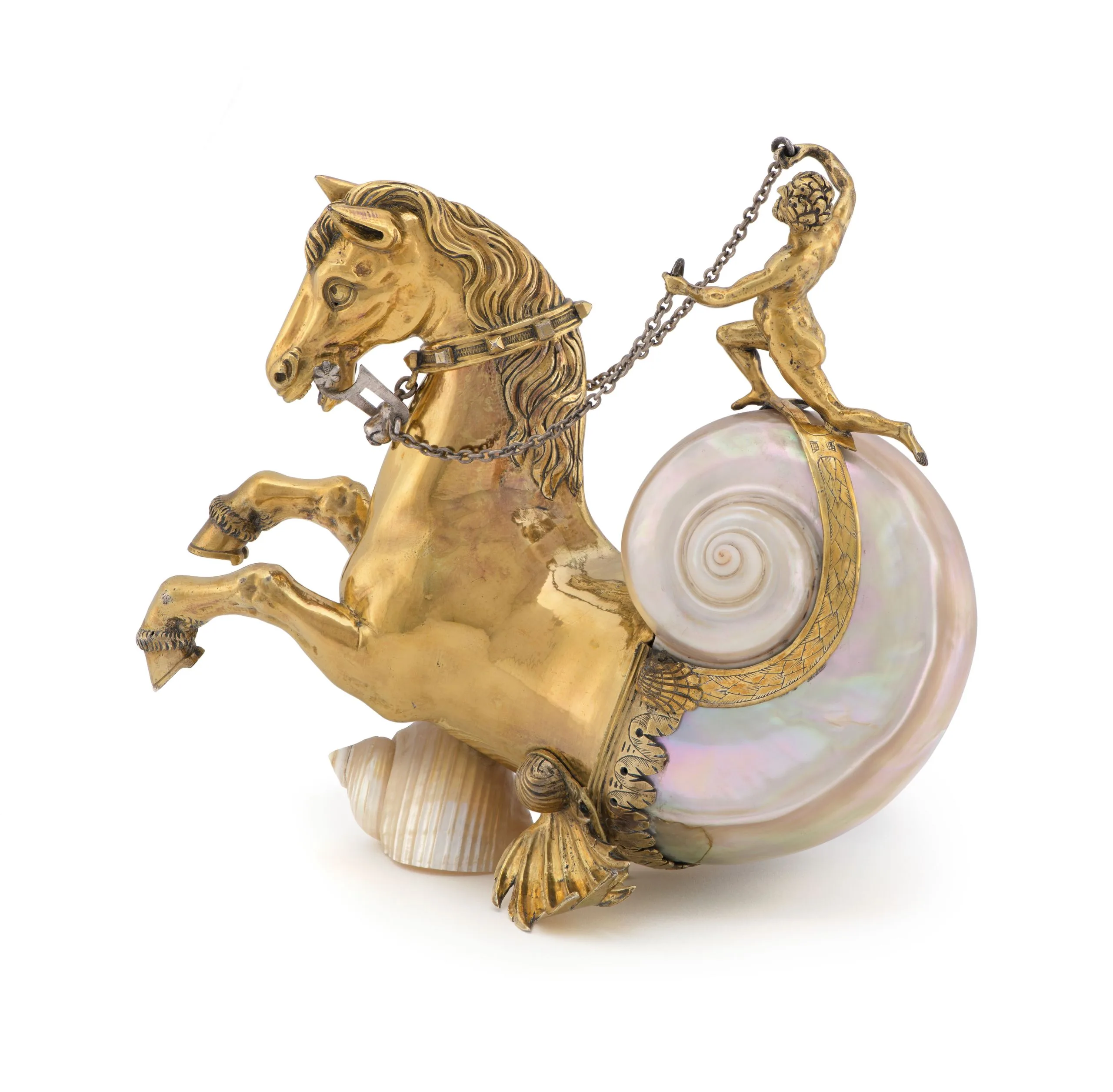
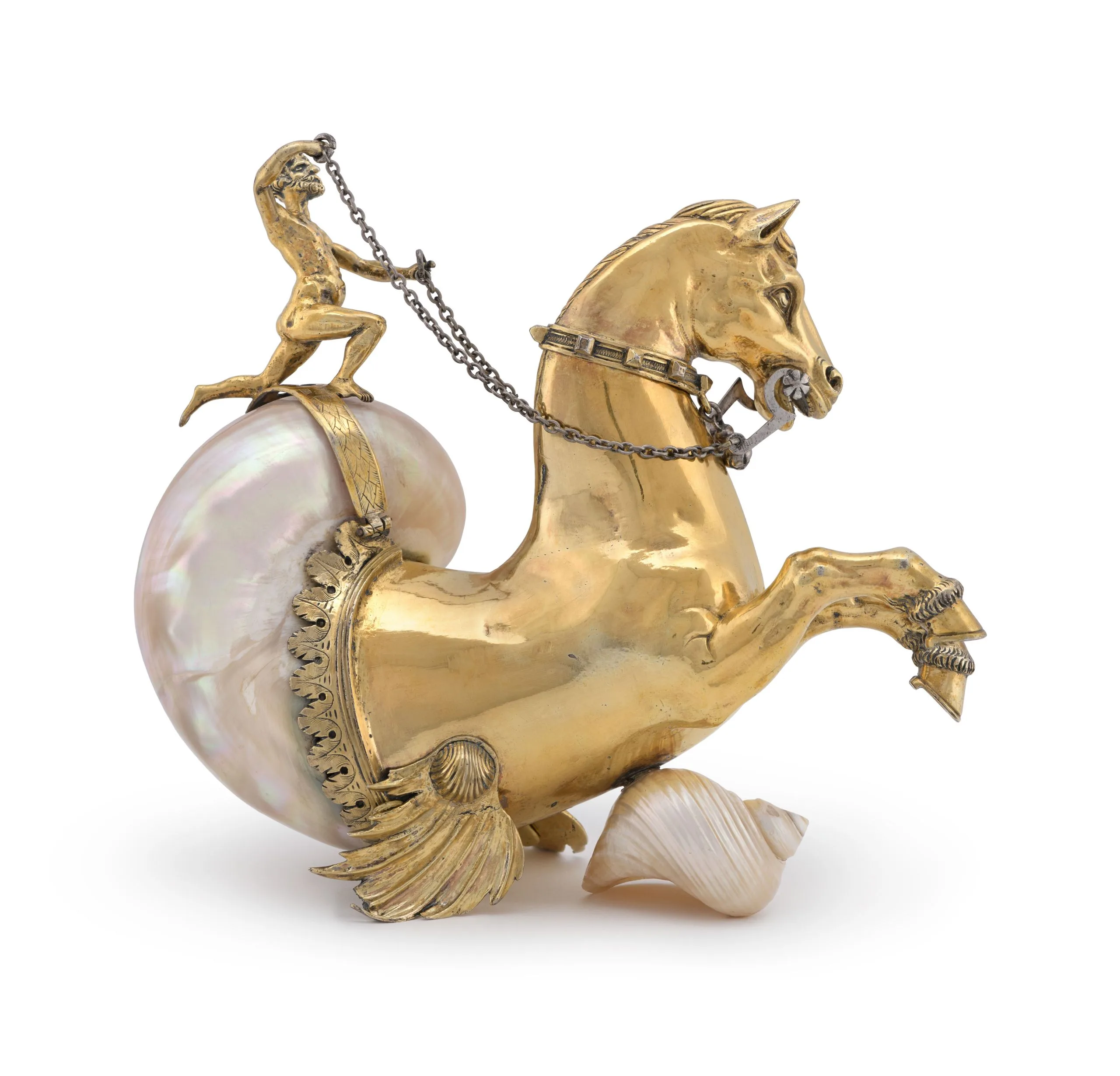
- Seahorse
- Date Made
- circa 1590-1600
- Medium
- Silver gilt, turban shell (Turbo marmoratus)
- Dimensions
- 7 x 7 7/8 in. (17.78 x 2 cm)
- Accession Number
- AC1992.152.108a-b
- Curatorial Notes
The turban shell belongs to a large taxonomic family of sea snails (Turbinidae) with spiral shells that rise to a point resembling a turban. Collectors prized turban shells, native to the warm waters of the Indian and Pacific Oceans, for their nacre, or mother-of-pearl, interior. A German silversmith transformed this shell by mounting it with a gilded silver seahorse, or hippocamp, a mythical creature with the upper body of a horse and lower body of a fish. The seahorse’s front legs are frozen in motion, and a small figure mounted to the top of the shell holds reins suggesting a struggle to restrain the powerful creature. The head of the seahorse can be detached at the collar, and the hollow body used as a drinking cup, although this object was probably intended for display on a banquet table or in a royal cabinet of art and natural wonders. Rarer than nautilus shells, turban shells were also rich with symbolic meaning for Renaissance collectors, signifying vanity, fertility, and mortality. Such layers of symbolism, as well as the shell’s rarity and beauty, guaranteed the prominence of a mounted turban shell in any princely collection.
- Selected Bibliography
- Thomas, Nancy, and Constantina Oldknow, eds. By Judgment of the Eye: The Varya and Hans Cohn Collection. Los Angeles: Hans Cohn, 1991.
- Mills, Rosie Chambers and Bobbye Tigerman. Beyond Bling: Contemporary Jewelry from the Lois Boardman Collection. Los Angeles: Los Angeles County Museum of Art; Munich: DelMonico Books-Prestel, 2016.
- Townsend, Jen and Renée Zettle-Sterling. Cast: Art and Objects Made Using Humanity's Most Transformational Process. Atglen, PA: Schiffer Publishing Ltd., 2017.
- Esguerra, Clarissa, and Michaela Hansen. Lee Alexander McQueen: Mind, Mythos, Muse. Los Angeles: Los Angeles County Museum of Art, 2022.