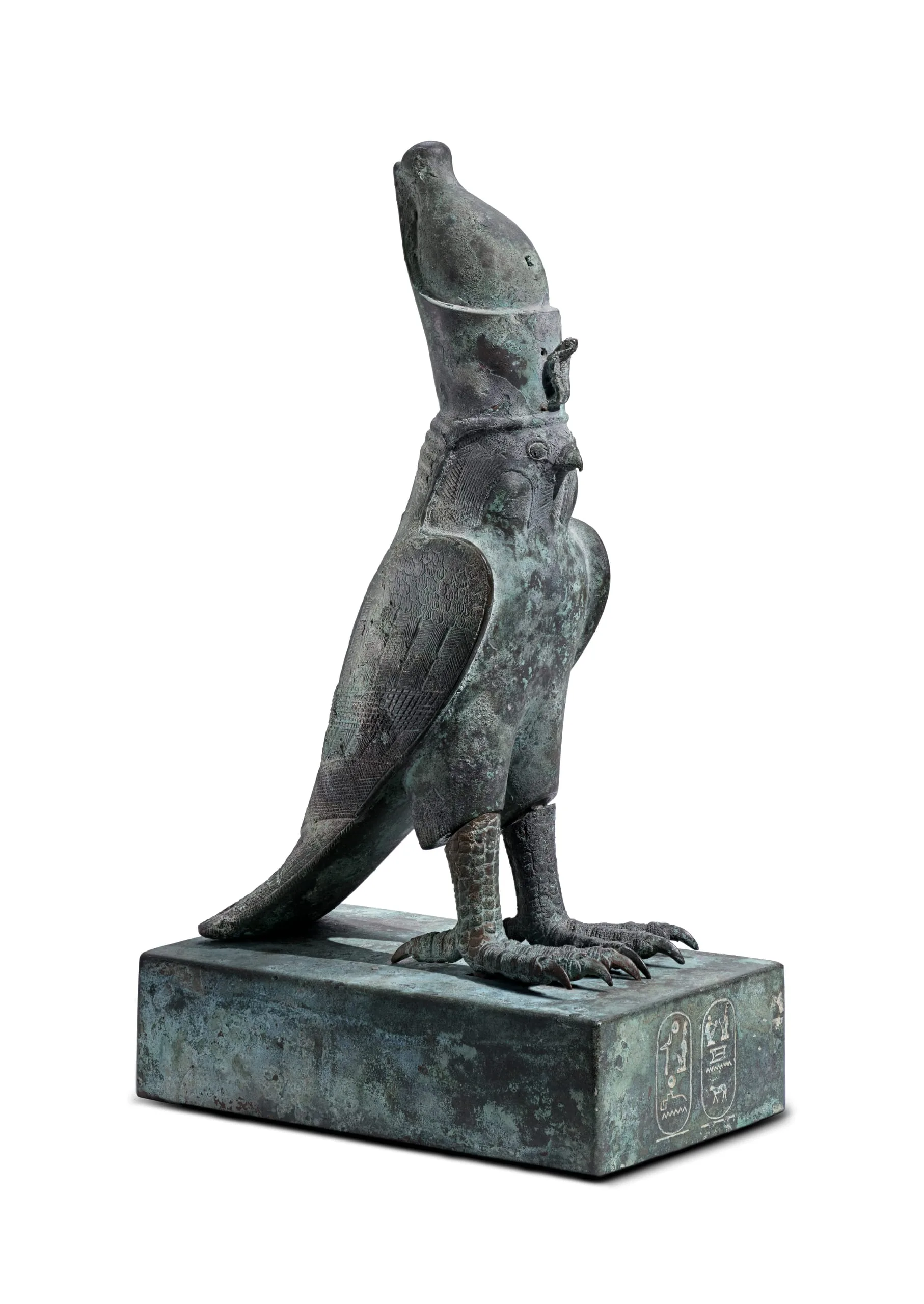
As the falcon god, “lord of the sky,” Horus served as the earthly embodiment of the king. With his father Osiris and mother Isis, he was part of the most significant triad of Egyptian gods. Horus-the-child, also known by his Greek name Harpocrates, is frequently depicted as a young boy seated on his mother’s lap, suckling at her breast. In this example, he is shown in another standardized form, an upright standing falcon wearing the composite emblem of kingship—the double crown of Upper and Lower Egypt.
But this statuette is highly unusual for several reasons. First, the image is rendered in precise, naturalistic detail; all elements of the falcon are finely delineated, from the delicate feathers to the rugged talons to the sharply crossed tail feathers. The intricate scallop, herringbone, and checkerboard patterning on the wings, along with the wavy neck feathers, are not known from any other image of Horus. The work is larger than most extant bronze images and was cast in four pieces—the body, two legs, and the base. These elements were carefully joined with two sets of tenons and slots. Finally, the base is engraved with cartouches bearing the names of two 19th Dynasty kings—Ramesses II (r. 1279−1213 BCE) and his son and successor Mernptah (r. 1213−1203 BCE). It is rare for such royal names to appear side by side, and the casting technology and compositional aspects of the work suggest it was made much later than the reigns of these two kings. It is possible that the artist, working many centuries later, copied the names from the impressive temple reliefs at a major site such as Thebes.
Provenance
With Rabi Gallery, London. Purchased by Hans Cohn 1986, gifted 1992 to: LACMA.
Publication
Thomas, Nancy, and Constantina Oldknow, eds. By Judgment of the Eye: The Varya and Hans Cohn Collection. Los Angeles: Hans Cohn, 1991, 15