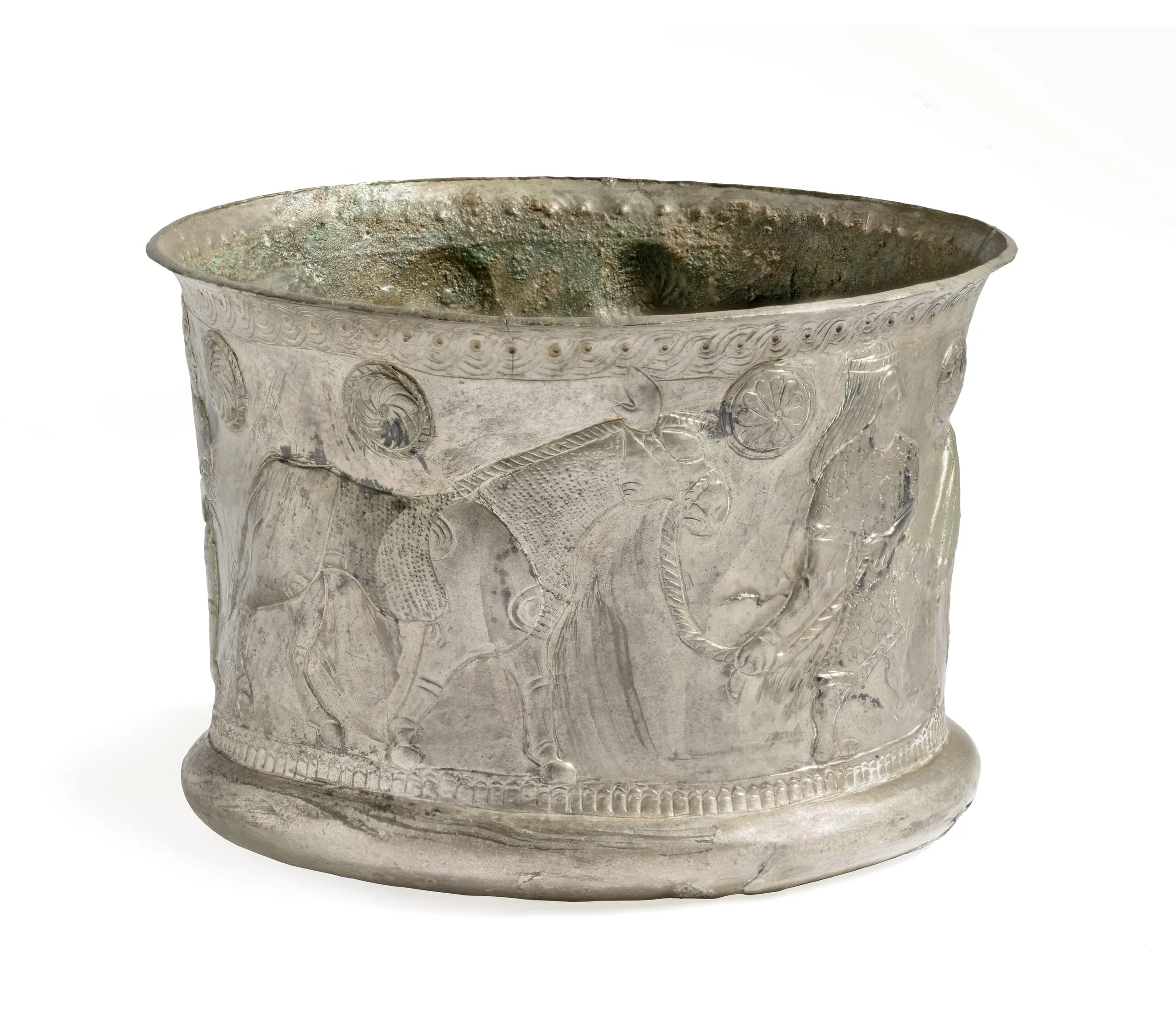
During the late second and early first millennia BCE, a substantial corpus of finely crafted silver and gold vessels emerged in northern and northwestern Iran. Defining examples of these objects, which are often decorated with figural images, have been recovered from archaeological sites such as Marlik, Hasanlu, and Kalardasht, indicating a thriving economy and a sophisticated artistic tradition in Iron Age Iran.
This silver cup belongs to this broader group and was likely produced in the same region. The scene on its exterior shows two men leading mules—judging from their large heads, long ears, and small hooves. A third mule follows the procession, unattended, with its lead rope dangling. The vessel has a flanged lip, suggesting it may have been used for drinking rather than pouring. Like other examples of precious metal vessels from this period, this cup was hammered into shape, with decoration achieved through repoussé from the inside.