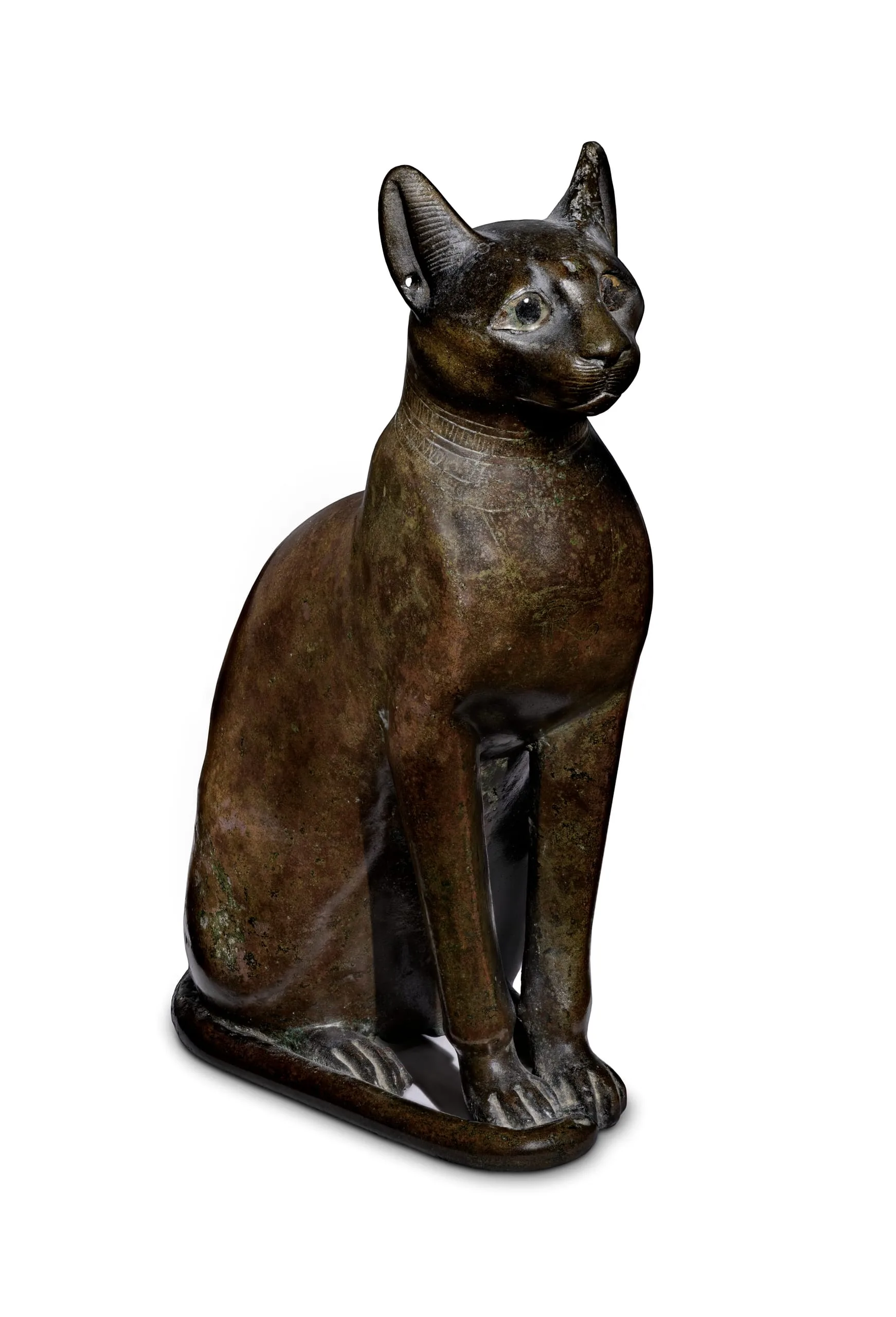
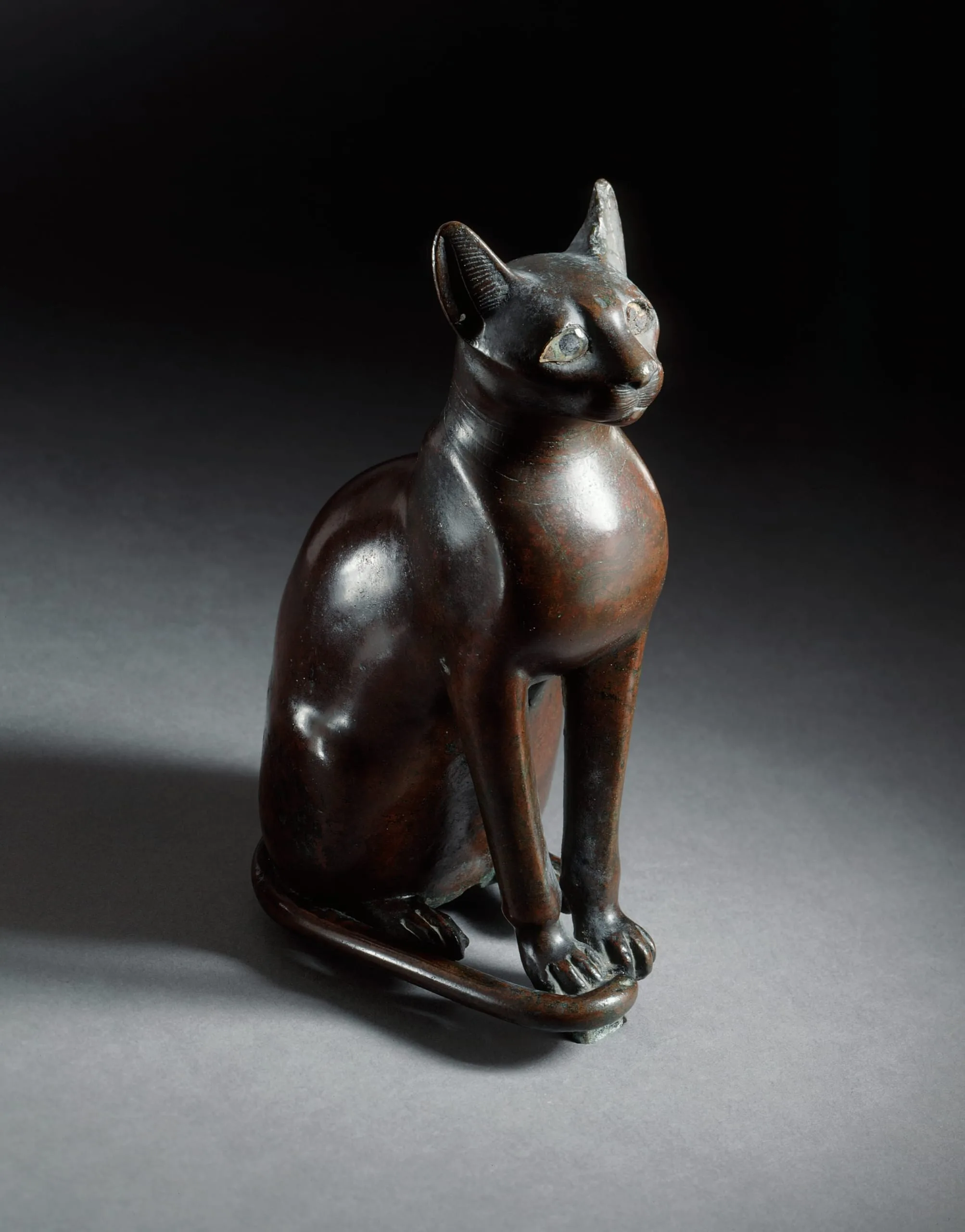
The goddess Bastet was represented as a feline, originally as a lioness-goddess and later a domestic cat, and was recognized by ancient Egyptians to be the daughter of the sun god Re. In her most aggressive form, she is identified in Old Kingdom Pyramid Texts as the protectress of the king. In her less ferocious form, she served as a guardian of the household and granaries, protecting them from vermin. Mummified cats were sometimes buried in wood or bronze coffins or in boxes topped with images of cats. This bronze example, probably too small to have served as the receptacle for a cat or kitten mummy, likely adorned a coffin for a sacred animal, attached with the two tenons at the base. The beautifully proportioned and contoured figure has a naturalistic and attentive posture with ears upraised and tail gracefully curved around the front paws. Both ears have been pierced, presumably for small gold circular earrings. The incised collar shows several rows of beads bound at the back of the neck with a wadjet pendant on the chest, an emblem of the god Horus, symbolic of health or wellness.
Bastet’s cult center was Bubastis (now known as Tell Basta), located in the northeastern delta region of Egypt. The site name is derived from the name of the goddess and originally held numerous cemeteries for the mummified remains of sacred cats.
Provenance: William Henry Forman (?), Dorking, Surrey; Major A.H. Browne (?), Callaly Castle, Northumberland; Loeb Collection; Dr. Hambuechen; Michael Abemayor, New York; sold to Hans Cohn 1967, Gift to LACMA, 1992.
Publications
Chaffers, W. Catalogue of the Works of Antiquity and Art collected by the Late William Henry Forman, Esq. ... and Removed in 1890 to Callaly Castle, Northumberland by Major A .H. Browne. Privately printed, 1892, no. 1547 (?).
Sieveking, Johannes, ed. Die Bronzen der Sammlung Loeb. Munich, 1913, no. 256, pl. 3.
Thomas, Nancy, and Constantina Oldknow, eds. By Judgment of the Eye: The Varya and Hans Cohn Collection. Los Angeles: Hans Cohn, 1991, 12627.