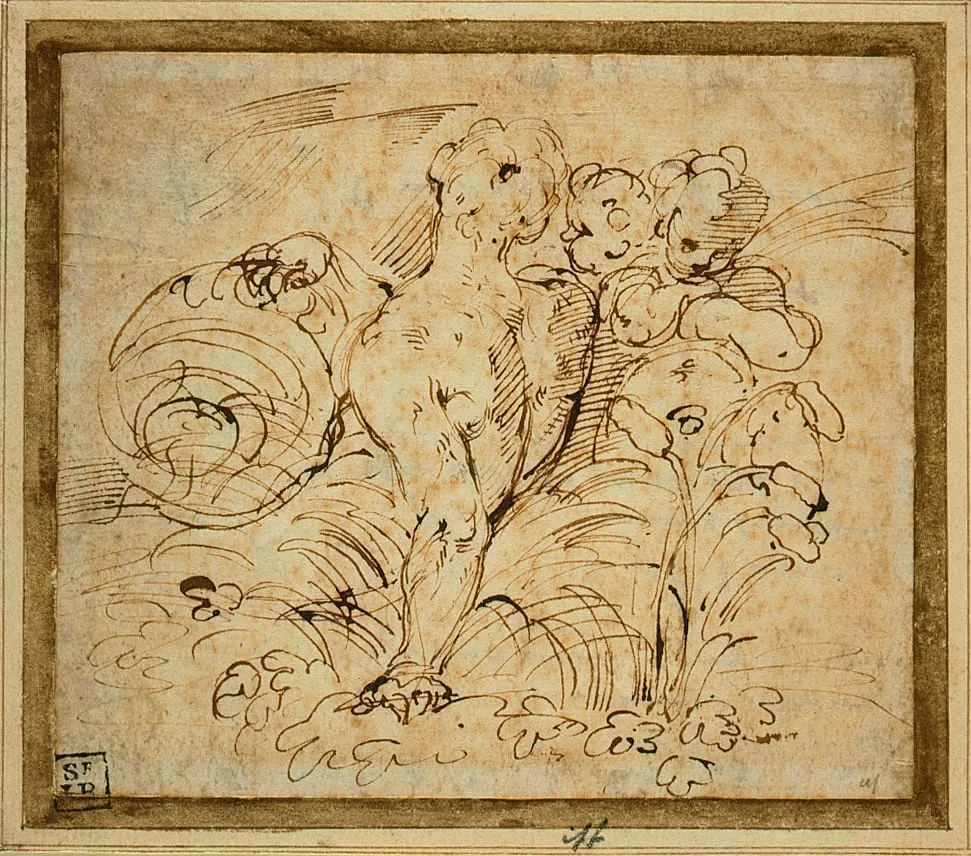
Excerpted from Davis, Bruce. Master Drawings in the Los Angeles County Museum of Art. Los Angeles: Los Angeles County Museum of Art, 1997, 17.
Parmigianino received his early artistic training from his uncles, who were also artists. In 1524 he went to Rome, where he became one of the favored artists of Pope Clement VII. In Rome he met other first-generation mannerist artists, particularly Rosso Fiorentino and Perino del Vaga, but was especially influenced by the works of Raphael, transforming the grace of Raphael into a highly refined and elegant manner. After the Sack of Rome in 1527, Parmigianino fled to Bologna, where he began to experiment with etching and became the first great practitioner of the medium. In 1530 he went to and spent the remainder of the decade on the commission, never completed, of frescoing the apse and vault of the church of Santa Maria della Steccata. His influence in the sixteenth century on court painting in Europe, especially in Fontainebleau and Prague, was profound.
The title was employed by Popham, who dated the drawing to about 1527–31 and described the subject as obscure. The object held by the figure, however, may in fact be an amphora rather than a globe, thus identifying the figure more specifically as a personification of a river god.